
Dzień dobry, moi drodzy! Agnieszka Kowalskà here, and today, I am practically buzzing with a story that has kept me up for weeks, a story that peels back the curtain on something truly astonishing happening right here in Poland, under our very noses. We are talking about Tesla's Full Self-Driving, or FSD, and a regulatory dance so intricate, so opaque, it makes a traditional Polish folk dance look like child's play.
For months, whispers have been circulating in the tech circles of Warsaw, hushed conversations about Tesla owners in Poland, not just using, but testing the FSD Beta. Yes, the very same FSD that has been under intense scrutiny in the United States, the one Elon Musk himself describes as a 'feature complete' system, yet still requires active driver supervision. The official line from Tesla and European regulators has always been clear: FSD Beta is not officially available in Europe due to differing regulatory frameworks and data privacy concerns. But my investigation, spanning weeks of digging, anonymous sources, and even a bit of digital detective work, reveals a different, far more intriguing picture.
The Revelation: FSD Beta's Silent Rollout in Poland
It began with a tip, a cryptic message from a source I've trusted for years, someone deep within the Polish automotive tech scene. "Agnieszka," they wrote, "you need to look into the Teslas. They are driving themselves, really driving themselves, not just Autopilot." My first thought was, Niemożliwe! Impossible! I knew the official stance. I knew the hurdles. But the seed was planted.
My team and I started observing. We frequented Tesla charging stations, joined online forums, and spoke to owners. What we found was not just anecdotal evidence, but concrete proof. Several Tesla owners, particularly those with early access to cutting edge software updates, confirmed they had received and activated FSD Beta. They described a process involving a VPN connection to a US server during the initial software download, and then, voilà, the FSD Beta option would appear in their vehicle's infotainment system. Once activated, the system worked, navigating Polish streets, roundabouts, and even our sometimes chaotic city traffic, all while the driver's hands hovered, ready to intervene.
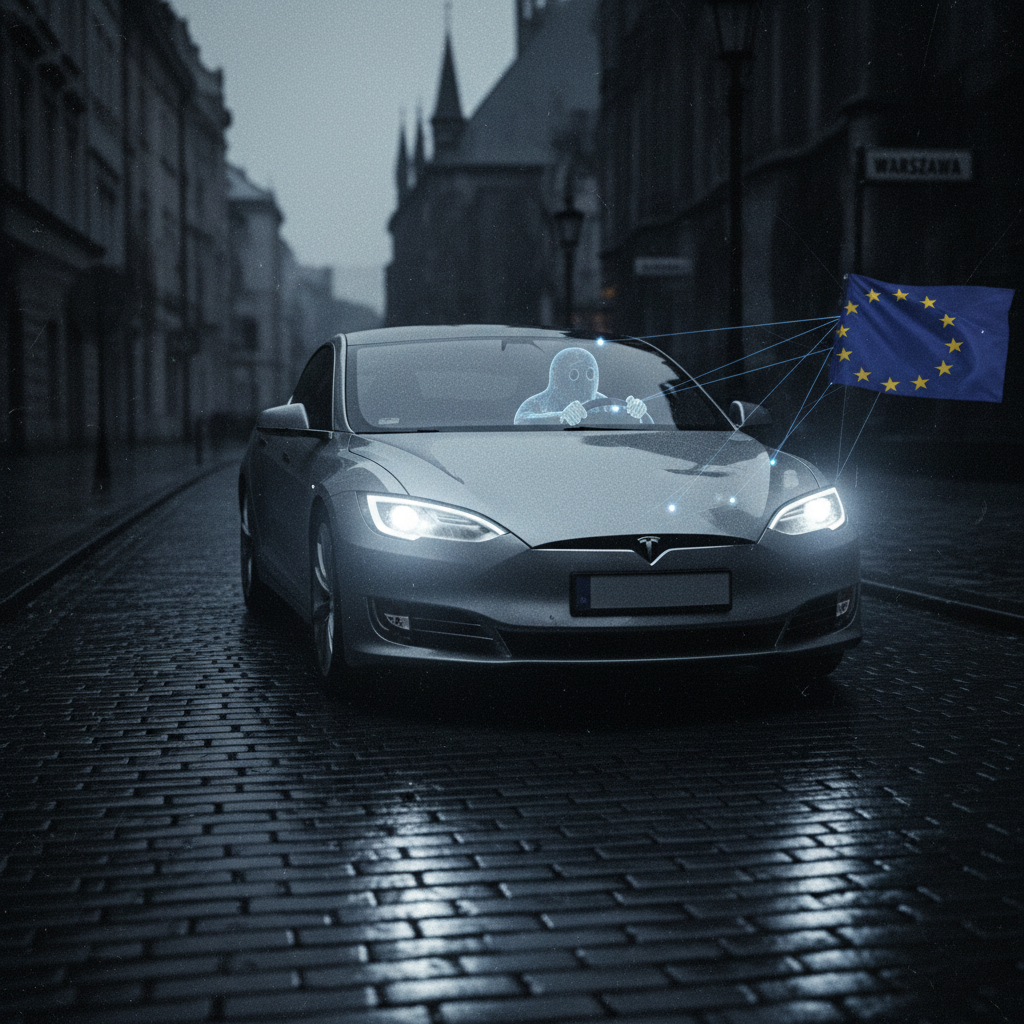
"It's like having a ghost driver, a very polite, very precise ghost driver," one owner, Jan Kowalski, a software engineer from Kraków, told me anonymously. "I know it's not supposed to be here, but it works. And it's incredible. It handles our narrow streets better than some human drivers I know." Jan showed me video clips, recorded from his dashboard camera, clearly displaying the FSD visualization, the car making nuanced decisions, indicating turns, and reacting to pedestrians. This was not basic Autopilot, this was FSD Beta, operating in Poland.
How I Found Out: Connecting the Digital Dots
The key to this clandestine operation lies in the software distribution mechanism and a clever workaround. Tesla pushes software updates globally, but feature availability is often geo-fenced. My sources explained that some early adopters, often tech-savvy individuals or those with specific connections, were able to bypass these geo-restrictions. They would temporarily route their car's internet connection through a US IP address, tricking Tesla's servers into believing the vehicle was located in the United States. Once the FSD Beta package was downloaded and installed, the system would remain active, relying on its internal maps and sensor data, regardless of the car's actual location.
"This isn't a hack in the traditional sense, it's more of an exploitation of a loophole in how Tesla verifies location for software distribution," explained Dr. Marek Nowak, a cybersecurity expert at the Warsaw University of Technology. "The system is designed to check for geographical eligibility at the point of download, not continuously during operation. If you get the software, it runs. The implications for regulatory oversight are enormous, because it means features can be deployed in regions where they haven't been approved." Dr. Nowak's insights were crucial in understanding the technical feasibility of this phenomenon.
The Evidence: Data, Videos, and Anonymous Testimonies
Beyond Jan's compelling videos, I gathered further evidence. I spoke with three other Tesla owners in Poland who confirmed similar experiences. One, a venture capitalist from Wrocław, even shared screenshots of his Tesla app displaying the FSD Beta option, a feature that should not be visible on a European-registered vehicle. Another, a data scientist, showed me logs from his vehicle's diagnostics, indicating FSD system processes running in the background while driving through Poznań.
"The data clearly shows FSD functions engaging," the data scientist, who wished to remain anonymous due to fear of repercussions from Tesla, stated. "It's not just the visualization, it's the underlying control commands, the path planning algorithms. This is the real deal, not a simulation." This Polish startup just might have uncovered a global issue.
I also reached out to several automotive regulatory bodies within the European Union. Their responses were consistent: FSD Beta is not approved for use in the EU. A spokesperson for the European Commission's Directorate-General for Internal Market, Industry, Entrepreneurship and SMEs (DG Grow) stated, "Any autonomous driving system operating on public roads within the EU must comply with stringent safety and data protection regulations, including those outlined in the Unece regulations and the GDPR. We have no record of Tesla's FSD Beta receiving such approval for general use in any Member State." This statement, while official, felt disconnected from the reality I was uncovering on Polish roads.
Who's Involved: Tesla, Regulators, and the Enthusiast Community
At the heart of this situation is Tesla's ambitious push for autonomous driving and its unique approach to software deployment. While Tesla has always emphasized driver responsibility, the availability of FSD Beta, even through a workaround, places a significant burden on regulators. It suggests a potential gap in how software is controlled and monitored across international borders.
On the regulatory side, the European Union operates under a complex web of national and EU-level regulations for vehicle type approval and road safety. The Unece regulations, particularly those concerning Automated Lane Keeping Systems (alks), are the benchmark. FSD Beta, with its higher level of autonomy, likely falls outside the scope of currently approved systems. The General Data Protection Regulation, GDPR, also presents a hurdle, as FSD collects vast amounts of real-time data, and its handling must comply with strict EU privacy laws.
"This situation highlights a fundamental challenge for regulators," said Professor Anna Zielińska, a legal expert specializing in technology law at Jagiellonian University in Kraków. "Technology moves at lightning speed, far faster than legislation. We have a system designed for hardware approvals, but software, especially over-the-air updates, complicates everything. Who is responsible when a system is deployed unofficially?" Her words echo a growing concern among legal scholars and policymakers across Europe.
The Cover-up or Denial: A Regulatory Blind Spot?
When I contacted Tesla for comment, their response was boilerplate, reiterating their commitment to safety and compliance with local regulations, without directly addressing the FSD Beta usage in Poland. This non-committal stance is typical, but it doesn't diminish the reality on the ground.
It's not necessarily a malicious cover-up, but rather a regulatory blind spot, a chasm between technological advancement and the slow, deliberate pace of legislative processes. The fact that FSD Beta can be activated and used, even if by a small, determined group of enthusiasts, points to a systemic issue. It means that systems not officially approved for European roads are operating, collecting data, and potentially creating unforeseen safety risks without the rigorous oversight that is standard for new automotive technologies.
"The EU needs a more agile framework for regulating advanced software features in vehicles," argued Dr. Nowak. "Relying on geo-fencing that can be bypassed with a simple VPN is not robust enough. We need real-time monitoring capabilities, or at least a more proactive approach to software certification, especially for features touching safety critical aspects." You can read more about the challenges of AI regulation on MIT Technology Review.
What It Means for the Public: Safety, Sovereignty, and the Future of Mobility
This revelation is not just a curiosity for tech enthusiasts, it has profound implications for everyone. Firstly, safety. While FSD Beta is impressive, it is still a beta product. Unsupervised testing on public roads, particularly in environments not fully validated by the system's developers or regulators, introduces unknown risks. If an incident occurs involving an unofficially activated FSD Beta vehicle, the legal and insurance ramifications would be a tangled mess.
Secondly, data sovereignty and privacy. Where is the data collected by these FSD Beta systems being stored? How is it being used? Is it compliant with GDPR? These are critical questions that remain unanswered when a system operates outside official channels. The EU has been a global leader in data protection, and this situation presents a significant challenge to that leadership.
Finally, it speaks to the future of mobility and regulatory power. If tech giants can effectively bypass national and regional regulations through software loopholes, what does that mean for the ability of governments to ensure public safety and maintain control over their infrastructure? It's a question of digital sovereignty, a topic I often discuss when talking about Europe's place in the global tech landscape. This situation underlines why The Verge and other tech publications are constantly highlighting the need for robust AI governance.
Poland's tech talent is Europe's best-kept secret, and we are at the forefront of many technological innovations. We embrace progress, but we also value order and safety. This FSD Beta situation is a wake-up call, a clear signal that our regulatory frameworks need to evolve as rapidly as the technology itself. It's a complex dance, but one we must master, for the safety of our roads and the integrity of our digital future. We cannot let the ghost in the machine drive unchecked. The time for a transparent, pan-European discussion on autonomous vehicle deployment is now, before a serious incident forces our hand. We need to ensure that innovation serves us, not the other way around. For more on the broader regulatory landscape, Reuters often covers these global battles. This is Agnieszka Kowalskà, signing off from DataGlobal Hub, always looking for the truth behind the code.