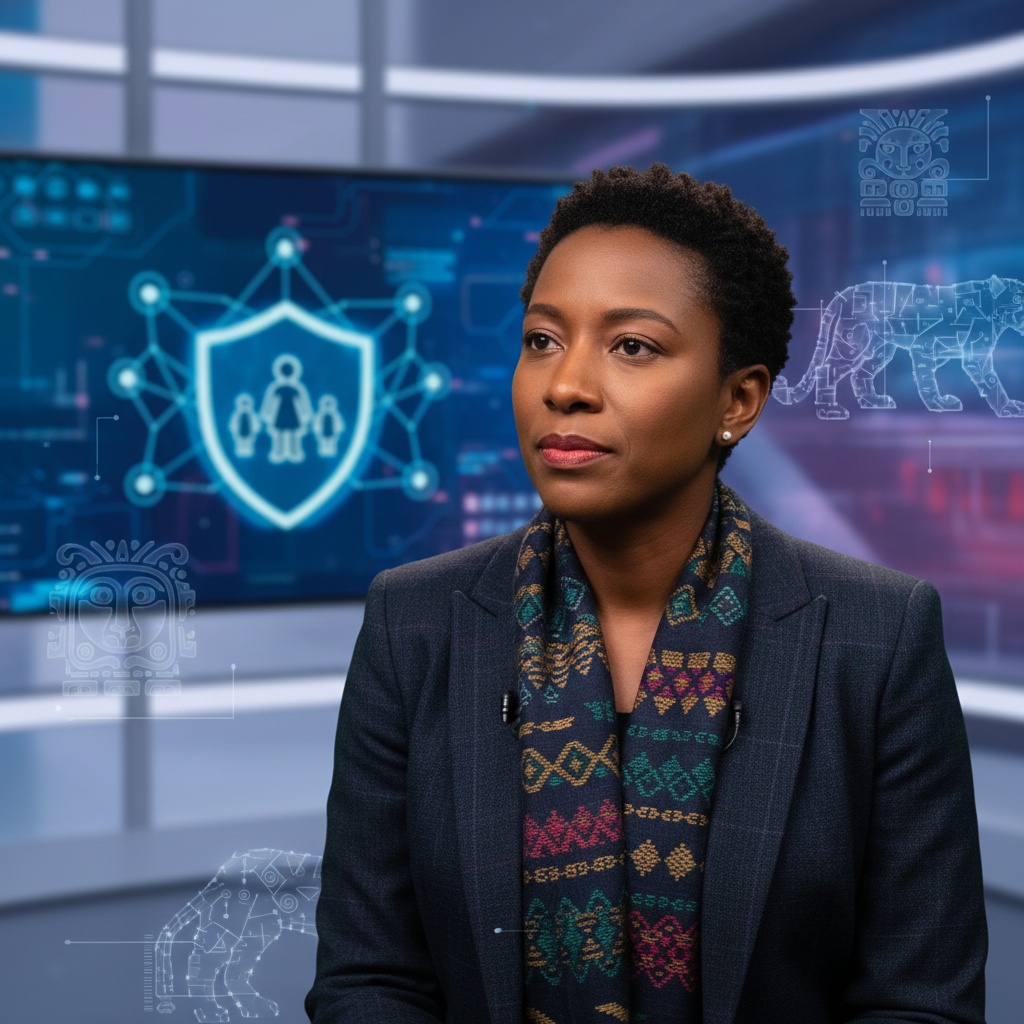
The sun was just beginning to warm the cobblestones of Antigua, painting the colonial facades in hues of gold and rose, as I prepared for my conversation. It was a perfect Guatemalan morning, the kind that makes you feel connected to something ancient and enduring. My thoughts, however, were on the future, specifically the future of our children in a world increasingly shaped by artificial intelligence. How do we, as a society, protect the innocence and development of young minds from the unseen forces of algorithms and AI generated content? This question led me to Dr. Joy Buolamwini, a name that resonates deeply in the world of AI ethics.
Dr. Buolamwini, a brilliant computer scientist and poet of code, founded the Algorithmic Justice League, an organization dedicated to highlighting and mitigating AI bias. While much of her foundational work focused on facial recognition and gender or racial bias, her insights extend far beyond, touching on the very fabric of how AI interacts with and influences human lives, particularly the most impressionable among us. Her journey, from Ghana to Oxford and MIT, is a testament to the power of curiosity and a relentless pursuit of justice in technology. Her grandmother's wisdom meets machine learning in a way that truly embodies a human centered approach.
“We are building systems that reflect the values and biases of their creators, and if we are not careful, those systems can perpetuate and even amplify harms, especially for children who are still forming their understanding of the world,” Dr. Buolamwini has often stated in various public forums. This sentiment echoes a profound concern I hear in many communities here in Guatemala, where digital literacy varies widely and the allure of online content is undeniable for our youth. Parents, many of whom did not grow up with smartphones or the internet, often feel ill equipped to navigate this new digital landscape, much less understand the subtle ways AI might be influencing their children.
Her work, particularly the groundbreaking research on facial recognition bias, showed how AI systems often misidentify individuals with darker skin tones or women, a revelation that sparked global conversations about fairness and accountability. Imagine this bias extending to AI generated content targeting children. What narratives are being subtly reinforced? What stereotypes are being perpetuated without conscious awareness? These are not abstract questions, but pressing concerns that demand our immediate attention.
Dr. Buolamwini emphasizes the need for what she calls 'auditing algorithms' and demanding transparency. “We need to ask, who is being left out and who is being harmed?” she said in a recent interview with MIT Technology Review. This question becomes even more critical when considering children. An AI system designed to recommend educational content might inadvertently expose a child to inappropriate material, or worse, manipulate their nascent understanding of reality through deepfakes or highly persuasive, AI generated narratives. The potential for manipulation, for shaping beliefs and desires without critical thought, is immense and terrifying.
In a small village in Guatemala, where access to education might be limited but a shared community tablet offers a window to the world, the content consumed by a child can have an outsized impact. If that content is curated by an AI that prioritizes engagement over well being, or worse, is designed to extract data or promote harmful ideas, the consequences can be devastating. This is a story about resilience, but also about vigilance.
Dr. Buolamwini advocates for what she calls 'empathetic AI development,' a process that prioritizes human values and societal impact over pure technological advancement. She envisions a future where AI is not just intelligent, but also wise, ethical, and protective. “We must move beyond merely building powerful AI to building responsible AI,” she asserted during a recent discussion on AI ethics, a sentiment widely reported by outlets like The Verge. This means involving diverse voices in the design process, including educators, child psychologists, and parents, to ensure that the systems built are truly beneficial and safe for children.
One of the most insidious aspects of AI generated content and manipulation for children is its subtlety. It is not always overt propaganda, but rather a slow, steady drip of curated information, personalized recommendations, and emotionally resonant narratives that can subtly shift perspectives. Think of an AI powered toy that learns a child's preferences and then subtly steers them towards certain products, or an educational app that uses AI to create highly personalized, yet potentially biased, learning pathways. The lines between helpful personalization and harmful manipulation blur.
The Algorithmic Justice League's work, including their 'Coded Bias' documentary, has brought these issues to the forefront, making complex technical concepts accessible to a wider audience. Their efforts have pushed for legislation and policy changes that demand greater accountability from AI developers. For children, this could translate into stricter regulations on how AI is used in educational tools, social media platforms, and entertainment, ensuring that their digital experiences are enriching and safe, not exploitative.
Protecting minors from AI generated content and manipulation is not just a technical challenge, it is a societal imperative. It requires a multi faceted approach, from robust technical safeguards to comprehensive digital literacy programs for both children and parents. Here in Guatemala, organizations like the Fundación Ramiro Castillo Love are working to bridge digital divides and promote responsible technology use, understanding that access must come with awareness. Their efforts, though perhaps not directly focused on AI ethics, lay crucial groundwork for understanding digital impacts.
As Dr. Buolamwini eloquently puts it, “We need to ensure that the future we are building with AI is one where everyone can thrive, not just a select few.” For our children, this means a digital world where their curiosity is nurtured, their privacy is respected, and their development is protected from the unseen hands of algorithms. It means demanding that the powerful tools of AI are wielded with wisdom and compassion, always keeping the well being of the next generation at the forefront. The conversation with Dr. Buolamwini left me with a sense of urgent hope, a belief that through collective action and ethical foresight, we can shape AI to be a protective 'nahual' for our children, guiding them safely through the digital world, rather than a shadowy force they must fear. For more insights into the broader ethical implications of AI, you can explore resources from organizations like OpenAI and their ongoing discussions on responsible AI development.