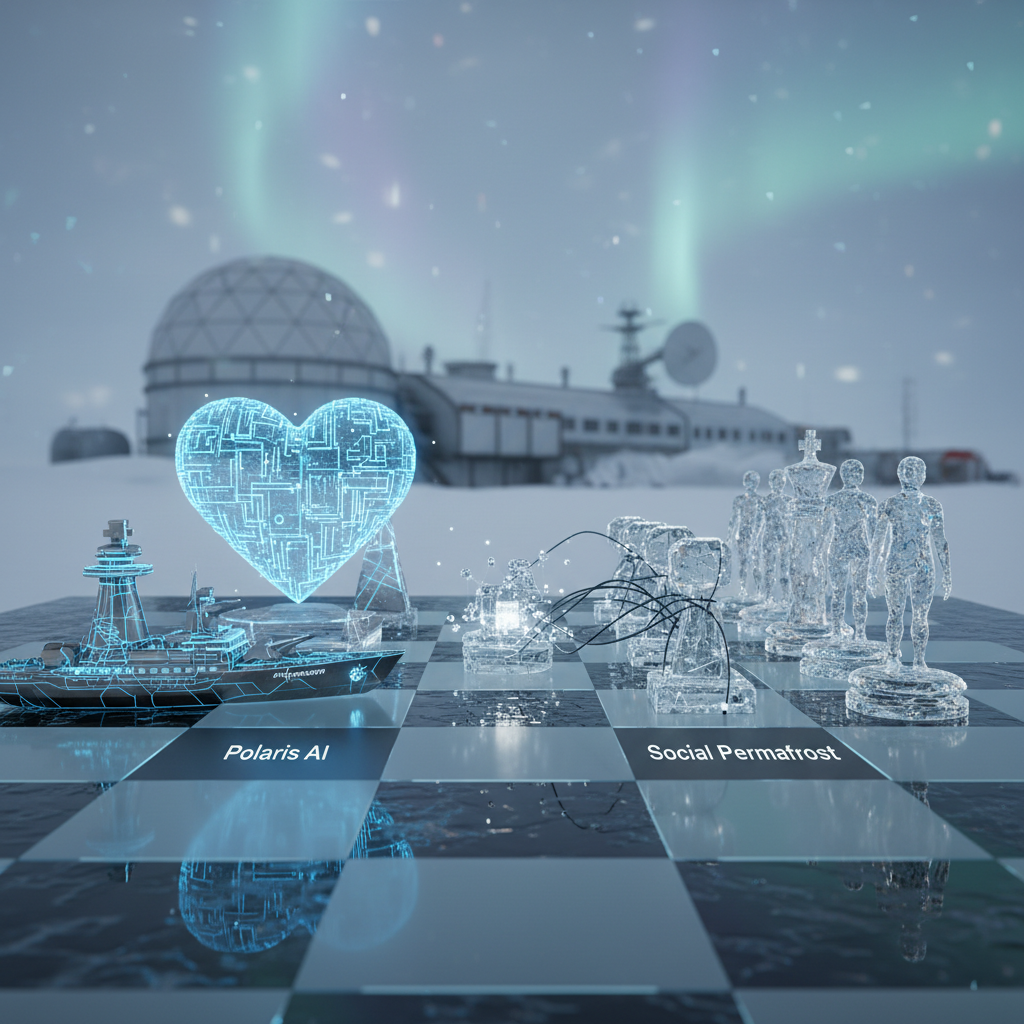

The stark, unforgiving landscape of Antarctica often serves as a metaphor for the human condition, stripped bare of urban complexities. Here, at Vostok Station, where temperatures routinely plummet below -50°C, the psychological resilience of individuals is tested daily. It is against this backdrop of extreme isolation that the Russian state corporation Rosatom, a key player in our nation's technological and scientific endeavors, has unveiled its ambitious new strategy: 'Polaris', an AI companion system designed to mitigate the psychological stresses of prolonged isolation.
The Strategic Move: Rosatom's Polaris Initiative
In late 2025, Rosatom announced a multi-year, 15 billion ruble investment into the development and deployment of 'Polaris', a suite of advanced AI companions. These systems, leveraging large language models from homegrown Russian developers like Yandex and Sber AI, alongside multimodal interfaces, are intended for personnel in highly isolated, high-stress environments. The initial rollout targets Arctic and Antarctic research stations, offshore drilling platforms, and long-duration space missions. The stated objective is clear: to provide cognitive and emotional support, combat loneliness, and enhance overall mental well-being where human interaction is scarce or strained. "Our goal is not to replace human connection, but to supplement it, to provide a constant, intelligent presence that can adapt to individual needs and offer structured psychological support," stated Dr. Elena Petrova, lead psychologist for Rosatom's Human Factors division, in a recent internal briefing.
Context and Motivation: A Response to Extreme Isolation
The motivation behind Polaris is rooted in a very real and pressing concern. The data from our Antarctic station reveals a consistent challenge: the psychological toll of isolation. Studies conducted at Bellingshausen Station, for instance, indicated a 35% increase in reported feelings of loneliness and a 20% rise in minor depressive symptoms during the six-month winter-over period among personnel without robust social support networks. Traditional methods, such as tele-psychology sessions, are often hampered by satellite latency and the inherent limitations of scheduled, infrequent contact. Rosatom's strategy posits AI companions as a continuous, always-available resource, capable of personalized interaction and proactive monitoring of emotional states. This is a direct response to the unique demands of environments where, at -40°C, technology behaves differently, and human psychology is pushed to its limits.
Furthermore, the initiative aligns with broader national strategies for technological sovereignty and leadership in AI. By developing advanced AI for specialized, high-stakes applications, Russia aims to demonstrate its capabilities on the global stage, positioning itself as a pioneer in human-AI interaction for extreme conditions. This is not merely about mental health, it is also about strategic technological advantage, a sentiment echoed by many within our scientific community.
Competitive Analysis: A Cold War of Companionship?
While Rosatom's Polaris focuses on state-controlled, high-security applications, the global landscape of AI companions is rapidly evolving. Companies like OpenAI with their advanced GPT models, Meta's Llama-powered AI personas, and even specialized startups like Character.AI, are all vying for dominance in the burgeoning market of digital intimacy. These commercial entities primarily target the general consumer, offering customizable, often emotionally engaging, conversational agents. Their strategies revolve around user engagement, personalization, and seamless integration into daily life, often through subscription models.
Rosatom's approach, however, diverges significantly. It is a top-down, state-directed deployment, emphasizing reliability, data security, and adherence to specific psychological protocols rather than open-ended, free-form interaction. This closed ecosystem approach, while ensuring control and mitigating certain risks, also limits the diversity of interaction models and the rapid iterative improvements seen in open-market AI development. "The commercial models prioritize user freedom and engagement, sometimes at the expense of psychological safety," observed Dr. Kirill Volkov, a senior researcher at the Russian Academy of Sciences. "Rosatom, by contrast, is building a system with a very specific, therapeutic mandate. The question is whether that mandate allows for the organic, human-like connection that truly alleviates loneliness, or if it becomes another form of controlled interaction."
Strengths and Weaknesses: A Double-Edged Digital Sword
The strengths of the Polaris strategy are evident. Its state backing ensures substantial funding and access to high-performance computing infrastructure. The focus on extreme environments provides a unique testing ground for robust, resilient AI systems, generating valuable data that could inform future developments. The integration with existing psychological support frameworks offers a structured approach to mental well-being, moving beyond mere conversational novelty. The potential for proactive intervention, where AI detects distress signals and alerts human professionals, represents a significant leap in remote psychological care.
However, the weaknesses are equally pronounced. The primary concern revolves around the potential for over-reliance and the blurring of boundaries between artificial and authentic relationships. If individuals in extreme isolation begin to prioritize interactions with Polaris over the limited human contact available, it could paradoxically exacerbate social withdrawal. There is also the inherent risk of algorithmic bias, even in a controlled environment. If the AI's responses are not sufficiently nuanced or culturally sensitive, it could alienate users or provide inappropriate advice. The lack of transparency in the underlying algorithms, a common issue with proprietary state-developed AI, could also foster distrust. Furthermore, the very nature of a state-mandated companion raises ethical questions about autonomy and the right to choose one's emotional support, even in challenging circumstances.
"While the intention is benevolent, the long-term psychological effects of deep, sustained interaction with an AI companion in an environment like Antarctica are largely unknown," cautioned Professor Anya Kuznetsova, an ethicist specializing in AI from Lomonosov Moscow State University. "We must proceed with extreme caution, establishing clear ethical guidelines and continuous psychological monitoring. The human psyche is not a simple circuit board to be rewired by algorithms."
Verdict and Predictions: Navigating the Permafrost of Social Change
Rosatom's Polaris strategy is a bold, necessary, yet deeply complex undertaking. It addresses a critical need for psychological support in extreme environments, leveraging cutting-edge AI to tackle a problem that has plagued human exploration for centuries. However, its success hinges not just on technological prowess, but on a profound understanding of human psychology and ethics.
I predict that the initial deployment of Polaris will yield mixed results. While some personnel will undoubtedly find solace and support in these digital companions, others may experience increased feelings of alienation or a sense of being perpetually monitored. The crucial determinant will be the degree to which Rosatom can foster a balanced approach, emphasizing Polaris as a tool for support rather than a substitute for genuine human connection. Regular, anonymous feedback mechanisms and independent ethical oversight will be paramount.
Looking ahead, the insights gained from Polaris in the Antarctic could profoundly influence future AI companion development, not just for extreme environments but for broader societal applications. The challenge for Rosatom, and indeed for all developers in this space, is to ensure that in our pursuit of technological solutions for loneliness, we do not inadvertently create new forms of isolation. Science at the bottom of the world provides invaluable lessons, and in this instance, it is teaching us that the human heart, even in its digital manifestations, remains the most complex frontier. The data from our Antarctic station, meticulously collected, will ultimately tell the true story of whether Polaris thaws or deepens the social permafrost.
For further reading on the societal impact of AI companions, one might consult analyses from Wired or academic discussions found on arXiv. The broader implications for enterprise AI strategies are also regularly covered by Reuters. The ethical considerations discussed here are also relevant to the cultural impact of AI, as explored in articles like When AI Companions Come Home: Dr. Hineata Te Rangi on Character.AI, Connection, and Aotearoa's Ethical Compass [blocked].