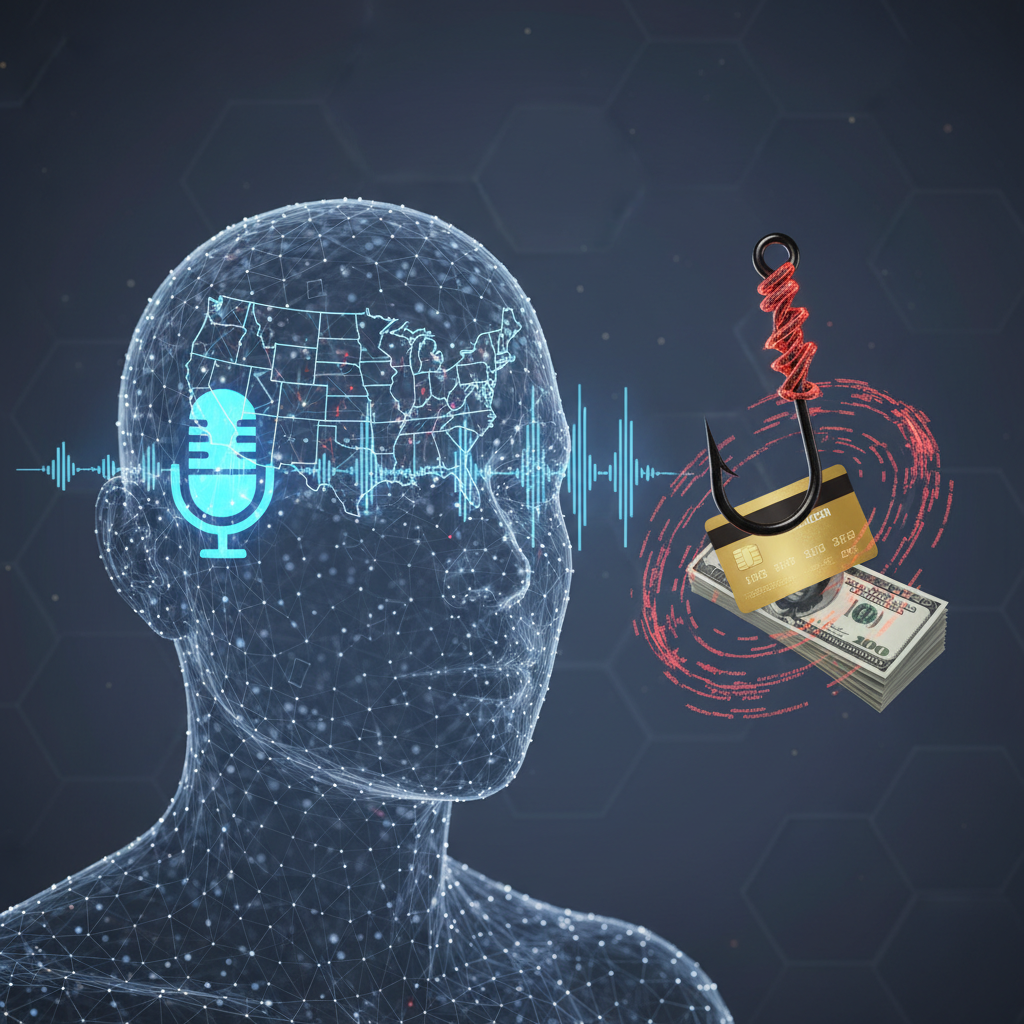

The digital landscape, once heralded as a frontier of innovation and prosperity, has become a treacherous battleground. In the shadows, a new breed of criminal enterprise is leveraging artificial intelligence to craft scams so insidious, so convincing, that they are dismantling the very foundations of trust in our financial systems. This is not merely about opportunistic fraudsters; this is about highly organized syndicates employing cutting edge AI to mimic voices, impersonate identities, and siphon billions from unsuspecting Americans. The lobbying records tell a different story about the focus of AI regulation in Washington, but the reality on the ground, in the bank accounts of ordinary citizens and corporations alike, is far more urgent.
The Technical Challenge: Crafting Believable Digital Deception
The fundamental problem for AI-powered fraud is achieving a level of verisimilitude that bypasses human scrutiny and automated detection systems. For voice cloning, this means generating speech that not only sounds like the target individual but also carries their unique prosody, emotional inflections, and even background noise characteristics. For phishing, it involves creating contextually relevant, grammatically impeccable, and visually authentic communications that exploit cognitive biases and social engineering principles. The sheer scale and adaptability required for these operations demand sophisticated machine learning pipelines, often leveraging generative adversarial networks (GANs) or diffusion models, combined with advanced natural language processing (NLP) and computer vision techniques.
Architecture Overview: The Fraudster's AI Toolkit
A typical AI-powered scam operation, particularly one involving voice cloning and sophisticated phishing, can be conceptualized as a multi-stage pipeline. At its core are data acquisition, model training, content generation, and distribution. Each stage presents unique technical challenges and opportunities for both offense and defense.
-
Data Acquisition Layer: This involves scraping public data, such as social media posts, news interviews, corporate earnings calls, or even publicly available voice samples, to build a profile of the target. For voice cloning, even a few seconds of audio can be enough. For phishing, corporate directories, LinkedIn profiles, and leaked databases provide the raw material for impersonation.
-
Voice Cloning Module: This is often built upon a text-to-speech (TTS) system augmented with speaker adaptation techniques. A common architecture involves a vocoder (e.g., WaveNet, HiFi-GAN, or DiffSVC) for high-fidelity audio synthesis, coupled with a speaker encoder (e.g., trained on a large dataset like LibriSpeech or Vctk) that extracts a low-dimensional embedding representing the target speaker's unique vocal characteristics. This embedding is then fed into the vocoder, conditioning it to generate speech in the target's voice. More advanced systems utilize end-to-end models like Tacotron 2 or FastSpeech 2, further enhanced by speaker embedding networks.
-
Phishing Content Generation Module: This relies heavily on large language models (LLMs) such as OpenAI's GPT series or Anthropic's Claude. These models are fine-tuned on vast corpora of legitimate and fraudulent communications. They can generate highly convincing email subject lines, body text, SMS messages, and even chatbot scripts. Coupled with image generation models (e.g., Stable Diffusion or Midjourney), they can create fake login pages, corporate branding, or official-looking documents that are nearly indistinguishable from genuine assets. The LLM's ability to maintain context and tone is critical here.
-
Distribution and Evasion Layer: This involves automated sending mechanisms, often leveraging compromised accounts or botnets, to distribute phishing attempts at scale. Techniques for evading spam filters, such as domain rotation, URL obfuscation, and polymorphic content generation, are integrated. For voice scams, this might involve automated dialing systems or VoIP infrastructure.
Key Algorithms and Approaches
-
Generative Adversarial Networks (GANs): Crucial for generating realistic data, GANs consist of a generator network that creates synthetic samples (e.g., fake voices, phishing emails) and a discriminator network that tries to distinguish real from fake. Through adversarial training, the generator becomes increasingly adept at producing highly convincing fakes. In voice cloning, GANs can refine vocoder outputs for naturalness.
-
Diffusion Models: These newer generative models, like Dall-e 3 or Midjourney, are gaining traction for their ability to produce high-quality, diverse outputs. They work by progressively adding noise to data and then learning to reverse this process, effectively