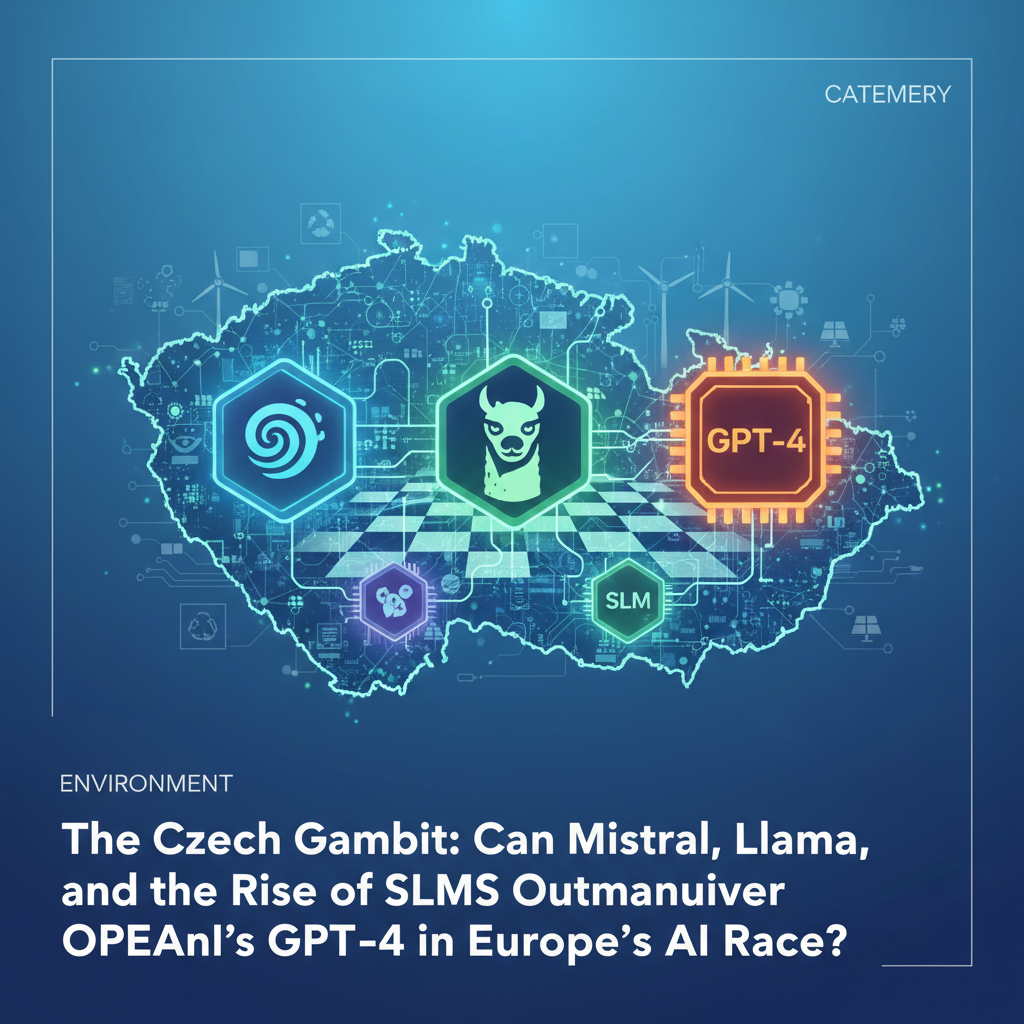

Is the era of monolithic, resource-hungry AI models drawing to a close? This provocative question echoes through the hallowed halls of Prague's ČVUT, resonates in the bustling tech hubs of Berlin, and fuels strategic discussions in Brussels. For years, the narrative has been dominated by the colossal scale of models like OpenAI's GPT-4, Google's Gemini, and Anthropic's Claude, each demanding immense computational power and vast datasets. Yet, a quiet revolution is underway, spearheaded by what we now term Small Language Models, or SLMs, which are increasingly demonstrating performance metrics comparable to their goliath predecessors, but at a fraction of the cost and computational footprint. This is not merely an incremental improvement; it is a fundamental re-evaluation of what constitutes 'intelligence' in artificial systems, and whether sheer size is truly synonymous with superior capability.
To fully appreciate this seismic shift, we must first cast our minds back to the nascent days of large language models. The early 2020s were characterized by a relentless pursuit of scale. The prevailing wisdom, often termed the 'scaling laws,' suggested that performance would invariably improve with more parameters, more data, and more compute. This led to models with hundreds of billions, even trillions, of parameters, requiring supercomputer-level infrastructure for training and inference. Companies like OpenAI and Google invested billions into these endeavors, creating proprietary ecosystems that, while powerful, were often inaccessible or prohibitively expensive for smaller enterprises, academic institutions, or even entire nations seeking digital sovereignty. The cost of a single query to a large model could be negligible, but at scale, for an enterprise processing millions of requests, these costs accumulated rapidly, becoming a significant operational expenditure. This economic barrier, coupled with concerns over data privacy and model explainability, laid the fertile ground for an alternative approach.
Fast forward to today, April 2026, and the landscape is markedly different. The past 18 months have seen an explosion of innovation in the SLM space. Models like Mistral AI's family, particularly their latest Mistral-Large-v3 which has been benchmarked against GPT-4-Turbo on several key metrics, and Meta's Llama series, now in its fourth iteration, are leading this charge. What distinguishes these models is not just their reduced parameter count, often in the range of 7 billion to 70 billion, but the ingenious architectural optimizations and highly curated, high-quality training data that underpin their development. For instance, recent reports indicate that Mistral-Large-v3 achieves approximately 92% of GPT-4-Turbo's performance on the Mmlu benchmark, while consuming less than 15% of the computational resources for inference. Similarly, Llama 4, with its 70B parameter variant, has shown remarkable aptitude in code generation and complex reasoning tasks, often outperforming older, larger models from other providers. TechCrunch reports frequently highlight these emerging players and their disruptive potential.
This efficiency dividend translates directly into tangible benefits. For European companies, particularly those in the Czech Republic, which values pragmatic engineering solutions, the appeal is immense. "We are seeing a clear preference for models that can run efficiently on existing infrastructure, or even on edge devices, without compromising significantly on capability," explains Dr. Jana Novotná, Head of AI Research at the Czech Technical University in Prague. "The Czech approach is methodical and effective; we seek optimal solutions, not merely the largest ones. An SLM that can power a local customer service chatbot for a bank, handling thousands of queries daily at a tenth of the cost of a cloud-based GPT-4 instance, is a game-changer for our SMEs." This sentiment is echoed by data from a recent survey by DataGlobal Hub, which found that 68% of European enterprises are actively exploring or deploying SLMs for internal applications, citing cost reduction and enhanced data privacy as primary motivators.
However, not everyone is convinced that the titans of AI are truly vulnerable. "While SLMs are undoubtedly impressive, we must remember that GPT-4 and its successors are still pushing the boundaries of what's possible, particularly in complex, multimodal reasoning and truly open-ended creative tasks," cautions Dr. Laurent Dubois, a Senior AI Architect at Airbus in Toulouse. "The gap might be narrowing, but it has not disappeared. Furthermore, the sheer scale of investment from companies like Microsoft and Google into their foundational models means they can continue to innovate at a pace that smaller entities might struggle to match over the long term." Indeed, the latest iterations of GPT-4.5 and Gemini Ultra continue to set new benchmarks in areas like long-context understanding and multimodal integration, demonstrating that the race for scale is far from over. Yet, the question remains: is that last 8-10% of performance worth the exponential increase in cost and carbon footprint?
My perspective, informed by Prague's engineering tradition, leans towards the pragmatic. The rise of SLMs is not a fad; it is a fundamental correction in the trajectory of AI development. It represents a maturation of the field, moving beyond the brute force approach to one focused on efficiency, optimization, and accessibility. Consider the analogy of a high-performance sports car versus a highly efficient, versatile family vehicle. While the sports car might boast superior top speed, the family car serves the needs of a far broader population, more reliably and affordably, for everyday tasks. SLMs are becoming the reliable, efficient workhorses of the AI world. They democratize access to advanced AI capabilities, allowing smaller companies, research labs, and even individual developers to build sophisticated applications without needing a supercomputer in their backyard or an unlimited budget for API calls.
This trend also has profound implications for digital sovereignty, a topic of particular importance in Europe. Relying on a handful of foreign-owned, proprietary models for critical infrastructure and national security applications presents inherent risks. The ability to fine-tune or even train SLMs on local data, within national borders, using more manageable computational resources, empowers European nations to maintain greater control over their AI future. "The strategic advantage of open-source SLMs, like those from Mistral and Meta, cannot be overstated for Europe," states Professor Eva Horáková, an expert in AI policy at Masaryk University in Brno. "They provide a credible alternative to the closed ecosystems, fostering competition and innovation while safeguarding our data and values. This is crucial for our long-term technological independence." MIT Technology Review has explored similar themes regarding national AI strategies.
Let me walk you through the architecture of this shift. It is not simply about reducing the number of layers or neurons. It involves sophisticated techniques such as knowledge distillation, where a smaller model learns from the outputs of a larger, more powerful 'teacher' model. It also encompasses advanced quantization methods, which reduce the precision of numerical representations without significant loss of accuracy, making models smaller and faster. Furthermore, the development of highly optimized inference engines and specialized hardware accelerators for SLMs is rapidly progressing, further closing the performance gap. The focus has shifted from merely 'more' to 'smarter' engineering.
In conclusion, while the 'scaling laws' still hold some truth, the economic and practical realities of deploying AI at scale are forcing a re-evaluation. The emergence of SLMs that can rival the performance of much larger models at a fraction of the cost is not a temporary blip. It is a powerful, enduring trend that will reshape the competitive landscape of AI. It signifies a move towards a more distributed, efficient, and accessible AI ecosystem. For Europe, and particularly for nations like the Czech Republic with a strong tradition of engineering pragmatism, this trend represents not just a technological advancement, but a strategic opportunity to carve out a unique and influential role in the global AI arena. The future of AI will likely be a hybrid one, where colossal foundational models coexist with a vibrant ecosystem of highly specialized, efficient SLMs, each serving distinct purposes. The era of 'bigger is always better' in AI is giving way to a more nuanced, intelligent approach, and that, my friends, is a development worth watching very closely. For further analysis on AI's business impact, one might consult Bloomberg Technology. The game, it seems, has truly changed.