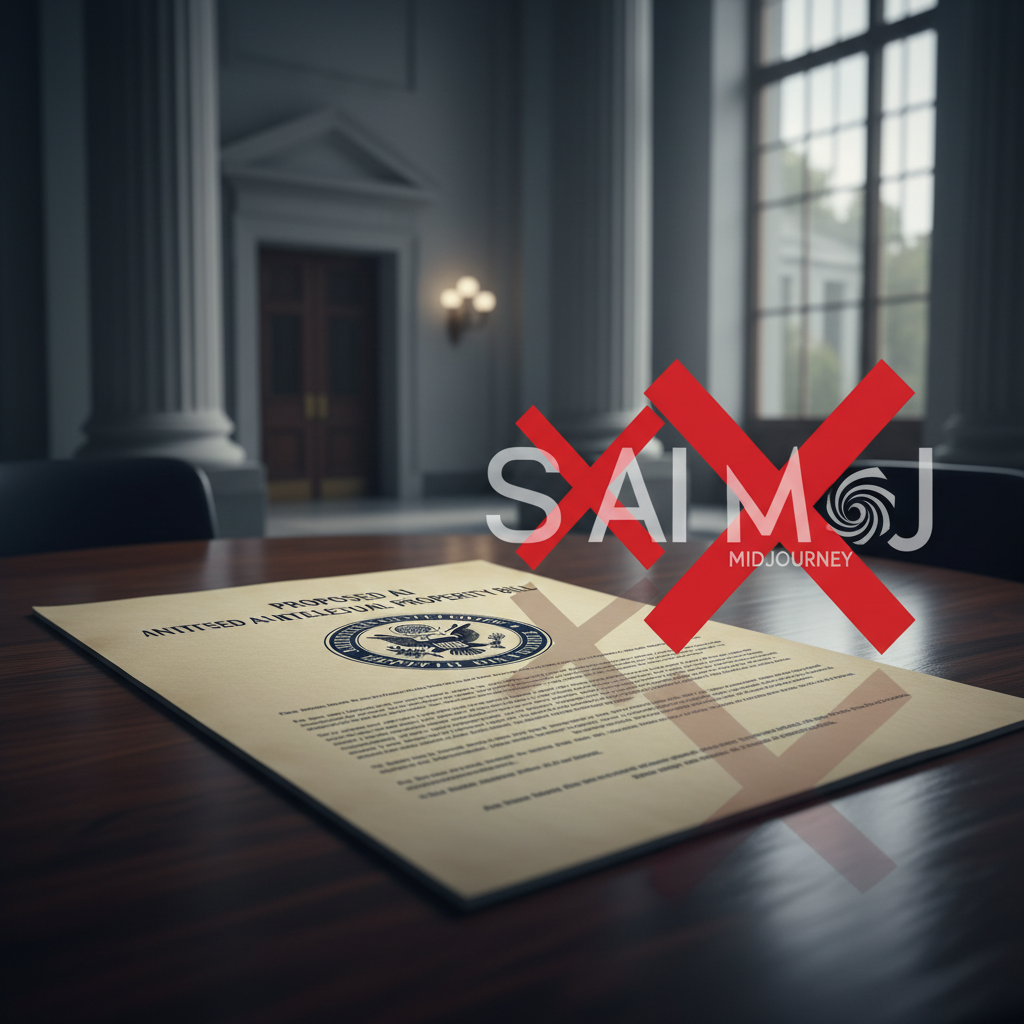
The digital frontier of artificial intelligence, particularly in generative imagery, is a battleground where innovation clashes with entrenched interests. For months, the creative industries, spearheaded by Hollywood's most powerful guilds and studios, have been whispering about a legislative solution to what they perceive as an existential threat: AI models trained on copyrighted material. Now, those whispers have solidified into a concrete proposal, a bill quietly circulating in congressional backrooms that could fundamentally alter the trajectory of companies like Stability AI and Midjourney within the United States.
This proposed legislation, tentatively titled the 'Artificial Intelligence Creative Works Protection Act,' seeks to reclassify the act of training generative AI models on copyrighted content, specifically images, text, and audio, as a 'public performance' or 'derivative work' under existing copyright law. This is a significant legal maneuver, designed to trigger royalty payments and licensing requirements that do not currently exist. The bill, as leaked drafts suggest, would establish a new federal agency or task an existing one, possibly the Copyright Office, with creating a mandatory licensing framework. This framework would dictate terms for AI developers, potentially requiring them to pay a percentage of their revenue or a per-use fee for every piece of copyrighted material ingested into their training datasets.
Who is behind this audacious policy push, and why now? My investigation reveals a meticulously coordinated lobbying effort, primarily funded by the Motion Picture Association MPA, the Recording Industry Association of America Riaa, and several prominent artists' guilds, including the Directors Guild of America and the Screen Actors Guild. These organizations, with their deep pockets and decades of experience navigating Washington's labyrinthine corridors, have poured an estimated $75 million into lobbying efforts over the past year alone, specifically targeting AI-related legislation. The lobbying records tell a different story than the public narrative of protecting individual artists; they paint a picture of major corporations seeking to secure new revenue streams and maintain control over content distribution in the age of AI. Sources close to congressional aides indicate that Representative Eleanor Vance D-CA, a long-standing champion of Hollywood interests, is a primary architect of the bill, working closely with Senator Robert Sterling R-NY, who has voiced concerns about intellectual property rights in the digital age.
In practice, this legislation would create an unprecedented regulatory burden for AI developers. Imagine a system where every image, every line of text, every sound clip used to train a model like Stability AI's Stable Diffusion or Midjourney's image generation platform requires individual licensing or falls under a complex blanket agreement with a newly empowered collective rights organization. This is not merely about attribution; it is about monetizing the very data that fuels these models. For startups, the administrative overhead and potential financial liabilities could be crippling. Even established tech giants like Google or Meta, with their vast legal departments, would face significant compliance challenges and potentially astronomical costs. The bill also proposes a 'right to forget' clause, allowing copyright holders to demand their works be purged from training datasets, a technical and logistical nightmare for models already deployed and in use.
Industry reactions have been swift and largely negative, particularly from the AI startup ecosystem. Emmet Cole, CEO of a prominent generative AI art platform based in Brooklyn, stated, "This isn't about fair compensation; it's about erecting a tollbooth on the information superhighway. It will stifle innovation, push development overseas, and ultimately hurt American competitiveness." He continued, "We are already seeing venture capital firms becoming hesitant to invest in generative AI companies in the US because of this regulatory uncertainty." Meanwhile, larger tech players like OpenAI and Anthropic have adopted a more cautious, wait-and-see approach, with some sources suggesting they are quietly exploring alternative training methodologies or even contemplating offshore operations to circumvent potential US regulations. A recent TechCrunch report highlighted the growing concerns among AI startups regarding regulatory headwinds.
Civil society groups and independent artists present a more complex perspective. Organizations like the Electronic Frontier Foundation EFF have voiced strong opposition, arguing that the bill misunderstands the nature of AI training and could undermine fair use principles. "Training an AI model is transformative, not merely duplicative," explained Dr. Lena Khan, a senior policy analyst at the EFF, during a recent panel discussion in Washington D.C. "To treat every input as a performance is to fundamentally misinterpret how these systems learn and create." However, many individual artists, particularly those whose works have been directly used without consent to train these models, welcome the legislative intervention. Sarah Jenkins, a freelance illustrator from Seattle whose distinctive style has been replicated by AI, expressed her frustration, saying, "My livelihood is being eroded. If AI companies profit from my work, I deserve to be compensated. This bill is a necessary step to protect creators." The debate highlights a deep schism between those who see AI as a tool for creative augmentation and those who view it as a threat to human artistry.
Will this ambitious regulatory framework work? The answer is far from clear. On one hand, the sheer political muscle of Hollywood and its allies could push this bill through, especially with bipartisan concerns about AI's impact on employment and intellectual property. The potential for new revenue streams for legacy media companies is a powerful motivator. On the other hand, the technical challenges of implementation are immense. How does one accurately track and compensate for billions of data points? What constitutes a 'purge' from a neural network? The bill could also face significant legal challenges, with arguments centering on fair use, the First Amendment, and the definition of a 'derivative work' in the context of machine learning. The US legal system, known for its intricate interpretations of copyright, is ill-equipped to handle such a novel challenge without years of litigation. Furthermore, an overly restrictive US policy could simply drive AI innovation to more permissive jurisdictions, undermining America's leadership in this critical technological field. As MIT Technology Review recently explored, the global race for AI dominance is heavily influenced by regulatory environments.
Washington's AI policy is shaped by these players, and the outcome of this legislative battle will have profound implications for the future of generative AI. It is a high-stakes poker game, with the creative economy, technological progress, and billions of dollars hanging in the balance. The question remains whether lawmakers, swayed by powerful lobbyists, will create a framework that fosters responsible innovation or one that inadvertently stifles the very creativity it purports to protect. For now, companies like Stability AI and Midjourney operate under a cloud of uncertainty, their future in the American market contingent on the legislative winds blowing through Capitol Hill. The stakes are too high for us to simply accept the official narratives; we must continue to scrutinize the money, the power, and the potential consequences of every policy decision. This is not just about technology; it is about who controls the future of creation itself. For more insights into the intersection of AI and copyright, consider resources like Ars Technica's AI section.