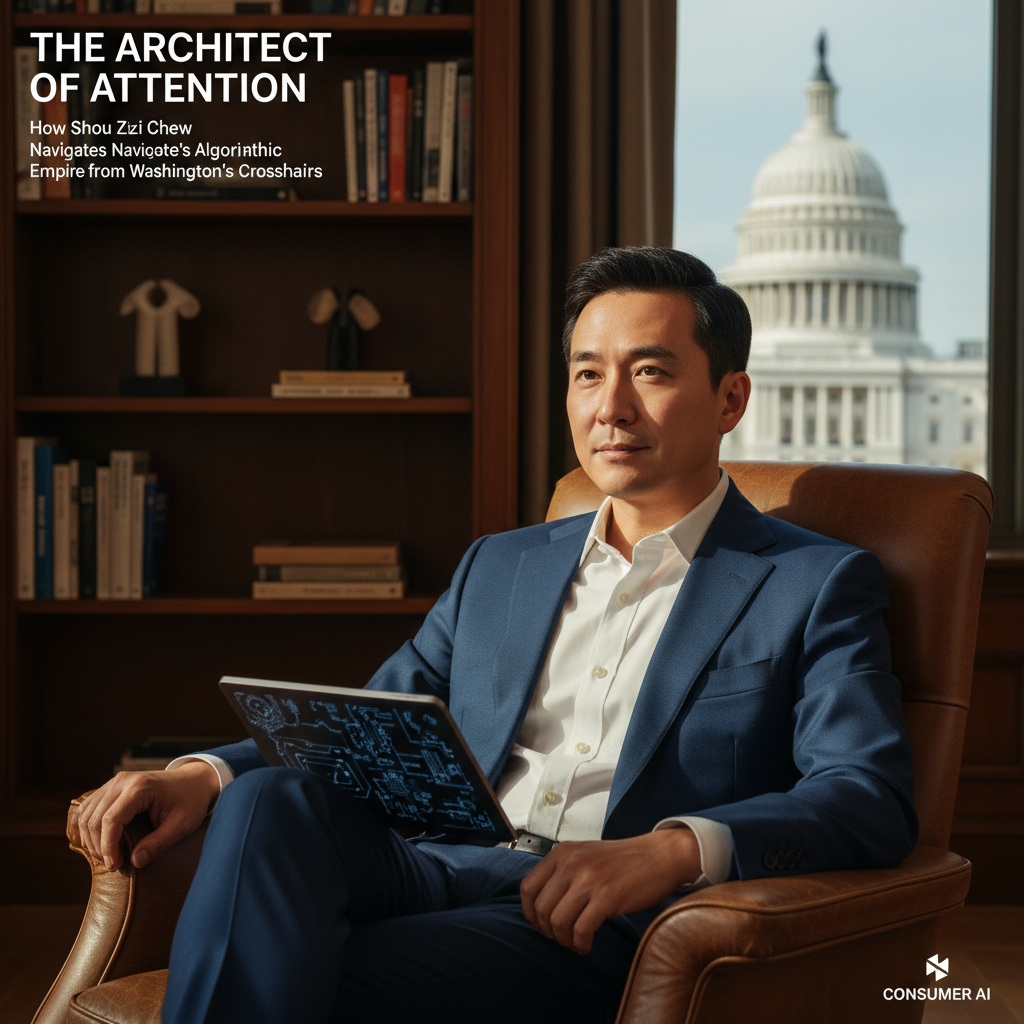
The fluorescent hum of the Dirksen Senate Office Building often serves as a stark backdrop for the high-stakes drama of Washington, D.C. It was there, amidst the marble and stern gazes, that Shou Zi Chew, the unassuming CEO of TikTok, found himself in March 2023, testifying before Congress. His calm demeanor belied the immense pressure: defending an application that has captivated over 170 million Americans, yet remains inextricably linked to its Chinese parent company, ByteDance. This moment, more than any other, encapsulates the defining challenge of his tenure: how to operate a global phenomenon, powered by an unparalleled AI, while assuaging profound national security concerns in the United States. It is a tightrope walk that few executives have ever attempted, let alone sustained.
Chew's journey to this prominent, often precarious, position is a narrative woven through elite American institutions and the cutthroat world of global finance. Born in Singapore, a city-state renowned for its strategic geopolitical position and economic prowess, Chew's early life was marked by academic rigor and a global outlook. He served his mandatory national service in the Singapore Armed Forces, an experience that instilled discipline and a strategic mindset. This foundation was further solidified by his education at University College London, where he earned a Bachelor of Economics degree. However, it was his subsequent move across the Atlantic to the United States that truly shaped his trajectory.
He enrolled in Harvard Business School, a crucible for future leaders, graduating in 2010. It was during his time at Harvard that he interned at Facebook, an early exposure to the burgeoning social media landscape that would later become his battleground. This period was pivotal, offering him an insider's view into the mechanics of digital platforms and user engagement. The lobbying records tell a different story than the public narrative of a purely technological ascent; they reveal a sophisticated understanding of capital markets and international relations that would prove invaluable.
After Harvard, Chew plunged into the world of investment banking, joining Goldman Sachs. His tenure there, though brief, provided him with a deep understanding of corporate finance and market dynamics. He then transitioned to DST Global, a prominent venture capital firm known for its early investments in some of the world's most transformative technology companies, including Facebook, Airbnb, and notably, ByteDance. It was at DST Global that Chew first encountered ByteDance, then a nascent company with audacious ambitions. He led DST Global's initial investment in ByteDance in 2013, a move that would prove prescient and ultimately define his career path.
His relationship with ByteDance deepened over the years. He joined the company directly in 2021 as its Chief Financial Officer, a role that positioned him at the heart of its global operations and financial strategy. Just a few months later, he was appointed CEO of TikTok, succeeding Kevin Mayer. This rapid ascent underscored ByteDance's trust in his financial acumen and his ability to navigate complex international business environments. His mandate was clear: to steer TikTok through its explosive growth while addressing the escalating geopolitical tensions, particularly those emanating from Washington.
Building the company under the shadow of intense scrutiny has been a monumental task. Chew has focused on operational independence for TikTok, launching initiatives like Project Texas, a proposed restructuring designed to wall off American user data from ByteDance and place it under the supervision of Oracle. The goal is to create a robust data security architecture that meets U.S. government demands. This endeavor has involved significant investment, reportedly billions of dollars, and the hiring of thousands of engineers and security experts within the United States. "We are committed to transparency and accountability," Chew stated in a recent interview, a sentiment he frequently reiterates to lawmakers and the public. "Our priority is to protect the data and privacy of our 170 million American users." This commitment is not merely rhetorical; it is a strategic imperative for the company's survival in the U.S. market.
Funding and growth for TikTok have been astronomical, driven by its proprietary AI-powered recommendation engine. This algorithm, often described as the most powerful on Earth, has been the secret sauce behind TikTok's ability to personalize content with uncanny accuracy, leading to unprecedented user engagement. ByteDance, as the parent company, has seen its valuation soar, reportedly reaching hundreds of billions of dollars at its peak, making it one of the world's most valuable privately held companies. This financial success, however, has only intensified the spotlight, intertwining economic power with national security concerns.
Today, Shou Zi Chew remains at the helm of TikTok, a company that continues to redefine digital media and cultural trends. He spends a significant amount of time in the United States, engaging with policymakers, industry leaders, and the public. His presence in Washington is a constant reminder that Washington's AI policy is shaped by these players, not just by legislation. He understands that the fate of TikTok in America hinges not just on its technological prowess, but on its ability to build trust and demonstrate compliance. This is a battle fought not just in the marketplace, but in the halls of power.
What drives Chew is a blend of ambition, pragmatism, and a deep understanding of the global digital economy. He is a technologist by proxy, a financier by training, and a diplomat by necessity. His background, straddling both Eastern and Western cultures and economies, positions him uniquely to bridge divides, or at least attempt to. "The internet is a global phenomenon," he has argued, "and we believe in the free flow of information and creativity." This perspective, however, often clashes with the prevailing sentiment in Washington, where concerns about data sovereignty and foreign influence dominate the discourse.
What's next for Shou Zi Chew and TikTok is an open question, one that will likely be decided not just by market forces, but by legislative action. The ongoing debate in Congress over potential divestiture or outright bans of TikTok in the U.S. underscores the precariousness of his position. My investigation reveals that the company continues to invest heavily in lobbying efforts, deploying significant resources to articulate its case to American lawmakers. According to reports, TikTok spent over $10 million on lobbying in 2023, a clear indication of the high stakes involved in shaping its future in the U.S. market. Reuters has extensively covered these legislative battles.
The narrative of Shou Zi Chew is more than just a founder's profile; it is a microcosm of the larger struggle for technological supremacy and digital sovereignty in the 21st century. His ability to navigate these treacherous waters will not only determine the future of TikTok but also offer a blueprint, or perhaps a cautionary tale, for other global tech companies caught between competing geopolitical interests. The stakes are immense, not just for a company, but for the very fabric of how information and culture flow across borders in an AI-driven world. The intersection of AI, money, and power in Washington D.C. has rarely been so starkly illuminated as it is through the lens of TikTok's ongoing saga. For more insights into the broader implications of AI in society, consider exploring analyses on MIT Technology Review. The path forward for TikTok, and for Chew, remains uncertain, but his relentless engagement with American policy makers highlights the enduring influence of Washington on global tech. For a deeper dive into AI's societal impact, Wired offers various perspectives.