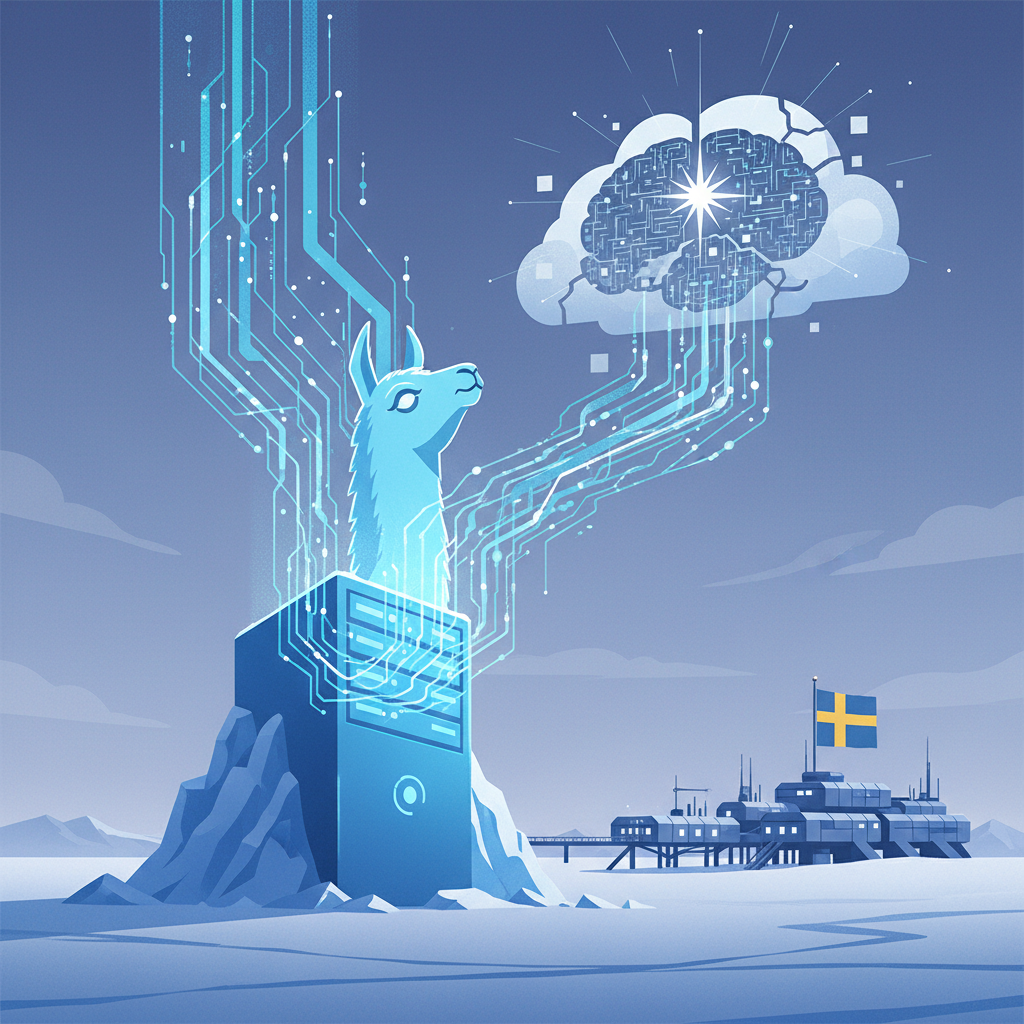

Last night, the aurora lit up our research station, painting the sky in hues of green and violet that defy description. It is a spectacle that reminds you of the vast, untamed beauty of our world, and how small we are within it. Yet, even here, at the very bottom of the world, the digital currents of artificial intelligence ripple through our lives, shaping our research, our communication, and our future. And when I look at the landscape of AI today, particularly the fierce debate surrounding open versus closed models, I find myself thinking about Meta and its Llama models, and what their strategy truly means for us all.
Meta, under the leadership of Mark Zuckerberg, has taken a bold, some might say audacious, stance by championing open-source AI with its Llama series. This is not merely a technical decision; it is a philosophical declaration in a world increasingly dominated by proprietary, black-box systems. While giants like OpenAI and Google guard their most advanced models like state secrets, Meta has chosen a different path, one that resonates deeply with the collaborative spirit essential for survival and progress in places like Antarctica. In the silence of Antarctica, you hear things differently, and what I hear is a call for shared knowledge, for collective advancement.
My perspective, forged in the stark realities of polar research, makes me inherently skeptical of anything that centralizes power or restricts access. Here, every piece of data, every shared insight, can mean the difference between a breakthrough and a missed opportunity. The same applies to AI. When Meta released Llama 2 to the public, and then continued with Llama 3, it was not just releasing code; it was releasing potential. It allowed researchers, startups, and even individual developers around the globe to inspect, adapt, and build upon some of the most advanced large language models available. This is crucial for fostering innovation beyond the walled gardens of Silicon Valley.
Consider the implications. Small teams, perhaps even university students in Uppsala or researchers in our own Swedish Polar Research Secretariat, can now access and fine-tune models that would otherwise be prohibitively expensive or entirely inaccessible. This democratization of AI technology is not just good for business; it is good for humanity. It means more diverse perspectives feeding into the development of AI, leading to more robust, less biased, and ultimately more beneficial applications. As Dr. Yann LeCun, Meta's Chief AI Scientist, has often articulated, open science accelerates progress. He stated in a recent interview, "If you want to make progress in science, you have to share your knowledge." This sentiment is a cornerstone of scientific endeavor, and it is heartening to see it applied to AI.
Of course, there are counterarguments. Critics often raise concerns about safety and misuse. They argue that making powerful AI models widely available could lead to the proliferation of misinformation, deepfakes, or even more nefarious applications. Companies like Anthropic and OpenAI often cite these risks as reasons for their more controlled release strategies. Dario Amodei, CEO of Anthropic, has repeatedly emphasized the need for careful alignment and safety research before deploying highly capable models to the public. He is not wrong to be cautious; the risks are real and substantial. We must be vigilant.
However, I believe that the benefits of openness, when coupled with responsible development and community oversight, far outweigh the dangers of secrecy. A closed ecosystem, while perhaps offering a facade of control, ultimately creates a single point of failure and stifles the very mechanisms that could identify and mitigate risks. When thousands of eyes are on a model, scrutinizing its weaknesses and contributing to its improvement, it becomes stronger, safer, and more resilient. Moreover, an open approach encourages the development of defensive AI tools, allowing the broader community to build countermeasures against potential misuse. This is what AI looks like at the end of the world, a tool for collective problem-solving, not just corporate gain.
Furthermore, the open-source movement in AI is not just about Meta. It is about a broader shift. Companies like Mistral AI in Europe are thriving by embracing similar principles, proving that there is a viable business model in collaboration, not just competition. Hugging Face, a platform that has become a central hub for open-source AI, demonstrates the incredible power of a community-driven approach, hosting countless models and datasets. This vibrant ecosystem is a testament to the power of shared innovation. You can see the sheer volume of activity on platforms like Hugging Face and understand the momentum behind this movement.
Meta's commitment to Llama, despite the immense investment required, suggests a long-term vision that extends beyond immediate profit. It is a strategic play to embed their technology deeply within the global AI infrastructure, fostering a generation of developers and applications built on their foundation. This is a smart move, but it is also a profoundly impactful one for the broader AI community. It creates a counterbalance to the dominance of a few powerful players and ensures that the future of AI is not solely dictated by the commercial interests of a select few.
From my vantage point here, where the vastness of the ice sheet stretches to the horizon, the idea of a truly open and collaborative future for AI feels not just desirable, but essential. The challenges we face, from climate change to global health crises, demand collective intelligence and shared tools. Meta's Llama models are not perfect, no technology ever is, but they represent a significant step towards an AI ecosystem that is more accessible, more innovative, and ultimately, more aligned with the needs of a diverse global society. We cannot afford to let the future of AI be locked away behind proprietary walls. The stakes are too high, and the potential for shared progress is too great. The battle for the open AI ecosystem is far from over, but with Meta's Llama leading the charge, there is a glimmer of hope for a brighter, more inclusive future. The world needs this openness, and frankly, I think it is the only way forward for truly impactful AI development. For more insights into the broader AI landscape, I often turn to sources like MIT Technology Review to understand the long-term implications of these technological shifts.