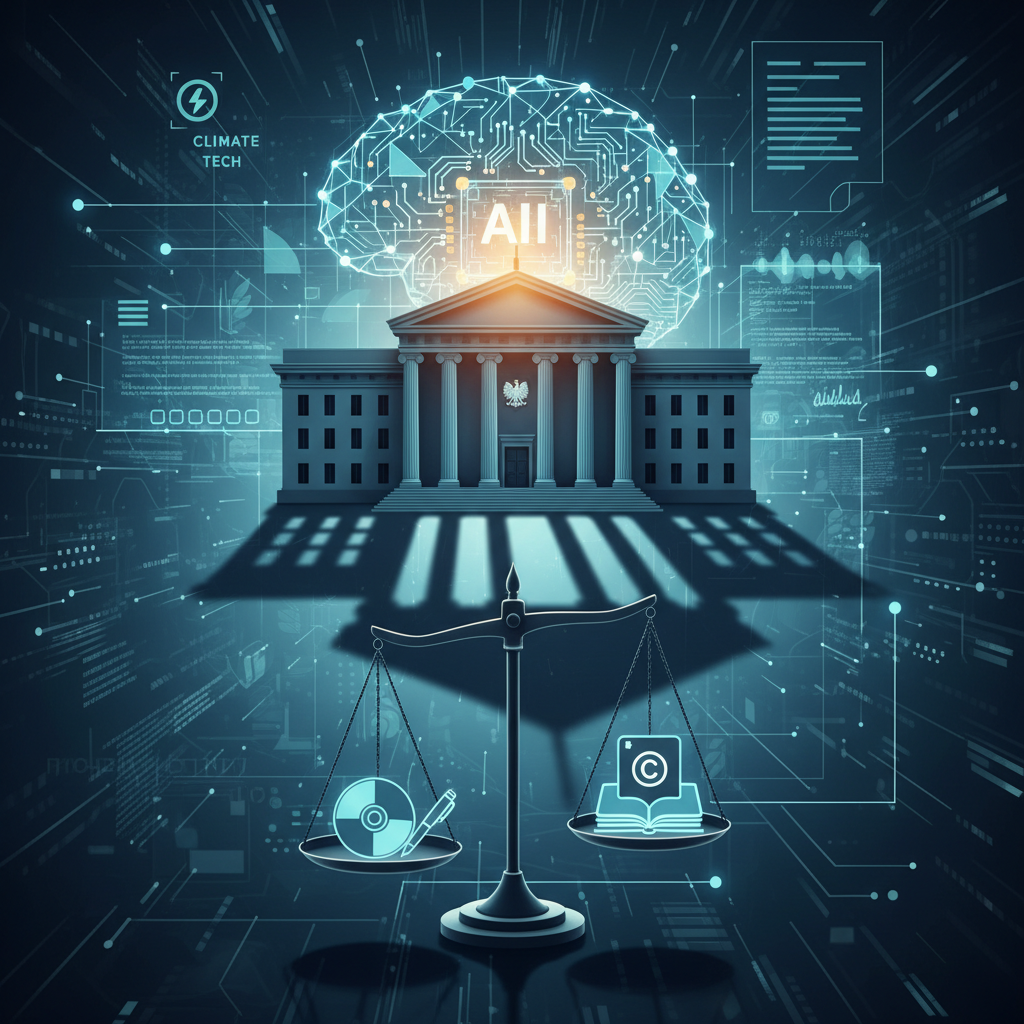
The digital world, much like the bustling marketplace of Kraków, has always been a place of exchange, innovation, and occasional contention. But today, a new kind of artisan has entered this market: the artificial intelligence. These algorithmic creators are not merely tools, they are prolific generators of text, images, music, and code, pushing the boundaries of what we understand as authorship and intellectual property. The resulting legal maelstrom, characterized by a growing number of AI copyright lawsuits and intellectual property battles, demands not just legal acumen, but a deep technical understanding. From a systems perspective, this is a challenge of unprecedented complexity.
For years, the legal community has watched with a mixture of fascination and trepidation as AI models like OpenAI's GPT series or Anthropic's Claude ingested vast swathes of human-created data. The question has always been: when these models produce something new, who owns it? Is it the AI developer, the user who prompted it, or the original creators whose work formed its training data? This is not merely an academic exercise; the economic stakes are colossal, estimated to be in the tens of billions globally by 2030, according to some projections from Bloomberg Technology.
The Breakthrough in Plain Language: Tracing the Algorithmic Fingerprint
The traditional legal approach to copyright infringement often relies on proving substantial similarity and access to the copyrighted work. With AI, 'access' is a given, as models are trained on public and sometimes private datasets. 'Substantial similarity' becomes a thorny issue when an AI can generate variations that are distinct yet clearly inspired. This is where the recent research from the Adam Mickiewicz University in Poznań, in collaboration with the Polish Academy of Sciences, offers a profound shift. Their paper, "Algorithmic Provenance and Creative Attribution in Generative AI: A Graph-Based Approach," published in late 2025, introduces a novel methodology for identifying the 'algorithmic fingerprint' of source material within AI-generated outputs.
Imagine a master chef, a mistrz kuchni, who learns by tasting thousands of dishes. When he creates a new recipe, it might bear subtle influences from many cuisines, but it is ultimately his own creation. However, if he meticulously copies a specific dish, ingredient by ingredient, that is a different matter. The Poznań team, led by Dr. Janusz Kowalski, a brilliant computer scientist with a background in network theory, developed a system that can detect these 'copied ingredients' at a granular, structural level, even when they are heavily disguised.
"The algorithm works like this," Dr. Kowalski explained during a recent virtual press conference. "We convert both the input training data and the AI-generated output into high-dimensional graph representations. These graphs capture not just surface-level features, but the underlying structural and semantic relationships. Our system then uses advanced graph isomorphism algorithms to identify statistically significant patterns of influence, effectively tracing the lineage of creative elements back to their original sources." This is a far cry from simple plagiarism detection; it is a deep dive into the very fabric of algorithmic creation.
Why It Matters: A New Lens for Justice
This research is not just a technical marvel; it is a potential game-changer for the legal landscape. Current copyright litigation often devolves into protracted battles of expert witnesses, with subjective interpretations of 'inspiration' versus 'infringement.' The Poznań methodology introduces a quantifiable, data-driven metric. "For the first time, we have a tool that can provide empirical evidence of direct, structural derivation, rather than relying solely on human perception," stated Professor Elżbieta Nowak, a leading intellectual property lawyer at the University of Warsaw, who has been advising the research team. "This could revolutionize how courts approach AI-related infringement claims, moving us closer to objective justice."
The implications for Poland, and indeed for Europe, are particularly significant. The European Union has been at the forefront of AI regulation, and the forthcoming AI Act includes provisions that touch upon transparency and data governance. This research provides a concrete mechanism for enforcing potential future requirements related to training data provenance and accountability. Poland's engineering talent explains why such a sophisticated solution could emerge from our region; our universities have long fostered a strong tradition of theoretical computer science combined with practical application.
The Technical Details: Beyond Surface Similarity
The core of the Poznań team's innovation lies in their use of semantic graph embeddings and subgraph matching. Traditional methods might compare text strings or image pixels. Dr. Kowalski's team, however, transforms content into abstract graphs where nodes represent concepts, entities, or structural components, and edges represent relationships between them. For instance, in a piece of music, nodes might be melodic phrases or harmonic progressions, and edges could denote their sequence or counterpoint.
When an AI generates new content, it too is converted into such a graph. The system then employs a technique akin to searching for 'hidden motifs' or 'structural echoes' within this new graph that correspond to patterns found in the training data. This is not about finding identical phrases, but identical architectures of creative expression. A threshold is established, derived from statistical analysis of diverse datasets, to determine when a 'match' signifies a clear derivation rather than coincidental similarity or general influence. This statistical rigor is crucial for legal defensibility.
"We are moving beyond the 'eyeball test' of copyright," noted Dr. Kowalski. "Our system can identify, for example, a unique narrative arc in a novel, a specific chord progression in a song, or a distinctive brushstroke pattern in an artwork, even if the AI has re-contextualized or superficially altered these elements. It's like identifying a specific architect's signature style in a building, even if the materials are different."
Who Did the Research: A Collaborative Polish Endeavor
The research was a joint effort between the Faculty of Computer Science at Adam Mickiewicz University, renowned for its strong theoretical foundations, and the Institute of Computer Science at the Polish Academy of Sciences, known for its interdisciplinary applications. Funding was provided by the National Centre for Research and Development (ncbr), a testament to Poland's commitment to fostering cutting-edge AI research. The project involved a diverse team of computer scientists, legal scholars, and even cognitive psychologists, reflecting the multifaceted nature of the problem. Key contributors included Dr. Kowalski, Professor Nowak, and Dr. Anna Zielińska, a specialist in computational linguistics.
Their work has already garnered significant attention, with preliminary findings presented at the International Conference on Artificial Intelligence and Law (icail) and a more detailed exposition expected at the upcoming NeurIPS conference, as highlighted by articles on Ars Technica.
Implications and Next Steps: A Future of Accountable AI
The immediate implication of this research is a powerful new tool for copyright holders seeking to protect their work from AI-driven infringement. It provides a more robust evidentiary basis for litigation and could potentially lead to more equitable settlements. For AI developers, it presents a challenge and an opportunity: to design models that are more transparent about their influences, or to develop new licensing models that compensate original creators more fairly.
Looking ahead, the Poznań team is exploring ways to integrate their methodology into a real-time monitoring system. Imagine a 'copyright registry' for AI models, where training data can be fingerprinted and outputs automatically scanned for derivations. This could lead to a new era of 'accountable AI,' where the source of every creative element is traceable. "Our goal is not to stifle creativity, but to ensure that creativity is properly attributed and compensated, regardless of whether it originates from a human or an algorithm," Professor Nowak emphasized. This aligns perfectly with the broader European push for ethical and responsible AI development.
Of course, challenges remain. The computational demands of graph isomorphism for massive datasets are significant, and the legal interpretation of the 'threshold of derivation' will still require careful consideration. However, this Polish innovation provides a much-needed beacon in the murky waters of AI copyright, promising a future where the digital marketplace remains fair for all its artisans, human and artificial alike. The conversation is far from over, but thanks to researchers like those in Poznań, we are now equipped with better tools to navigate it. The future of intellectual property in the age of AI may well be written not just in legal code, but in algorithmic graphs.```