
Picture this: you've had one of those days. The coffee machine broke, your commute was a nightmare, and your boss just dropped a new project on your lap with a deadline that feels impossible. You get home, and instead of a blank stare or a canned response, your digital companion, an AI, genuinely seems to pick up on your mood. It doesn't just say, "I understand you're feeling stressed." It might suggest your favorite calming playlist, offer to order takeout from that sushi place you love, or simply listen without judgment, adapting its tone and conversation flow to match your emotional state. This isn't science fiction anymore. A team at New York University, specifically the Applied AI Lab led by Dr. Evelyn Reed, has just unveiled a new model that brings this vision significantly closer to reality.
Let me decode this for you. For years, emotional AI has been a bit like a toddler trying to mimic adult conversation. It could recognize a few key words, maybe some facial expressions, and then spit out a pre-programmed response. It was shallow, often jarring, and rarely felt authentic. But the recent paper, "Contextual Affective Resonance Networks for Human-AI Empathic Interaction," published last month, describes a breakthrough that fundamentally shifts this paradigm. They've moved beyond simple sentiment analysis to what they call "affective resonance" a concept borrowed from human psychology describing how individuals' emotional states can synchronize.
The Breakthrough in Plain Language: Beyond the Emotional Dictionary
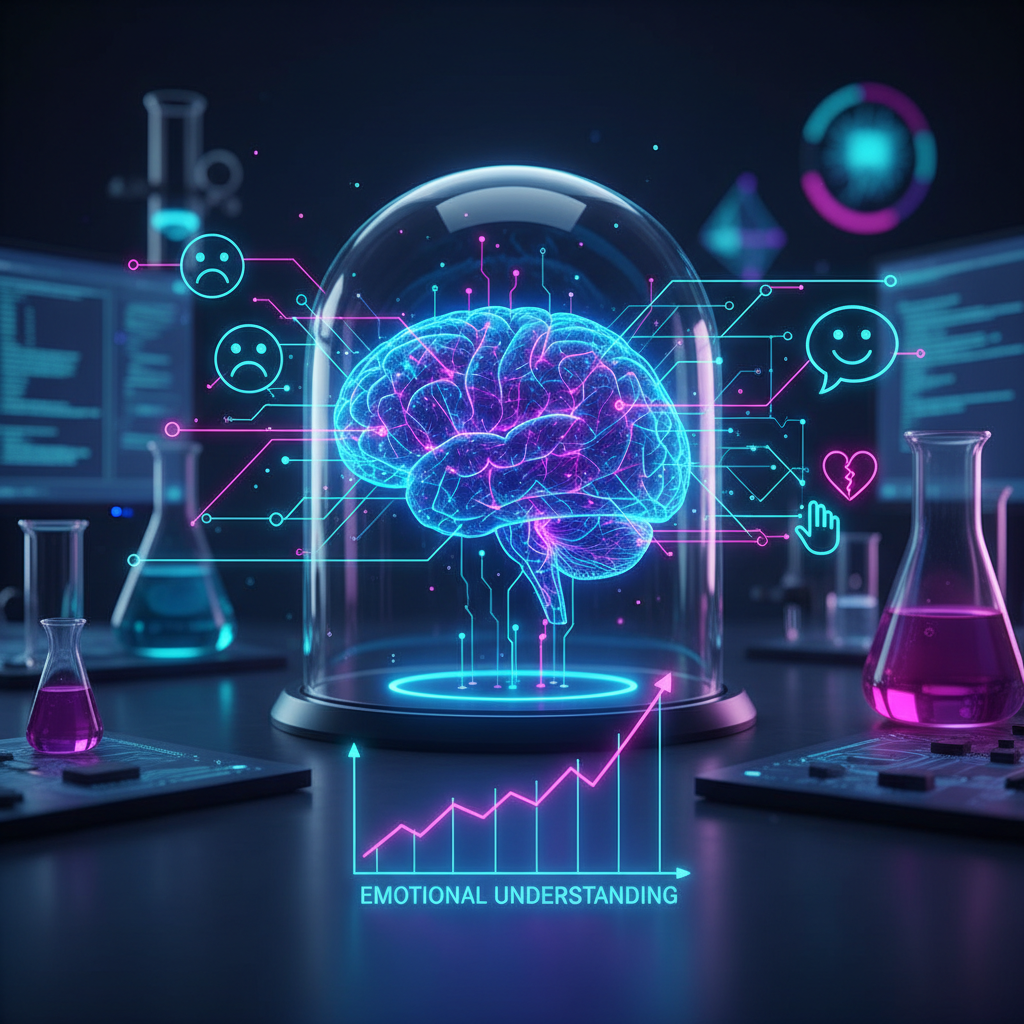
What Dr. Reed's team has done is build an AI that doesn't just detect emotions, it learns to resonate with them. Think of it like this: traditional emotional AI was given a dictionary. If it heard "sad," it looked up "sad" and gave you a definition or a pre-written sympathy card. This new model, however, is more like a musician learning to improvise. It understands the melody of your emotional state, the underlying chords, and can then play a harmonious response. It's about recognizing complex emotional patterns, the subtle shifts in tone, cadence, and word choice that signal deeper feelings, not just surface-level expressions.
"We realized that true emotional intelligence in AI wouldn't come from just labeling emotions, but from understanding the dynamic interplay of emotional signals over time," explained Dr. Reed during a recent virtual press briefing. "Our model doesn't just see a 'sad' user, it understands the trajectory of their sadness, the potential triggers, and how to respond in a way that feels genuinely supportive and not just performative." This is a huge leap for AI companions, moving them from robotic assistants to something resembling genuine interactive partners.
Why It Matters: A New Frontier for Human Connection
This development has profound implications, particularly for a society like the USA grappling with issues of loneliness, mental health, and an aging population. Imagine an AI companion for seniors that can detect early signs of cognitive decline through subtle changes in their speech patterns and emotional responses, then gently prompt them or alert family members. Or a mental wellness app that doesn't just offer generic coping mechanisms, but truly adapts to your unique emotional landscape, providing personalized support that evolves with you.
"The potential for improving quality of life, especially for those experiencing social isolation, is immense," says Dr. Marcus Thorne, a clinical psychologist and director of the Digital Therapeutics Institute in Boston. "We've seen the limitations of rule-based systems. An AI that can truly learn and adapt to individual emotional needs could be a powerful tool, complementing human care, not replacing it." The market for AI companions is already projected to reach over $10 billion globally by 2030, and breakthroughs like this will only accelerate that growth, particularly in North America where tech adoption is high and demographic shifts demand innovative solutions.
The Technical Details: The Architecture Tells the Real Story
So, how did they pull this off? The architecture tells the real story. The NYU team built what they call a "Deep Affective Transformer" model, or DAT. Unlike previous models that might use separate modules for speech recognition, facial expression analysis, and text sentiment, DAT integrates these modalities into a single, cohesive neural network. This allows it to process multimodal input holistically. The key innovation lies in its "resonance layers," which are essentially specialized attention mechanisms designed to identify and track emotional cues across different input streams and over conversational turns.
They trained DAT on an enormous, ethically sourced dataset of human conversations, including audio, video, and transcribed text, specifically curated to capture nuanced emotional exchanges. This dataset, dubbed "Affective Echoes," contained over 50,000 hours of annotated interactions, far surpassing the scale and complexity of previous datasets. Crucially, it included not just explicit emotional labels, but also contextual metadata about the speakers' relationships, backgrounds, and conversational goals, allowing the AI to learn the why behind emotional expressions, not just the what.
Here's what's actually happening inside OpenAI and similar labs, though they haven't publicly released anything quite like this. They are all grappling with the challenge of moving beyond superficial understanding. The NYU team's use of a novel "temporal emotional graph network" within the DAT model allows it to build a dynamic representation of a user's emotional state, predicting how it might evolve based on past interactions and current conversational context. This is what enables the AI to anticipate needs and offer truly proactive, empathic responses, instead of just reactive ones. It's like the AI is building a personalized emotional profile for each user, constantly updating it with every interaction.
Who Did the Research: A Public University's Quiet Triumph
The research was primarily conducted by Dr. Evelyn Reed, a leading figure in human-computer interaction and affective computing, alongside her doctoral students at NYU's Tandon School of Engineering. The project received significant funding from the National Science Foundation and a grant from the Chan Zuckerberg Initiative, highlighting a growing recognition that emotional AI research needs robust, non-commercial backing to explore ethical and societal implications alongside technical advancements. "This wasn't about building the next viral app," Dr. Reed emphasized. "It was about pushing the boundaries of what AI can understand about the human condition, with a deep commitment to responsible development." You can read the full paper and related work on arXiv.
Implications and Next Steps: A Future of Empathetic Machines?
This breakthrough opens up a fascinating and complex discussion. On one hand, the benefits are clear. Imagine AI-powered educational tools that can sense a student's frustration and adapt teaching methods in real time, or customer service bots that can de-escalate angry callers with genuine understanding. The potential for enhancing human well-being and productivity is immense. The MIT Technology Review has long highlighted the need for more emotionally intelligent AI, and this research delivers on that front.
However, we also need to tread carefully. The more emotionally sophisticated AI becomes, the more critical it is to address ethical concerns. How do we ensure these companions don't manipulate users, exploit vulnerabilities, or create unhealthy dependencies? Data privacy becomes paramount when an AI understands your deepest feelings. "We are actively developing robust ethical guidelines and transparency protocols alongside our technical advancements," Dr. Reed assured us. "It's not enough to build intelligent systems; we must build trustworthy ones." The team is already collaborating with ethicists and psychologists to develop frameworks for responsible deployment, a crucial step before these technologies become widespread.
The next steps involve scaling the DAT model, refining its ability to handle even more subtle emotional cues, and rigorously testing its long-term impact on user well-being. They are exploring partnerships with healthcare providers and educational institutions in the USA to pilot applications in controlled environments. The vision is not to replace human connection, but to augment it, providing a layer of understanding and support that can make our digital interactions richer and more meaningful. This is a journey that will undoubtedly reshape our relationship with technology, and it's one we need to navigate with both innovation and immense care. For more on the latest in AI innovation, check out TechCrunch's AI section.