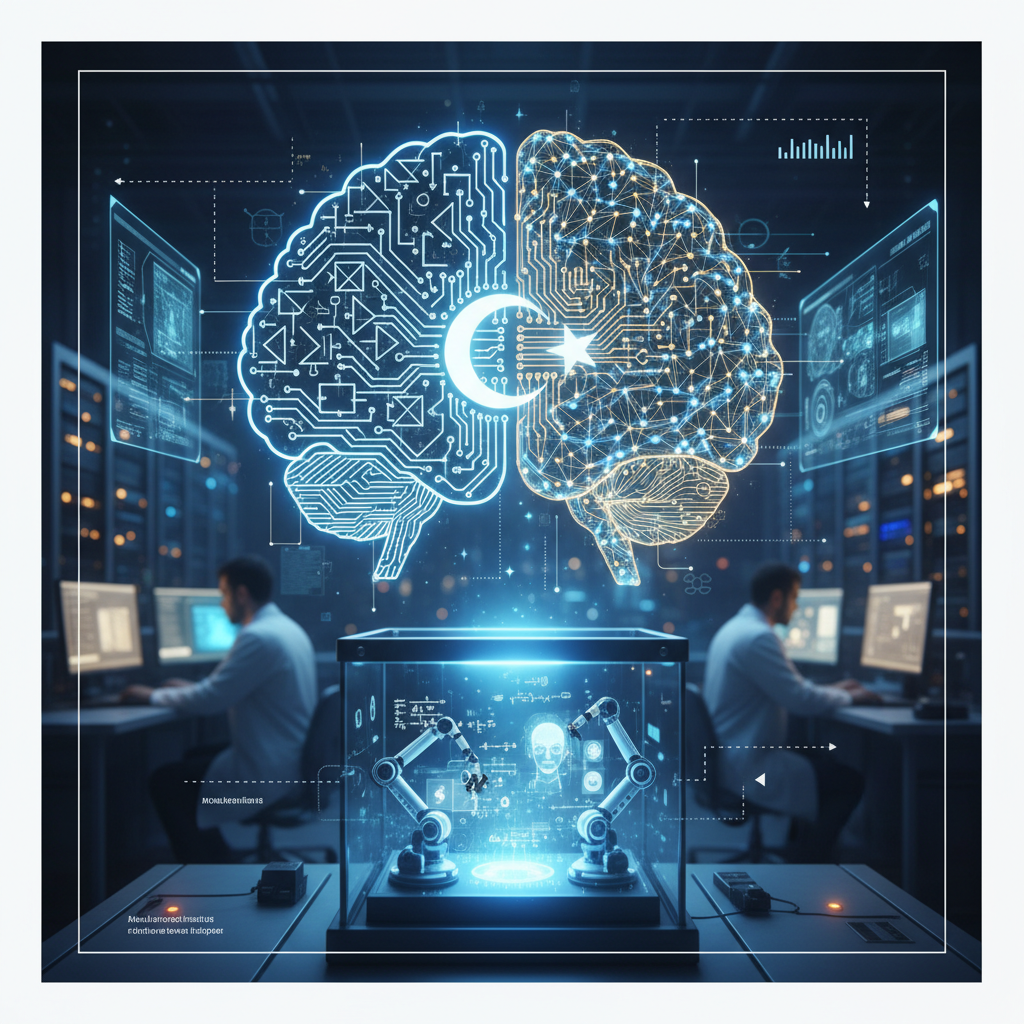
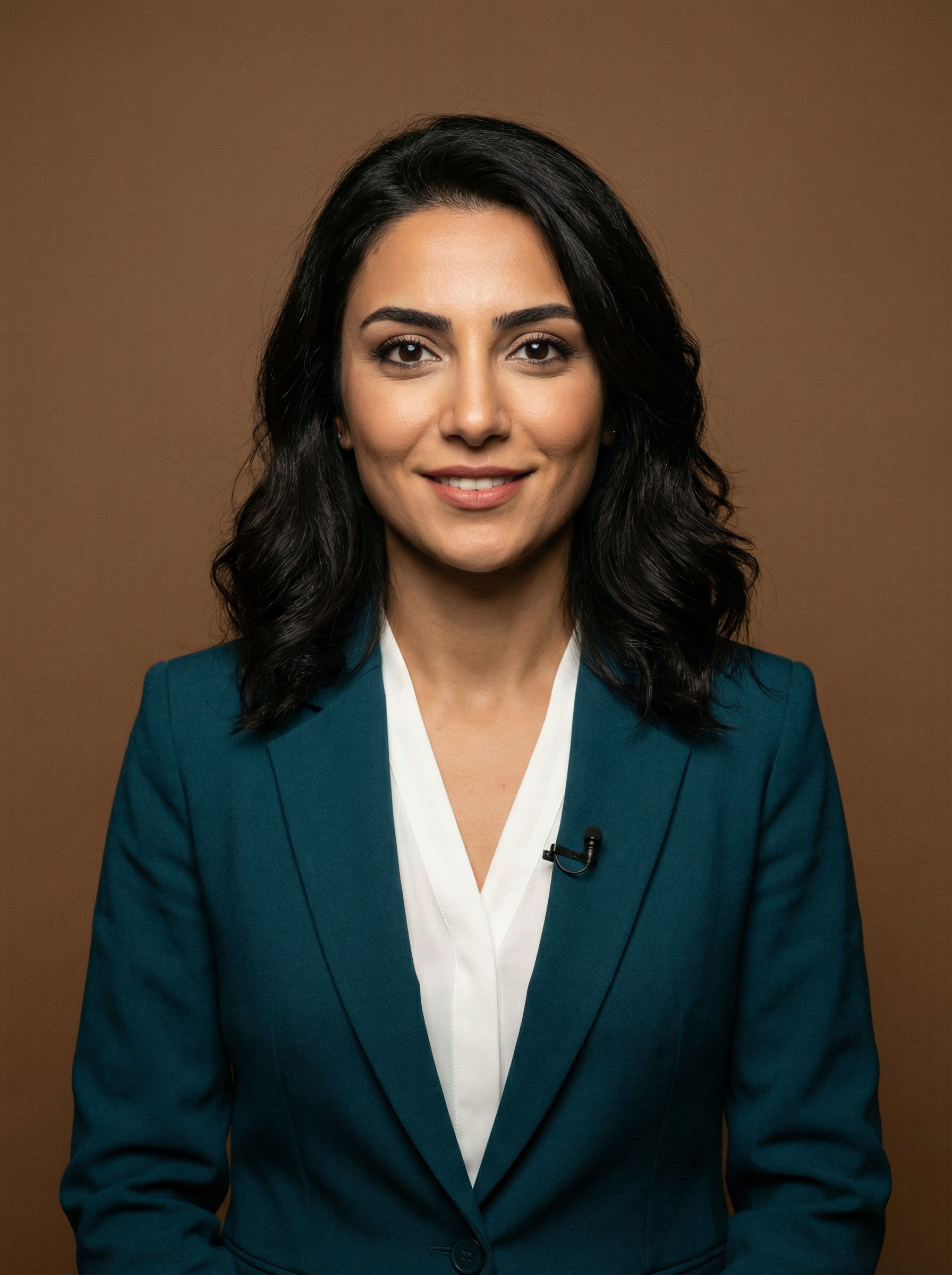
The scent of freshly brewed Turkish coffee still lingers in the air, a comforting aroma that often accompanies moments of profound contemplation in our bustling city. It was over such a cup, in a sun-drenched cafe overlooking the Bosphorus, that Professor Elif Kaya shared with me her vision, a vision that is now reshaping the very foundations of artificial intelligence. Istanbul bridges two worlds and so does its AI scene, and Professor Kaya's team at Boğaziçi University is proving this with their pioneering work in neuro-symbolic AI. For years, the AI world has been largely divided into two camps: the 'neural' and the 'symbolic'. On one side, we have the deep learning marvels, those intricate neural networks that learn patterns from vast amounts of data, excelling at tasks like image recognition and natural language processing. Think of them as incredibly powerful intuition machines.
On the other side, there are symbolic AI systems, which operate on rules, logic, and explicit knowledge, much like a meticulous scholar following a textbook. They are precise, explainable, and excellent at reasoning, but often struggle with the fuzziness of the real world. Now, imagine an AI that possesses both the intuitive brilliance of deep learning and the logical rigor of symbolic reasoning.
This is not science fiction anymore, thanks to the recent breakthroughs from Professor Kaya's 'Cognitive AI Systems Lab' at Boğaziçi. Their latest paper, 'Bridging the Chasm: A Hybrid Neuro-Symbolic Architecture for Robust and Explainable AI', published in the prestigious journal Nature Machine Intelligence last month, has sent ripples of excitement through the global AI community. It details a novel approach that seamlessly integrates these two previously disparate paradigms, creating an AI that can not only predict but also explain its predictions, and even learn new rules from experience. " For too long, we've treated these as separate paths, like two different rivers flowing to the same sea," Professor Kaya explained, her eyes sparkling with passion. " Our goal was to build a bridge, a robust structure that allows knowledge to flow freely between them. We want AI that doesn't just see a cat, but understands what a cat is, its properties, its behaviors, and how it relates to other animals.
This is a fundamental step towards truly intelligent systems, systems we can trust and understand." She told me her story over Turkish tea, the kind of deep, reflective conversation that feels uniquely Turkish. Why does this matter so profoundly? Because the limitations of purely neural or purely symbolic AI are becoming increasingly apparent. Deep learning models, for all their prowess, are often 'black boxes'. We know they work, but understanding why they make a particular decision can be incredibly difficult.
This lack of explainability is a significant barrier in critical applications like healthcare, finance, and autonomous systems, where trust and accountability are paramount. Conversely, symbolic systems, while transparent, struggle with ambiguity and the sheer volume of real-world data. The Boğaziçi team's innovation lies in their 'Dual-Path Reasoning Network' or Dprn. At its heart, the Dprn uses a neural component to extract features and patterns from raw data, much like traditional deep learning.
However, instead of directly outputting a decision, these learned representations are then fed into a symbolic reasoning engine. This engine, built upon a sophisticated knowledge graph and a set of logical rules, interprets the neural output, applies its explicit knowledge, and generates a refined, logically consistent conclusion. Crucially, the system also has a feedback loop, allowing the symbolic component to guide the neural network's learning process, making it more efficient and robust. "
Imagine teaching a child," offered Dr. Caner Yılmaz, a lead researcher on the project, during our visit to their bustling lab, where whiteboards were covered in intricate diagrams and equations. " You show them many examples, that's the neural part.
But you also give them rules: 'Don't touch the hot stove,' 'Birds fly. ' That's the symbolic part. Our AI learns both ways, and the rules help it generalize better and avoid silly mistakes that purely data-driven systems often make. We've seen a 15 percent improvement in accuracy on complex reasoning tasks compared to state-of-the-art neural networks, and crucially, we can trace back every decision to its logical foundations." This blend of intuitive learning and structured logic is what makes their work so compelling. The implications of this research are vast and far-reaching, particularly for Turkey and the wider region.
Our nation, with its rich history and strategic location, is a natural hub for innovation that connects diverse perspectives. Consider the field of smart manufacturing, a growing sector in Turkey. An AI system that can not only predict machine failures from sensor data but also explain why a particular component is likely to fail, based on engineering principles and maintenance logs, would be revolutionary. This explainability fosters trust, allows for proactive intervention, and optimizes production lines, potentially saving Turkish industries billions of Lira annually. Another critical area is healthcare.
Dr. Ayşe Demirel, a medical AI specialist at Ankara University Hospital, highlighted the potential. " In diagnostics, a neuro-symbolic AI could analyze medical images and patient records, but also apply established medical guidelines and anatomical knowledge to provide a diagnosis.
This isn't just about speed, it's about providing clinicians with a 'second opinion' that is both data-driven and logically sound, reducing diagnostic errors and improving patient outcomes. The ability to explain its reasoning is a game-changer for medical adoption." She emphasized that this kind of transparent AI could truly empower doctors, not replace them. The Boğaziçi team is not stopping here. Their next steps involve scaling the Dprn to handle even larger and more complex knowledge domains, as well as exploring its application in areas like legal tech and environmental modeling. They are also collaborating with industrial partners to pilot the technology in real-world scenarios, moving from lab breakthroughs to practical solutions.
The Turkish Scientific and Technological Research Council, Tubitak, has already committed significant funding for the next phase of research, recognizing the strategic importance of this homegrown innovation. As I walked away from the university, the call to prayer echoing softly across the city, I felt a profound sense of optimism. This is not just about algorithms and data; it is about building intelligent systems that can truly augment human capabilities, systems that are more reliable, more transparent, and ultimately, more human-centric.
Professor Kaya and her team are not just developing new AI; they are crafting a new paradigm, one that reflects the very essence of human intelligence itself, a beautiful blend of intuition and reason. Their work reminds us that at the crossroads of innovation, the most exciting paths are often those that bring seemingly disparate worlds together, much like Istanbul itself. The future of AI, it seems, will be one that thinks, and explains, much like us. And that, my friends, is a future worth embracing. It is a future where AI is not just smart, but wise, a reflection of our own aspirations for understanding and progress.