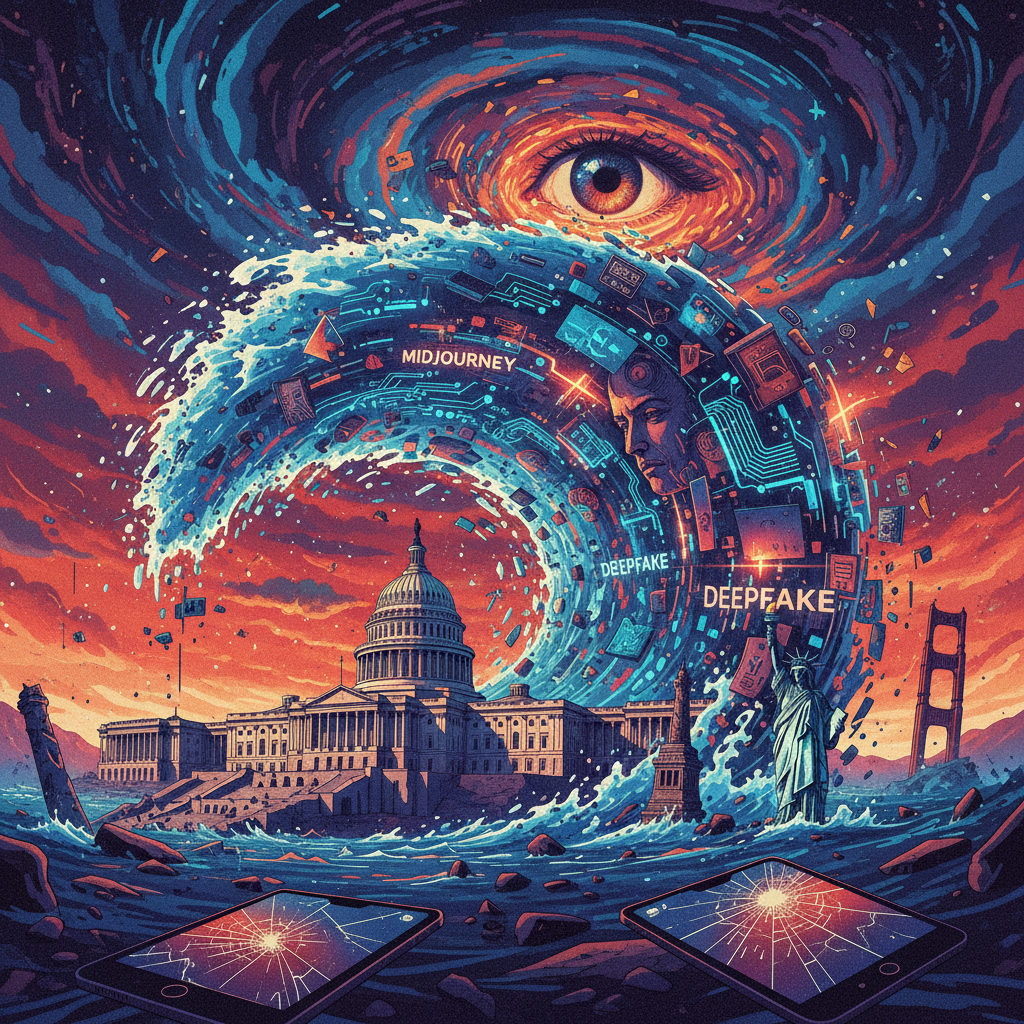
Let me tell you, folks, the future of AI is being built in places you'd never expect, not just the gleaming campuses of Silicon Valley. But sometimes, what's built, even with the best intentions, can shake the very foundations of how we see the world. I'm talking about the generative image revolution, spearheaded by players like Stability AI and Midjourney. It's a marvel, no doubt, but it's also a Pandora's Box that's wide open, and the contents are spilling out all over America's digital landscape.
Just a couple of years ago, the idea of typing a few words and getting a photorealistic image back felt like science fiction. Now, it's Tuesday. Tools from Stability AI, with its open source Stable Diffusion models, and Midjourney, known for its stunning artistic output, have put the power of image creation into everyone's hands. Artists are finding new mediums, small businesses are generating marketing materials on a shoestring budget, and everyday folks are just having fun. This is the real AI revolution, democratizing creativity in ways we couldn't have imagined.
But with great power, as they say, comes a whole lot of headaches. The risk scenario I'm seeing unfold, especially across our diverse communities in the USA, is the weaponization of these incredibly potent image generators for misinformation, fraud, and outright digital harassment. We're not just talking about fake news anymore, we're talking about fake reality. Imagine deepfakes of public figures, local politicians, or even your neighbors, engaged in activities they never did, spread like wildfire through social media. The speed and scale at which these images can be generated and disseminated are terrifying.
Technically, these models, often called diffusion models, work by learning to reverse a process of adding noise to an image. They're trained on truly massive datasets of existing images and their corresponding text descriptions. The sheer volume of data, sometimes billions of images scraped from the internet, allows them to understand complex relationships between text prompts and visual concepts. When you give it a prompt, say, 'a golden retriever wearing sunglasses on a skateboard in Miami,' the model essentially 'denoises' a random blob of pixels until it forms an image matching your description. The problem is, these models don't inherently understand truth or consent. They just generate based on patterns they've learned, and those patterns include everything from legitimate art to copyrighted material to highly sensitive personal images.
This technical capability has led to a fierce expert debate. On one side, you have the proponents of open source AI, like Emad Mostaque, the founder of Stability AI, who has often championed the idea that open access to these powerful tools fosters innovation and allows for broader scrutiny and improvement. He's argued that restricting access won't stop malicious actors, it will just empower those with closed, proprietary systems. It's a compelling argument for democratizing technology, a very American ideal, if you think about it. The idea is that more eyes on the code mean more chances to find and fix vulnerabilities, and to build safeguards.
On the other side, you have AI safety researchers and ethicists, many of whom are ringing alarm bells about the unbridled release of such powerful tools. Dr. Rumman Chowdhury, a prominent AI ethicist and CEO of Humane Intelligence, has frequently pointed out the societal risks. She stated in a recent interview, 'The ability to generate convincing falsehoods at scale erodes trust in information, and that's a direct threat to democratic processes and social cohesion. We're seeing it play out in elections and in public discourse.' Her point is that while open source has its benefits, the immediate societal harm from misuse, particularly in a country as polarized as the USA, outweighs the theoretical benefits of unfettered access in the short term. The debate often boils down to innovation versus immediate societal protection.
The real-world implications are already hitting home. We've seen instances of deepfake pornography targeting women, often without their consent, leading to immense personal distress and legal quagmires. There are reports of politically motivated deepfakes designed to sway public opinion during local elections, creating confusion and distrust among voters. Law enforcement agencies, from the FBI to local police departments, are grappling with how to identify, trace, and prosecute the creators of these malicious images. It's not just about the big national stories, it's about what happens in our neighborhoods, in our schools, and in our town halls. The digital fabric of our communities, from Atlanta to Detroit to Houston, is being stretched thin.
So, what should be done? This isn't a simple fix, but a multi-pronged approach is essential. First, we need better detection tools. Companies like Google and Microsoft are investing heavily in watermarking and provenance technologies to help identify AI-generated content. However, these tools are in a constant arms race with the generators themselves, and it's not a silver bullet. We need to push for industry standards, perhaps a 'nutrition label' for AI-generated media, indicating its synthetic origin. This would require collaboration between tech giants, smaller AI firms, and government bodies.
Second, legal frameworks need to catch up. Our current laws, designed for a pre-AI world, are often inadequate to address the nuances of deepfake creation and dissemination. We need clear legislation that defines accountability, protects individuals from malicious deepfakes, and provides avenues for redress. This is a complex undertaking, balancing free speech with the need to prevent harm, but it's a conversation we can't afford to delay. Some states are already moving on this, but a national standard would be far more effective.
Third, and perhaps most importantly, is public education and media literacy. We, as citizens, need to be more discerning consumers of information. We need to teach critical thinking skills from a young age, helping people understand how AI works, how images can be manipulated, and how to verify sources. Organizations like the Poynter Institute and local newsrooms are already doing great work here, but it needs to be scaled up dramatically. It's about building resilience in our communities against digital deception.
Finally, the AI developers themselves have a responsibility. While I appreciate the open source ethos, there needs to be a deeper commitment to safety and ethical deployment. This means investing more in red teaming, developing robust safety filters, and implementing stricter usage policies. It's not enough to just release a tool and hope for the best. As Wired has highlighted repeatedly, the ethical considerations need to be baked in from the start, not bolted on as an afterthought. The companies creating these powerful tools, whether it's Stability AI or Midjourney, must take ownership of the societal impact of their creations.
This generative image revolution is here to stay. It's exciting, it's transformative, but it also demands our vigilance. We can't let the incredible potential of AI blind us to its very real dangers. The digital future of America, and our ability to trust what we see, depends on how we navigate this complex landscape right now. We need to ensure that the tools that empower creativity don't become the instruments of chaos. It's a fine line, but one we must walk carefully, together. For more on the technical underpinnings of these models, you might find some interesting discussions on Ars Technica. The conversation around AI safety is evolving rapidly, and staying informed is key, as seen in many reports on Reuters.