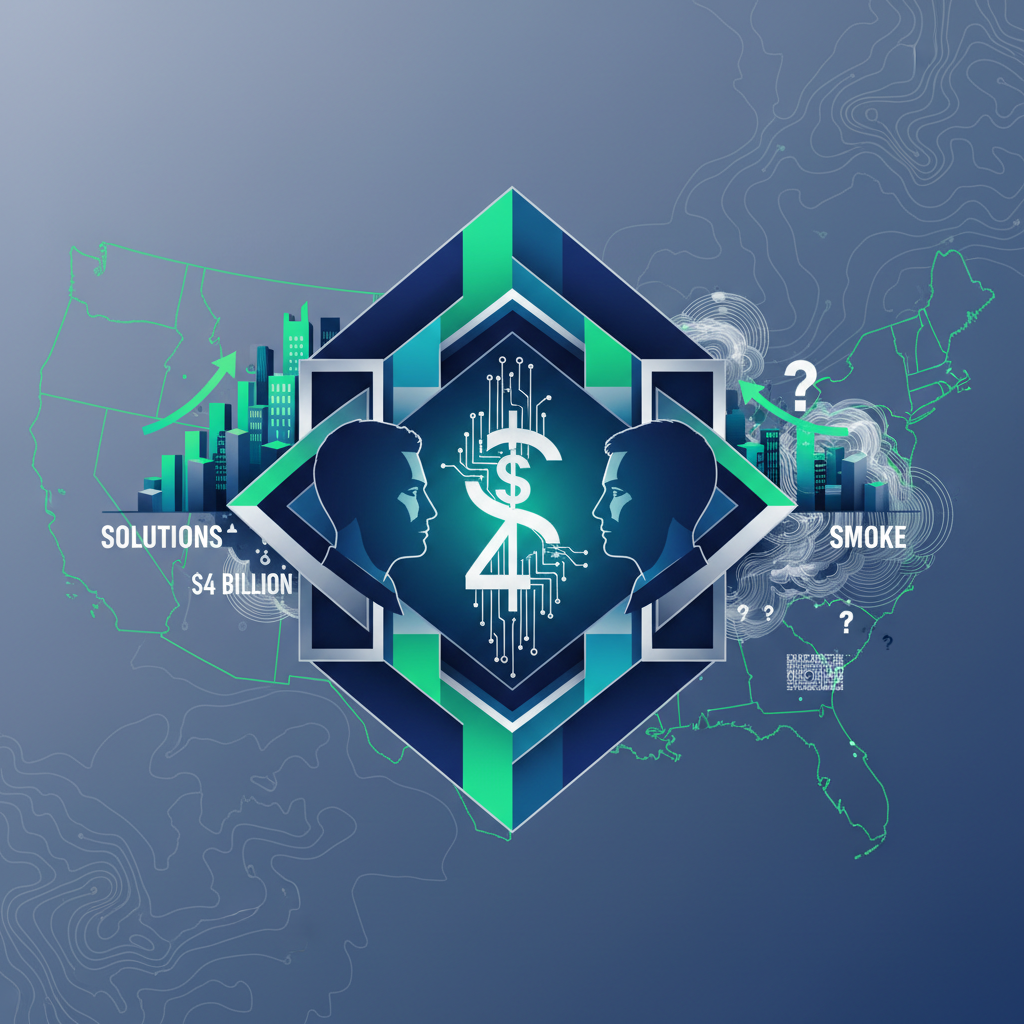
Let's be real. Every other week, it feels like some new AI startup pops up, claiming to revolutionize an industry, backed by a pile of cash that would make a small nation blush. This week, it's Sierra AI, co-founded by Bret Taylor and Clay Bavor, two names that carry serious weight in the tech world. Taylor, a former co-CEO of Salesforce and ex-CTO of Facebook, and Bavor, a long-time Google executive, are now selling the dream of AI-powered customer service. Their company is reportedly valued at a cool $4 billion. Four billion dollars, folks, for a company that's barely out of its toddler phase. The question isn't just if they can deliver, but if this latest AI gold rush is actually solving problems for everyday Americans or just creating another layer of digital redlining.
Silicon Valley has a blind spot the size of Texas, especially when it comes to understanding how their shiny new toys actually impact people outside their bubble. Customer service, in particular, is a battlefield. Anyone who has spent an hour on hold, navigating a labyrinth of automated menus, or getting generic, unhelpful responses from a chatbot knows the pain. So, the promise of an AI that can genuinely understand, empathize, and resolve issues sounds like a godsend. But we've heard this song before, haven't we?
Think back to the early 2010s, when the first wave of chatbots and virtual assistants started hitting the scene. Companies like Nuance Communications were making big promises about natural language processing transforming call centers. We got Siri and Alexa, which were great for setting timers or playing music, but try asking them to resolve a complex billing dispute or troubleshoot your internet connection. It was a disaster. The technology then, mostly rule-based or shallow machine learning, was nowhere near sophisticated enough to handle the nuances of human interaction, especially when emotions ran high. It often felt like talking to a brick wall, just a slightly more polite, digital brick wall.
Fast forward to today, April 2026. Generative AI, powered by large language models like OpenAI's GPT-4, Google's Gemini, and Anthropic's Claude, has changed the game. These models can generate remarkably human-like text, summarize complex information, and even hold coherent conversations. This is the foundation upon which Sierra AI is building its empire. They claim their AI can handle a wide range of customer interactions, from simple FAQs to more complex problem-solving, freeing up human agents for truly intractable issues. The idea is to move beyond the frustrating chatbot experience to something more akin to a highly knowledgeable, always-available human. According to a recent report by Reuters, investments in AI customer service solutions have skyrocketed, with projections showing the market reaching tens of billions by the end of the decade.
But here's what the tech bros don't want to talk about: the human cost. While Sierra AI and others promise efficiency and cost savings for businesses, what about the customer service representatives whose jobs are on the line? A study by the National Bureau of Economic Research last year estimated that AI could automate a significant portion of tasks currently performed by customer service agents, potentially displacing millions of workers in the USA alone. This isn't just about efficiency; it's about livelihoods. "We have to be incredibly thoughtful about how these technologies are deployed," says Dr. Joy Buolamwini, founder of the Algorithmic Justice League. "If we're not careful, we'll automate away jobs without creating equitable pathways for reskilling and re-employment, deepening existing economic disparities." Her point is sharp, and it's one Silicon Valley often conveniently overlooks.
I spoke with Maria Rodriguez, a customer service manager for a major telecommunications company based out of Dallas, Texas. She's seen the push for AI firsthand. "They're always talking about 'synergy' and 'optimization,'" she told me, her voice tinged with skepticism. "But what it often means is fewer people on the phones, longer wait times for the tough cases, and more frustrated customers. The AI handles the easy stuff, sure, but when a customer is truly upset, they want a human. They want to feel heard, not processed by a machine, no matter how clever it sounds." Her experience resonates with countless others across the country, from the bustling call centers of Arizona to the quiet offices in New England.
Then there's the issue of bias. AI models are trained on vast datasets, and if those datasets reflect societal biases, the AI will perpetuate them. What happens when an AI customer service agent, trained on predominantly white, English-speaking data, struggles to understand a customer with a strong accent or uses language that is culturally insensitive? Or worse, what if it inadvertently discriminates in how it routes calls or offers solutions? "Bias in AI is not a bug, it's a feature of biased data," explains Meredith Broussard, a data journalism professor at New York University and author of 'Artificial Unintelligence.' "Companies need to invest heavily in auditing their models for fairness and ensuring diverse data inputs, not just chasing the next valuation." This is an uncomfortable truth time for many in the industry, but it's one we absolutely must confront.
Sierra AI's founders are undeniably brilliant. Bret Taylor's track record at Salesforce and Facebook speaks volumes, and Clay Bavor's long tenure at Google, overseeing products like Google Cardboard and Google Lens, shows a deep understanding of consumer-facing technology. They've raised money from top-tier venture capital firms, signaling strong market confidence. Their technology, leveraging the latest in generative AI, is likely far more capable than the chatbots of old. They claim their system can learn from every interaction, continuously improving its ability to handle complex queries and adapt to brand-specific guidelines. This iterative learning is a key differentiator from previous generations of AI.
However, the real test won't be in the valuation, but in the trenches of actual customer interactions. Can Sierra AI truly deliver a consistently positive experience across diverse demographics and complex emotional landscapes? Can it do so without exacerbating job displacement or introducing new forms of algorithmic bias? The potential for truly transformative customer service is there, absolutely. Imagine an AI that can instantly access your entire service history, understand your specific problem, and offer personalized solutions, all without making you repeat yourself five times. That's the dream.
My verdict? Sierra AI, and the broader trend of AI in customer service, is not a fad. It's the new normal, whether we like it or not. The efficiency gains are too significant for businesses to ignore. However, its success, and more importantly, its ethical impact, hinges on a few critical factors. First, companies deploying these systems must prioritize human oversight and intervention, ensuring a seamless escalation path when AI inevitably falters. Second, there needs to be a serious, sustained investment in reskilling the workforce that will be affected. We can't just automate jobs away and expect people to figure it out. Finally, and perhaps most crucially, the development and deployment of these AI systems must be guided by principles of fairness, transparency, and accountability. Without these safeguards, Sierra AI, for all its billions, risks becoming just another shiny, expensive tool that makes life easier for corporations while making it harder for the very customers and employees it claims to serve. The future of customer service isn't just about smarter algorithms; it's about smarter, more ethical choices. We need to demand that from the industry, from Silicon Valley, and from companies like Sierra AI. For more on the ethical implications of AI, check out Wired's AI coverage. We also need to consider how these advancements might impact global labor markets, a topic often explored by MIT Technology Review.
This isn't just about a $4 billion startup; it's about the kind of future we're building, one AI interaction at a time. And we, the people, deserve a seat at that table, not just another automated response.