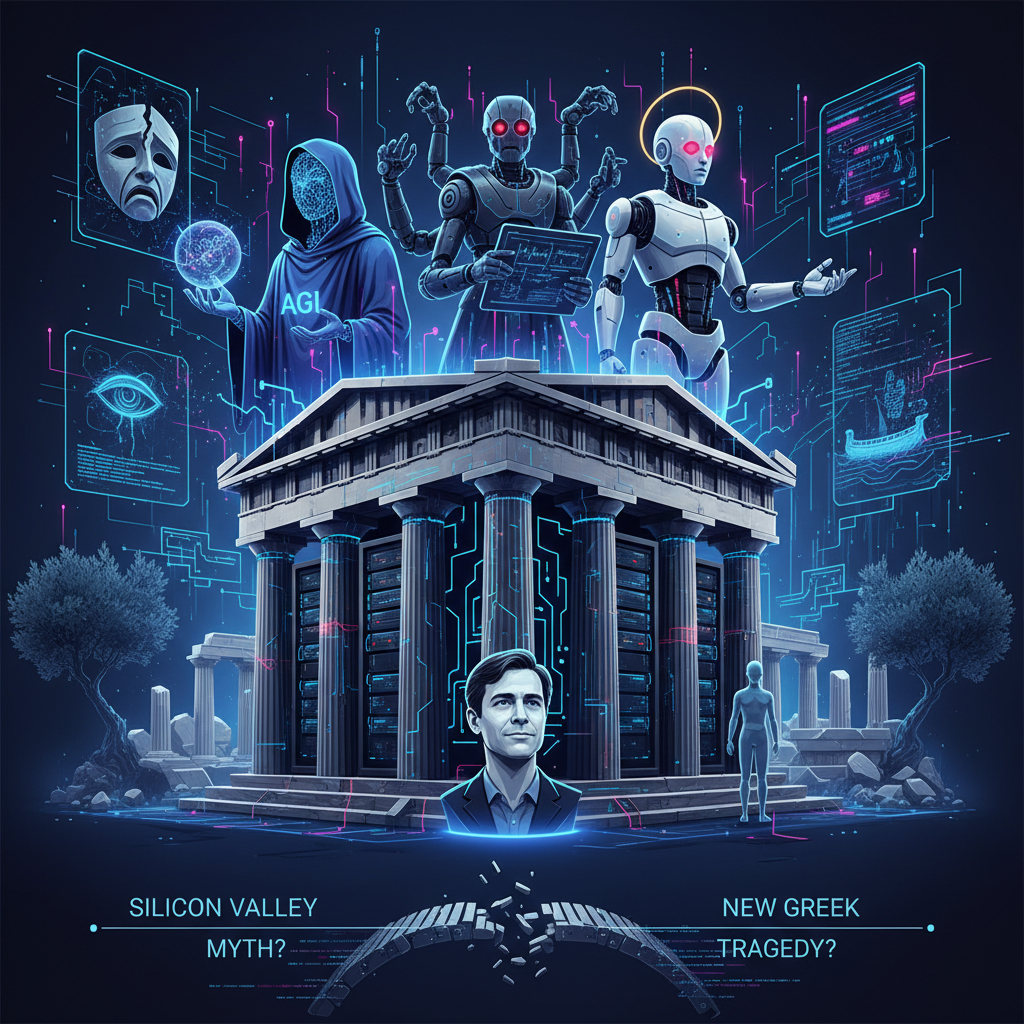

Let's be honest. The whole 'race to AGI' thing feels a bit like a modern retelling of the Argonauts, doesn't it? Except instead of a Golden Fleece, everyone is chasing a sentient algorithm, and instead of Jason, we have Sam Altman, Sundar Pichai, and a host of other tech titans, all convinced they are destined to be the first to bring this digital Prometheus to life. From my vantage point here in Athens, watching the drama unfold, it is hard not to chuckle, and then perhaps, pour another coffee. The gods of Olympus would have loved this AI drama, I think, probably placing bets on who crashes first.
For years, AGI, or Artificial General Intelligence, was the stuff of science fiction, a distant theoretical peak on the horizon of computing. Now, it is the stated goal of companies like OpenAI, Google DeepMind, and Anthropic, who are pouring billions of dollars and untold computational power into making machines that can learn, understand, and apply intelligence across a broad range of tasks, much like a human. Or, dare I say, perhaps even better than a human. The rhetoric is escalating, the timelines are shrinking, and the fear, or perhaps the fervent hope, of a truly intelligent machine is palpable.
But is this frantic sprint a genuine pursuit of a new era of intelligence, or just another Silicon Valley fad, destined to burn bright and then fizzle, leaving behind a trail of venture capital dust? My gut, honed by centuries of Greek skepticism, leans towards a healthy dose of both. We are certainly seeing unprecedented advancements, but the definition of AGI itself remains as elusive as a politician's promise.
Historically, the goal of creating intelligent machines has been a recurring dream, or nightmare, depending on your philosophical bent. From the ancient Greek myths of automatons crafted by Hephaestus to the mechanical chess players of the 18th century, humanity has always been fascinated by the idea of artificial life. Modern AI, however, began its serious journey in the mid-20th century, with pioneers like Alan Turing asking if machines could think. For decades, progress was incremental, marked by 'AI winters' when funding dried up and optimism waned. Then came the deep learning revolution, fueled by massive datasets and powerful GPUs from companies like NVIDIA, and suddenly, AI was not just thinking, it was seeing, speaking, and even creating art. This exponential leap has convinced many that AGI is not just possible, but imminent.
Today, the landscape is a battlefield of giants. OpenAI, with its GPT series, is perhaps the most vocal proponent of AGI, consistently pushing the boundaries of large language models. Their latest iterations, like GPT-4.5, demonstrate astonishing capabilities in reasoning, creativity, and problem-solving, making them indispensable tools for millions. Google DeepMind, with its history of conquering complex games like Go and now focusing on multimodal AI, is another formidable contender. Their Gemini models are designed to integrate various forms of data, moving closer to a holistic understanding of the world. Anthropic, founded by former OpenAI researchers, emphasizes safety and ethical development with its Claude models, arguing that AGI's arrival necessitates extreme caution.
According to a recent report by Reuters, investments in AI startups focusing on foundational models and AGI research have skyrocketed, reaching tens of billions of dollars annually. For instance, OpenAI's latest funding rounds have reportedly valued the company in the high tens of billions, reflecting investor confidence, or perhaps, investor Fomo, in their AGI ambitions. Microsoft, a major investor in OpenAI, has integrated AI capabilities across its product suite, from Copilot in Windows to Azure AI services, effectively betting its future on the success of these advanced models. Even Meta, through its AI research, is contributing to the open-source movement with models like Llama, albeit with a slightly different philosophical approach to accessibility.
But what do the experts say? Not everyone is convinced AGI is just around the corner, or even desirable. Dr. Yann LeCun, Meta's Chief AI Scientist and a Turing Award laureate, has often expressed skepticism about the current path to AGI, suggesting that current large language models lack true understanding and common sense. He argues that a fundamentally different architectural approach, perhaps inspired by biological learning, will be necessary. "We are missing some fundamental principles for intelligence," LeCun stated in a recent interview, "and until we discover those, we will not have human-level intelligence." His perspective is a crucial counterpoint to the more enthusiastic declarations coming from other labs.
On the other hand, Dario Amodei, CEO of Anthropic, believes that while AGI is a monumental challenge, the progress is undeniable. "We are seeing capabilities emerge that were unthinkable just a few years ago," Amodei told a conference last year. "The question is not if, but when, and how we ensure it is built safely and for the benefit of humanity." This sentiment underscores the growing concern for AI safety, a field that has gained significant traction as models become more powerful.
And what about Greece in all of this? While we may not have the multi-billion dollar AI labs of Silicon Valley, the implications of AGI are certainly not lost on us. Our academic institutions, like the National Technical University of Athens, are actively engaged in AI research, often focusing on niche applications and ethical considerations. We are, after all, the birthplace of philosophy, and the philosophical questions surrounding AGI are profound. What does it mean to be intelligent? What is consciousness? Greece to Silicon Valley: we invented logic, remember? These are not just academic musings, but urgent questions that will define our future with AGI.
I spoke with Dr. Maria Koutra, a professor of AI ethics at the University of Athens. "The focus on 'who gets there first' often overshadows the more critical question of 'how it should be built and governed,'" she observed. "We need global collaboration, not just a corporate race. The potential for misuse or unintended consequences is too great to leave to a handful of companies." Her words echo the growing calls for international cooperation and regulation, exemplified by initiatives like the European Union's AI Act, which aims to establish a robust regulatory framework for AI systems.
My verdict, if you insist on one, is that the race for AGI is both a genuine scientific endeavor and a spectacular marketing spectacle. The progress is real, transformative, and frankly, a little terrifying. We are indeed building increasingly capable machines that are changing industries, from healthcare to finance, and touching every aspect of our lives. The sheer computational power and data being thrown at this problem are unprecedented, and it would be foolish to dismiss the possibility of significant breakthroughs.
However, the notion of a singular, sudden 'AGI moment' feels overly simplistic, almost mythological. Intelligence is not a single switch to be flipped, but a spectrum of capabilities. We are likely to see a gradual emergence of advanced AI systems that exhibit increasingly general intelligence, rather than a sudden leap to a fully sentient, omniscient entity. The danger lies not just in the creation of such an entity, but in the societal disruption, economic upheaval, and ethical quandaries that even 'near-AGI' systems will undoubtedly bring.
So, while the titans of tech continue their epic quest, fueled by venture capital and visions of digital glory, I will be here, watching, analyzing, and occasionally, shaking my head. Pass the ouzo, this tech news requires it. Because whether it is a new golden age or a modern tragedy, the story of AGI is one that will define our future, and we Greeks know a thing or two about epic stories. For more insights into the philosophical implications of AI, you might find some interesting discussions on MIT Technology Review. The journey to AGI is less a sprint and more a marathon through uncharted philosophical territory, and we should all be paying very close attention to the map, or lack thereof. The stakes are, after all, quite literally, everything. And for a deeper dive into the technical advancements driving this race, Ars Technica often provides excellent coverage.