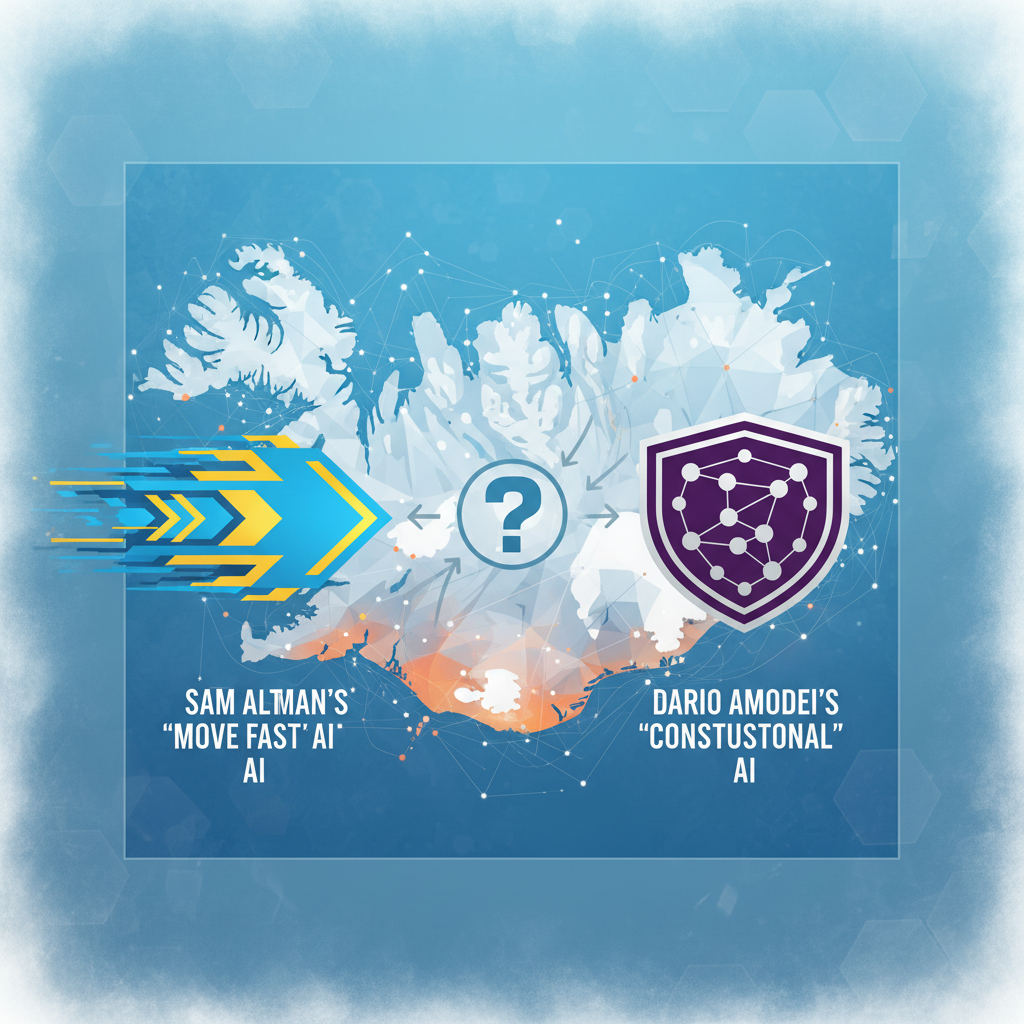
The AI industry is a bit like a geothermal power plant, isn't it? Lots of heat, a lot of steam, and everyone is trying to harness that power before it boils over. Lately, much of that steam has been generated by the contrasting philosophies of OpenAI and Anthropic. On one side, you have Sam Altman and OpenAI, pushing the boundaries of capability and speed. On the other, Dario Amodei and Anthropic, advocating for a more cautious, safety-first, 'constitutional' approach.
It makes for good headlines, certainly, but in Iceland, we tend to look past the drama and ask a simpler question: What does this actually do for us? Is this a fundamental divergence that will shape the AI landscape for decades, or just another Silicon Valley squabble that will eventually converge into a similar product offering? Let's dig into it, because the stakes are higher than just bragging rights.
The Philosophical Divide: Speed vs. Safety
OpenAI, co-founded by Elon Musk and now led by Sam Altman, has always had a bold, almost audacious vision: achieve artificial general intelligence, or AGI, and do it fast. Their mantra, often echoing Facebook's old 'move fast and break things' ethos, seems to be about rapid iteration, pushing models like GPT-4 and now GPT-5 into the wild, and letting the world figure out the implications as they go. The belief is that the benefits of AGI are so immense, we cannot afford to delay its arrival. They are not ignoring safety, mind you, but it often feels like an after-the-fact consideration, or a parallel track, rather than the primary constraint.
Anthropic, founded by former OpenAI researchers Dario Amodei and his sister Daniela Amodei, emerged from a concern that OpenAI was moving too quickly without sufficient guardrails. Their core philosophy, dubbed 'Constitutional AI,' embeds ethical principles directly into the training process of their models, like Claude. They aim to make their AI assistants helpful, harmless, and honest by design, not just by policy. This means more rigorous testing, slower deployment cycles, and a deep focus on alignment research from the outset. It's a more conservative, some might say responsible, approach to a technology that could fundamentally reshape society.
Data Points and Diverging Paths
Looking at the numbers, both companies have seen massive investment. OpenAI, famously backed by Microsoft with billions, has prioritized scaling compute and model size. Their latest GPT-5 model, rumored to be in advanced testing, is expected to boast trillions of parameters, pushing the envelope of what's possible. They've also been aggressive in commercializing their technology, integrating it into Microsoft products like Copilot and offering extensive API access, leading to a projected revenue run rate of over $2 billion annually by late 2025, according to industry reports.
Anthropic, while smaller in scale, has also attracted significant funding from Google and Amazon, totaling over $7 billion. Their focus has been less on raw size and more on the robustness and safety of their models. Claude 3, their latest offering, has been praised for its reduced propensity for harmful outputs and its ability to adhere to complex instructions, a direct result of their Constitutional AI approach. While their revenue figures are not as public as OpenAI's, their enterprise adoption is growing, particularly in sectors where trust and reliability are paramount, such as finance and healthcare.
“The market is clearly rewarding both approaches right now,” says Dr. Katrín Jónsdóttir, a senior AI researcher at the University of Iceland. “OpenAI captures the imagination with cutting-edge capabilities, while Anthropic appeals to those wary of unchecked power. It’s not a zero-sum game yet, but the long-term implications for regulation and public trust are significant.”
Expert Opinions: A Tale of Two Futures
Many in the industry see this as a healthy tension, a necessary dialectic in the development of such powerful technology. “Sam Altman’s drive to push boundaries is essential for innovation, but Dario Amodei’s caution provides a crucial counter-balance,” explains Professor Einar Magnússon, head of the Icelandic Institute of Technology. “Without both, we either stagnate or rush headlong into unknown dangers. The geothermal approach to computing, if you will, needs both the heat of innovation and the controlled flow of safety mechanisms.”
However, not everyone is convinced that these philosophies are truly distinct in practice. “At the end of the day, both companies want to build powerful, useful AI,” argues Anna Sigurðardóttir, CEO of Reykjavík-based AI startup ‘Gagnagrunnur ehf.’ “Anthropic might take longer, but they’re still aiming for AGI. OpenAI might move faster, but they’re also investing heavily in safety research. The difference often feels like marketing, a way to differentiate in a crowded market, rather than a truly fundamental schism.” She points to the fact that both companies are still largely driven by commercial imperatives and the pursuit of advanced capabilities, regardless of their stated ethical frameworks.
Indeed, some critics suggest that the 'safety' narrative can sometimes be a convenient shield. “When you’re building something potentially world-altering, talking about safety is good PR,” notes Jónas Pálsson, a veteran tech journalist based in Akureyri. “But the real test is whether those principles slow down profit or product release. So far, both companies seem to be doing quite well financially, which suggests their approaches, while different, are both commercially viable.”
The Icelandic Perspective: Practicality Over Philosophy
Here in Iceland, we think differently about this. Our small size and unique energy landscape mean we often prioritize practical, sustainable applications. The philosophical debates in Silicon Valley, while interesting, often feel distant from our immediate concerns: how can AI help us manage our fisheries more efficiently, preserve our language, or optimize our vast renewable energy grid? Small nations have big advantages in AI, particularly when it comes to focused applications and data privacy, but we need tools that are reliable and energy-efficient.
For us, the 'Constitutional AI' approach of Anthropic might offer more immediate appeal in certain sectors. Imagine an AI helping manage Iceland’s sensitive environmental data, where accuracy and ethical handling are non-negotiable. “A model designed with inherent safety and transparency, like Claude, could be invaluable for public sector applications here,” says Guðrún Ólafsdóttir, director of the Icelandic Data Protection Authority. “We need guarantees, not just promises, when it comes to sensitive information and critical infrastructure. The potential for bias or error in large language models is a significant concern for us, and Anthropic’s approach offers a more reassuring pathway.”
Conversely, OpenAI’s rapid development cycle and broad API access could empower Icelandic startups to innovate faster, integrating cutting-edge capabilities into new products and services without the need for massive in-house research teams. The sheer power of GPT models, even with their known limitations, is undeniable for creative industries, language translation, and content generation, which are all areas where Iceland could benefit from advanced AI capabilities. For more on the broader implications of AI, you can often find insightful discussions on sites like Wired.
My Verdict: A Necessary Tension, Not a Permanent Divide
So, is this a fad or the new normal? My bet is on a necessary tension that will eventually lead to a more balanced approach from both sides. OpenAI will likely continue to integrate more robust safety mechanisms as their models become more powerful and the regulatory landscape tightens. Anthropic, while prioritizing safety, will also need to keep pace with capabilities to remain competitive. The market demands both innovation and responsibility.
What we are seeing is not a permanent fork in the road, but rather two different routes to the same destination: powerful, general-purpose AI. The journey, however, will be shaped by these contrasting philosophies. For Iceland, the key will be to leverage the best of both worlds: the raw power and accessibility of models like GPT for innovation, and the ethical rigor of Constitutional AI for critical, sensitive applications. The future of AI, much like our volcanic landscape, will be forged by both immense power and careful, deliberate shaping. For ongoing business insights, Bloomberg Technology often has good coverage.
Ultimately, the debate between OpenAI and Anthropic is a crucial one, forcing us all to confront the profound implications of AI. But let's not get lost in the Silicon Valley echo chamber. The real measure of success won't be who built the biggest model or the safest one first, but whose technology genuinely improves lives and empowers communities, even in places as far-flung and practical as our little island in the North Atlantic. And that, my friends, is a data point worth watching.