
The air in Mexico City always hums with a particular energy, a vibrant mix of tradition and relentless progress. But lately, when I hear the buzz about OpenAI's latest moves, specifically their aggressive push with ChatGPT Enterprise, I cannot help but feel a familiar unease. It is a story I have seen unfold many times, a narrative where the future is painted in broad strokes from Silicon Valley, often forgetting the intricate, diverse canvases of places like Latin America. They say ChatGPT Enterprise is reshaping corporate workflows, making companies faster, smarter, more efficient. But for whom, I ask? And at what cost to those who are not at the table?
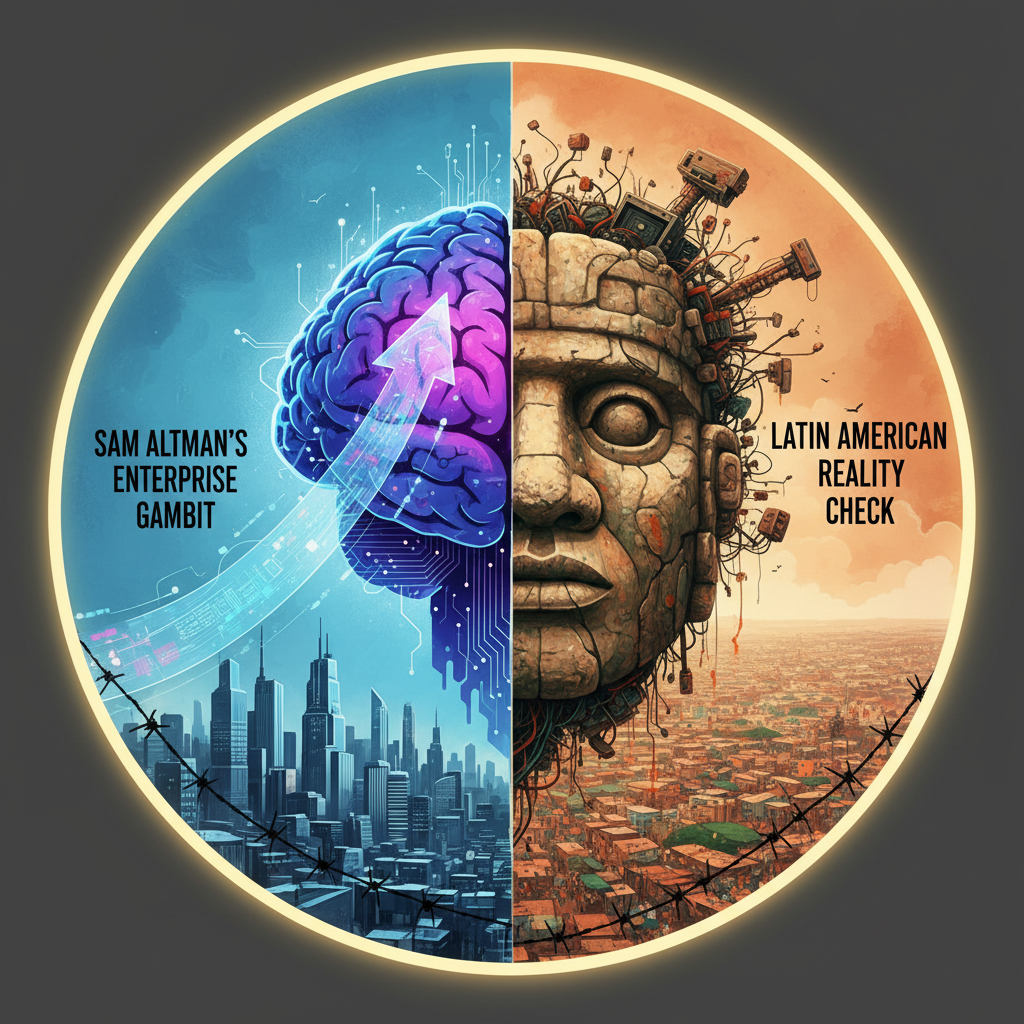
My conviction is this: while the technological advancements are undeniable, the current trajectory of enterprise AI, spearheaded by giants like OpenAI, risks widening the chasm between the global north and south, between the tech-rich and the tech-poor. This is not just about adopting new tools; it is about who benefits, whose data is prioritized, and whose cultural nuances are understood. La tecnología es para todos, but sometimes it feels like it is only for those who can afford the premium subscription and have the infrastructure to support it.
Let us be clear. OpenAI, under the leadership of Sam Altman, has done something truly remarkable with large language models. ChatGPT, in its various iterations, has captivated the world. Now, with ChatGPT Enterprise, they are offering a more secure, scalable, and powerful version tailored for businesses. The pitch is compelling: enhanced data privacy, faster performance, and advanced analytics for large organizations. We hear stories of companies streamlining customer service, automating report generation, and even accelerating product development. For a multinational corporation with deep pockets and a global footprint, this sounds like a dream come true, a path to unprecedented productivity gains.
Consider the case of a major financial institution in New York, for example. They can deploy ChatGPT Enterprise to analyze market trends, draft complex legal documents, or personalize client communications at lightning speed. "Our legal team has seen a 40 percent reduction in time spent on initial document review since implementing ChatGPT Enterprise," commented Elena Vargas, Chief Legal Officer at Global Capital Group, in a recent industry briefing. "The efficiency gains are simply staggering, allowing our experts to focus on higher-value strategic work." This is a powerful testament to the tool's capability.
However, my concern is not with the technology itself, but with its implementation and accessibility. When I look at the landscape here in Mexico, or across Latin America, I see a different reality. Many small and medium-sized enterprises, the backbone of our economies, struggle with basic digital infrastructure. How can we expect them to integrate sophisticated enterprise AI solutions when reliable internet access remains a luxury in many regions, or when the cost of licensing these advanced models is prohibitive? The narrative of universal efficiency often overlooks these fundamental disparities.
Some might argue that this is simply the natural progression of technology, that early adoption always favors those with resources, and that eventually, these tools will trickle down. They might say that the benefits are so great that companies must adapt or be left behind. "The market will dictate adoption," says Dr. Ricardo Morales, an economist specializing in technology diffusion at the Universidad Nacional Autónoma de México. "Companies that embrace these tools will gain a competitive edge, and eventually, the cost will decrease, making them more accessible to smaller players. It is a matter of time." He points to the historical adoption of personal computers or the internet as examples of this trickle-down effect.
But I believe this perspective is overly simplistic and dangerously passive. We cannot afford to wait for a trickle-down effect that might never fully reach the communities that need it most. The digital divide is not just about hardware; it is about knowledge, training, and culturally relevant applications. If ChatGPT Enterprise is trained predominantly on data from English-speaking, Western contexts, how well will it truly understand the nuances of Mexican Spanish, the specific legal frameworks of Colombia, or the unique consumer behaviors in Argentina? Will it perpetuate biases embedded in its training data, biases that could disadvantage Latin American businesses or misinterpret our cultural expressions?
This affects every family in Latin America, whether they realize it or not. If our local businesses cannot compete on an equal footing due to a lack of access to these powerful tools, it impacts job creation, economic growth, and ultimately, the quality of life for our people. We risk becoming mere consumers of technology rather than active participants and innovators. Mexico's AI story is not being told, until now, and it is a story that demands more than just passive consumption.
We need to see a proactive effort from companies like OpenAI to ensure their enterprise solutions are not just powerful, but also equitable and inclusive. This means more than just offering a Spanish language option; it means investing in localized training data, understanding regional business practices, and perhaps even developing tiered pricing models that acknowledge economic realities outside of Silicon Valley. It means forging partnerships with local tech hubs, universities, and governments to build capacity and foster indigenous AI talent.
Consider the work being done by startups like 'Nopal AI' in Guadalajara, which is developing domain-specific language models tailored for Mexican legal and administrative processes. "We cannot rely solely on global models that generalize across cultures," explains Sofia Ramirez, CEO of Nopal AI. "Our goal is to build AI that truly understands the intricacies of our local context, from our legal jargon to our unique cultural expressions. That is where true efficiency and fairness lie." Their approach highlights the need for localized solutions, not just generic enterprise tools.
My call to action is clear: we must demand more from the architects of our AI future. We must push for policies and practices that ensure equitable access, cultural relevance, and ethical deployment of enterprise AI. It is not enough for these tools to be efficient; they must also be just. The promise of AI should be a rising tide that lifts all boats, not just the superyachts of the global elite. Otherwise, we risk creating a future where technological advancement only serves to deepen existing inequalities, a future that is efficient, yes, but profoundly unfair. The future of work, and indeed the future of our societies, depends on us asking these difficult questions now, before the corporate workflows are entirely reshaped beyond our influence. For more insights into the broader implications of AI, readers might find valuable perspectives on MIT Technology Review. The conversation around enterprise AI's impact on global economies is just beginning, and it is crucial that voices from every corner of the world are heard. For context on how other regions are navigating similar challenges, consider reading about Sam Altman's Enterprise Gambit: Is ChatGPT Enterprise a Golden Goose or a Trojan Horse for European Firms? [blocked]. We must ensure that the benefits of this new era of productivity are shared broadly, not hoarded by a select few. The innovation from companies like OpenAI is astounding, but its equitable distribution is the real challenge. For more on the latest in AI business news, you can check Reuters Technology. We must ensure that our unique cultural identities are not lost in the pursuit of universal efficiency. The time for passive observation is over; the time for active participation and advocacy is now.