
The pursuit of Artificial General Intelligence, or AGI, has become the technological equivalent of a modern space race, complete with its own charismatic astronauts and audacious timelines. From the vantage point of Brussels, where policy often moves with the deliberate pace of a well-oiled clockwork, the fervent pronouncements from Silicon Valley regarding imminent AGI breakthroughs often elicit a measured skepticism. Is this truly the dawn of a new era, or merely another cycle of inflated promises designed to attract capital and talent? Brussels has questions and so should you.
The historical echoes of technological overreach are not lost on those of us in Europe. We have witnessed cycles of hype, from the dot com bubble to the blockchain frenzy, where grand visions often outpaced tangible utility. The current AGI narrative, largely championed by figures such as Sam Altman of OpenAI and Dario Amodei of Anthropic, suggests a future where machines possess cognitive abilities akin to or exceeding human intellect across a broad spectrum of tasks. OpenAI, for instance, has openly stated its mission revolves around ensuring AGI benefits all humanity, a noble goal that nonetheless carries an implicit assumption of its eventual arrival. This ambition, however, often overlooks the intricate regulatory and societal frameworks that must evolve concurrently, particularly within a diverse and democratically minded bloc like the European Union.
Consider the historical context. The concept of intelligent machines dates back centuries, but the modern pursuit of AGI gained significant momentum with the advent of deep learning and large language models. In 2012, AlexNet's victory in the ImageNet challenge marked a turning point, demonstrating the power of neural networks. Fast forward to 2023 and 2024, and we see models like GPT-4 and Claude 3 exhibiting astonishing capabilities, from complex reasoning to creative writing. These advancements have fueled the AGI narrative, with some experts predicting its arrival within the next decade. A recent survey conducted by the AI Now Institute suggested that over 60 percent of leading AI researchers believe AGI could be achieved by 2040, a figure that, while speculative, underscores the growing conviction within the field.
However, the path to AGI is fraught with both technical and ethical hurdles. Professor Dr. Isabelle Dubois, a leading computational linguist at KU Leuven, articulates a common European concern. “While the progress in large language models is undeniable, conflating advanced pattern recognition with genuine general intelligence is a conceptual leap that lacks empirical validation,” she states. “The current models excel at what they are trained on, yet they fundamentally lack common sense reasoning, true understanding, and the ability to learn efficiently from limited data, hallmarks of human cognition. To claim AGI is around the corner based on current performance is, frankly, premature and potentially misleading.” Her perspective highlights a critical distinction often blurred in the fervor of Silicon Valley announcements.
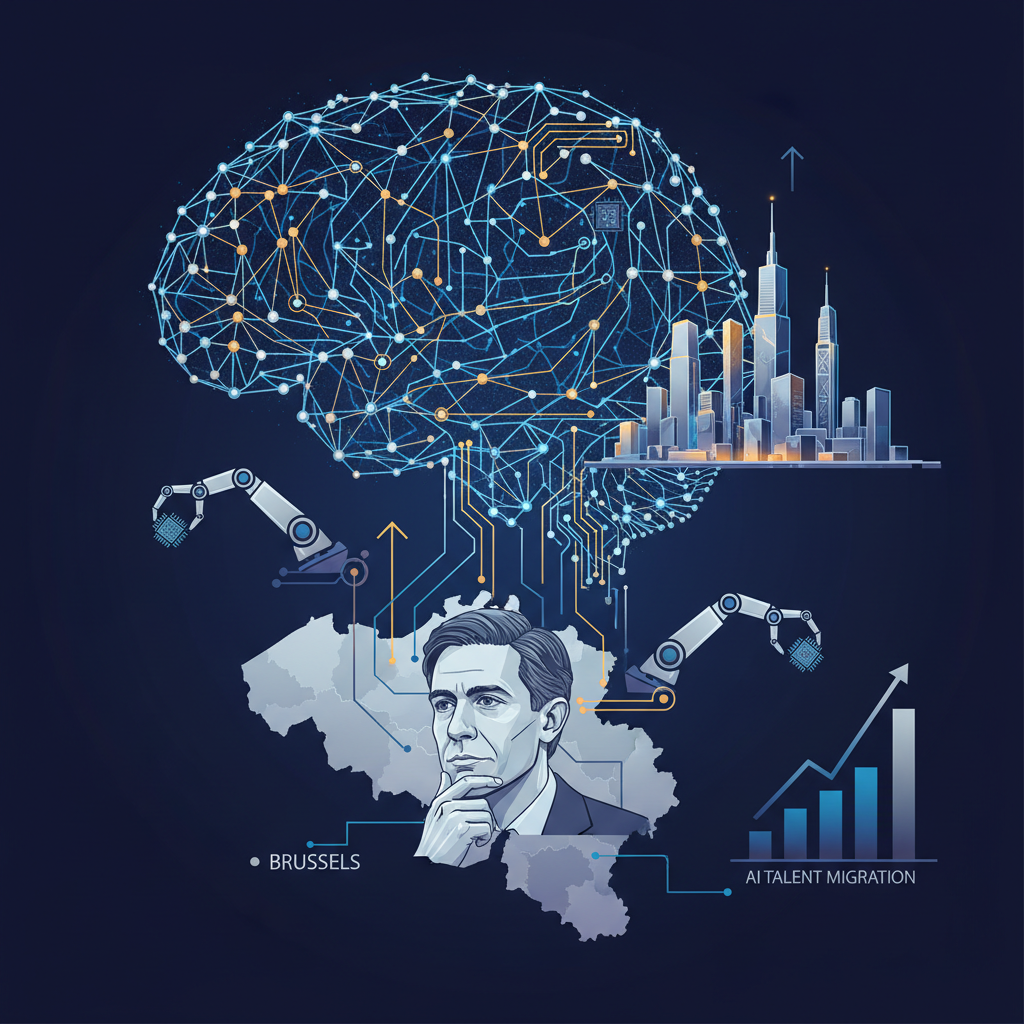
The economic implications for a region like Belgium are also profound. If AGI truly materializes, the impact on labor markets, education, and national competitiveness would be immense. Will Europe be a consumer or a creator in this new paradigm? Belgian pragmatism meets AI hype, and the result is a cautious approach. “Our talent pool, particularly in areas like machine learning and robotics, is highly sought after globally,” explains Dr. Jan Van der Velde, Director of the Flanders AI Research Programme. “We risk a significant brain drain if our brightest minds are continually lured by the immense resources and speculative promises of American tech giants. We need to foster an environment where groundbreaking AI research can thrive here, with a clear ethical compass, rather than simply reacting to developments elsewhere.” This sentiment resonates deeply within the European research community, which often operates with more constrained budgets compared to their US counterparts.
Indeed, the EU's approach deserves more credit than it gets. While American companies race to build, the European Union has been meticulously crafting the AI Act, a landmark piece of legislation designed to regulate AI systems based on their risk level. This proactive stance, finalized in early 2024, aims to ensure that AI development and deployment within the bloc adhere to fundamental rights and safety standards. “The AI Act is not merely a regulatory burden, it is an investment in trust,” asserts Ms. Helena Vandenberghe, a senior policy advisor at the European Commission’s Directorate General for Communications Networks, Content and Technology. “By establishing clear guardrails now, we aim to prevent the societal dislocations and ethical quandaries that a rushed, unregulated AGI race could unleash. We are building a framework for responsible innovation, not stifling progress.” This legislative foresight, while sometimes criticized for its perceived slowness, offers a crucial counterpoint to the 'move fast and break things' ethos prevalent in other tech hubs.
The question of 'who gets there first' is also intrinsically linked to geopolitical power dynamics. The nation or bloc that achieves AGI could gain an unprecedented advantage in economic, scientific, and even military domains. This realization has spurred significant national investments, from the United States' renewed focus on AI research to China's ambitious AI development plans. For Belgium, a small but highly interconnected nation at the heart of Europe, this global race necessitates a collaborative European strategy. We cannot compete on raw capital alone, but we can lead on ethical governance, specialized applications, and the integration of AI into complex, multilingual environments. The linguistic diversity of Belgium, with its Dutch, French, and German speaking communities, presents a unique challenge and opportunity for multilingual AI development, an area where European expertise could truly shine.
My verdict, after sifting through the bold proclamations and the cautious analyses, remains one of measured skepticism. While the advancements in AI are undeniably impressive, the leap to AGI, as colloquially understood, still appears to be a distant horizon, not an imminent reality. The current 'race' is perhaps better characterized as a sprint in specialized AI capabilities, often conflated with a marathon towards general intelligence. The danger lies not in the pursuit itself, but in the uncritical acceptance of hype, which can divert resources, misinform public discourse, and create unrealistic expectations. We must distinguish between genuine progress and marketing rhetoric. The real challenge for Europe, and for Belgium, is not to win a race defined by others, but to shape the future of AI in a way that aligns with our values of human-centricity, fairness, and democratic oversight. The work being done in Brussels to regulate AI, though less flashy than a new model release, may ultimately prove to be the more enduring and impactful contribution to humanity's technological journey. For more insights into the broader implications of AI policy, readers might find valuable analysis on MIT Technology Review or Reuters' AI section. Furthermore, the ongoing debate around digital sovereignty in Europe, as explored in articles like Meta's Llama Unleashed: Why Europe's Digital Sovereignty Hinges on Open AI, Not Silicon Valley's Walled Gardens [blocked], provides crucial context for understanding Europe's strategic position in this global technological competition. The conversation about AGI is far from over, and its real impact will depend less on who declares victory first, and more on how responsibly and equitably it is developed and deployed.