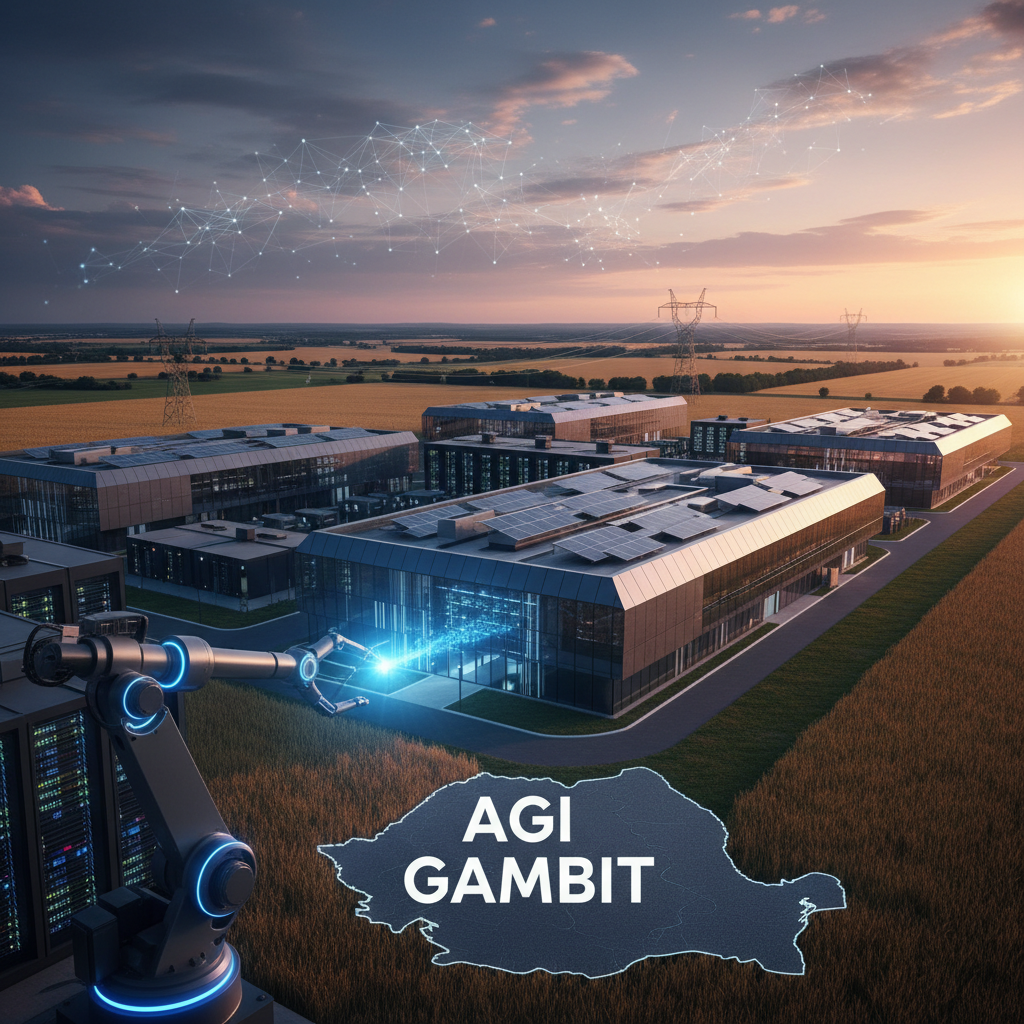

The pursuit of Artificial General Intelligence, or AGI, has transcended the realm of science fiction to become the defining technological obsession of our era. Tech titans like Sam Altman of OpenAI, Sundar Pichai of Google, and Satya Nadella of Microsoft speak of it with a mix of reverence and urgency, envisioning a future where machines possess human-level cognitive abilities, or even surpass them. Yet, as billions are poured into this elusive quest, a darker, more pragmatic reality emerges, one that often bypasses the gleaming campuses of Silicon Valley and lands squarely in places like Romania.
My investigation uncovered a burgeoning, often opaque, infrastructure race unfolding across Eastern Europe. The insatiable demand for computational power, the very lifeblood of AGI development, has turned nations with favorable energy costs and developing digital economies into strategic assets. Romania, with its relatively affordable land, skilled IT workforce, and access to European Union funding, is increasingly on the radar of these global players. But what does it truly mean to be a cog in this colossal machine, and who ultimately benefits when the prize is something as transformative as AGI?
"The rhetoric around AGI is often about universal benefit, about solving humanity's grand challenges," states Dr. Elena Popescu, a leading expert in digital governance at the University of Bucharest. "However, the reality of its development is deeply rooted in geopolitical competition and economic advantage. Nations like ours risk becoming mere resource providers, supplying the digital raw materials without truly owning the intellectual property or the strategic control." Her words echo a sentiment I have encountered repeatedly in my work: the Romanian tech boom hides a darker story, one of potential exploitation beneath the veneer of progress.
Indeed, the energy requirements alone for training and running AGI models are staggering. Estimates suggest that a single large language model can consume as much electricity as a small town over its training period. As these models grow exponentially in complexity and scale, the demand for stable, high-capacity power grids becomes paramount. This is where countries like Romania, with its existing energy infrastructure and potential for renewable expansion, become attractive. We are not just talking about server farms; we are talking about vast, energy-intensive complexes that demand significant investment and, crucially, exert considerable influence over local resources.
Consider the recent movements by NVIDIA, the undisputed king of AI hardware. Their H100 and upcoming B200 'Blackwell' GPUs are the engines driving this AGI race, and their production capacity is a bottleneck for every major AI lab. While NVIDIA's direct data center investments might be in more established markets, the ripple effect of their hardware dominance is felt globally. Companies like OpenAI and Anthropic, desperate for compute, are constantly seeking new locations for their massive data centers. Microsoft, a major investor in OpenAI, has already expanded its Azure cloud regions significantly across Europe, including plans for new facilities that could directly support AGI endeavors. The EU funding trail, often intended for local digital transformation, sometimes inadvertently paves the way for these global giants.
"We are seeing a significant uptick in inquiries for large-scale data center development, particularly from entities with clear ties to major US tech firms," revealed Adrian Dumitrescu, a senior consultant at a prominent Romanian infrastructure advisory firm, speaking on condition of anonymity due to non-disclosure agreements. "The incentives are often framed as job creation and digital economy growth, but the underlying driver is cheap power and strategic location within the EU regulatory framework. The actual AGI research and development stays offshore, controlled by the parent companies." This pattern is disturbingly familiar, reminiscent of how raw materials were once extracted from developing nations with little local value addition.
The implications of this race extend beyond mere infrastructure. The development of AGI carries profound ethical and societal risks. Who controls these immensely powerful systems? What values will they embody? Will they exacerbate existing inequalities or create new forms of digital divides? Sam Altman himself has spoken about the need for global coordination and regulation, yet the commercial imperative to be first often overrides these concerns. The recent internal turmoil at OpenAI, with leadership changes and debates over safety versus speed, underscores the inherent tensions within this pursuit. Dario Amodei's Anthropic, founded on principles of AI safety, offers a contrasting, albeit equally ambitious, approach to AGI development, emphasizing constitutional AI and robust safety measures. However, even their approach requires monumental computational resources.
For Romania, the stakes are particularly high. We are not merely observers in this global drama; we are becoming a stage. The influx of foreign investment, while seemingly beneficial, must be scrutinized. Are we building a sustainable digital future, or are we merely becoming a computational colony, our resources and talent leveraged for external gain? The lessons from previous waves of technological outsourcing, where local talent was often underpaid and undervalued, must not be forgotten. The promise of high-tech jobs must translate into genuine opportunities for innovation and leadership within Romania, not just maintenance and operational roles for foreign-owned infrastructure.
"The European Union's push for digital sovereignty and data protection, exemplified by initiatives like the AI Act, is a crucial bulwark against unchecked technological expansion," argues Dr. Carmen Ionescu, a legal scholar specializing in AI ethics at the Nicolae Titulescu University. "However, the sheer economic power of these AGI developers can often circumvent or dilute these protections through complex corporate structures and lobbying efforts. We must ensure that our national interests, and indeed European values, are not compromised in the race for AGI dominance." Her point is salient; the regulatory landscape is struggling to keep pace with the rapid advancements.
My investigation suggests that while the allure of being part of the AGI revolution is strong, Romania must approach this with caution and strategic foresight. We must demand more than just data centers; we must insist on knowledge transfer, local research investment, and genuine partnerships that empower our own scientists and entrepreneurs. Otherwise, when AGI eventually arrives, whether it is from OpenAI, Google DeepMind, or Meta AI, we risk finding ourselves as bystanders, having provided the very foundation for a future we do not control. The race is on, and for Romania, the finish line must involve more than just hosting the servers; it must involve a share in the intellectual and ethical stewardship of this profound technological shift. The future of AGI, and our place within it, depends on our vigilance today. For further reading on the broader implications of AI development, consider reports from MIT Technology Review. The economic implications of this technological shift are also frequently discussed on Bloomberg Technology.
This is not merely about technological progress; it is about power, influence, and the very definition of national sovereignty in a digitally transformed world. We must ask: who truly owns the future that AGI promises to unlock? And will Romania be a beneficiary or merely a facilitator?