
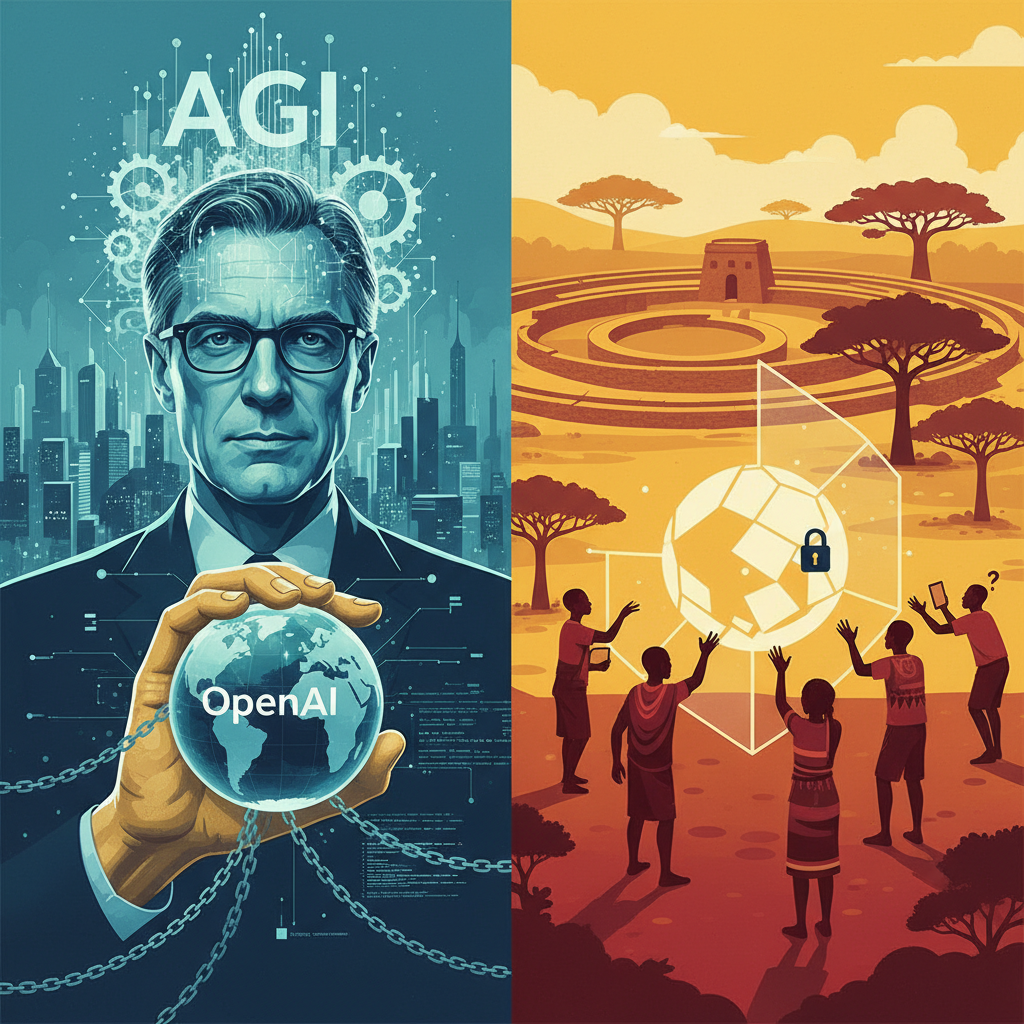

Let's be honest, when Sam Altman talks about Artificial General Intelligence, it sounds like he's painting a picture of a golden age, a future where humanity is uplifted, where problems melt away under the benevolent gaze of super-smart machines. It's a beautiful vision, a compelling narrative that has captivated investors and innovators alike. But from where I sit, here in Harare, watching the sun rise over the kopjes, I can't help but wonder: whose humanity is he talking about, exactly? And who gets to decide what 'benevolent' truly means when the keys to this powerful future are held by such a tightly knit group?
OpenAI, the company Altman leads, is a fascinating beast. It started as a non-profit, remember? A grand experiment to ensure AGI benefits all of humanity, not just corporate shareholders. A noble goal, one might say, like a communal granary designed to feed an entire village. But then, things got complicated. The costs of building these colossal models, the insatiable hunger for computing power, it all led to the creation of a 'capped-profit' entity, a hybrid structure that has left many, including myself, scratching their heads and raising an eyebrow or two. It's like the granary suddenly started charging exorbitant prices for its maize, with the profits going to a few select elders, while still claiming to serve the whole village.
Now, I'm not naive. I understand that innovation, especially at this scale, requires serious capital. Billions of dollars have poured into OpenAI, much of it from Microsoft, a company that clearly sees AGI as the next frontier in its global dominance. This investment has propelled OpenAI to the forefront of the AI race, giving us GPT-4 and the promise of even more powerful models to come. But this pivot, this intricate dance between non-profit ideals and profit-driven realities, has created a governance structure that feels, to put it mildly, opaque. It's a structure that gives immense power to a very small group of individuals, ostensibly to safeguard AGI for humanity, but also to steer a multi-billion dollar enterprise.
My concern, and it's a deep one, isn't just about the money. It's about control, about representation, and ultimately, about the soul of this technology. When you have a handful of people making decisions that could fundamentally reshape society, decisions about what AGI will be, what it will prioritize, and how it will be deployed, it demands scrutiny. The infamous boardroom drama of late 2023, where Altman was briefly ousted and then reinstated, laid bare the fragility and the inherent contradictions of OpenAI's setup. It showed us that even within this supposedly altruistic framework, power struggles are real, and the future of AGI can hang by a thread, dependent on the whims of a few board members.
As Professor Mthuli Ncube, a former Zimbabwean Minister of Finance and a keen observer of global technological trends, once said,