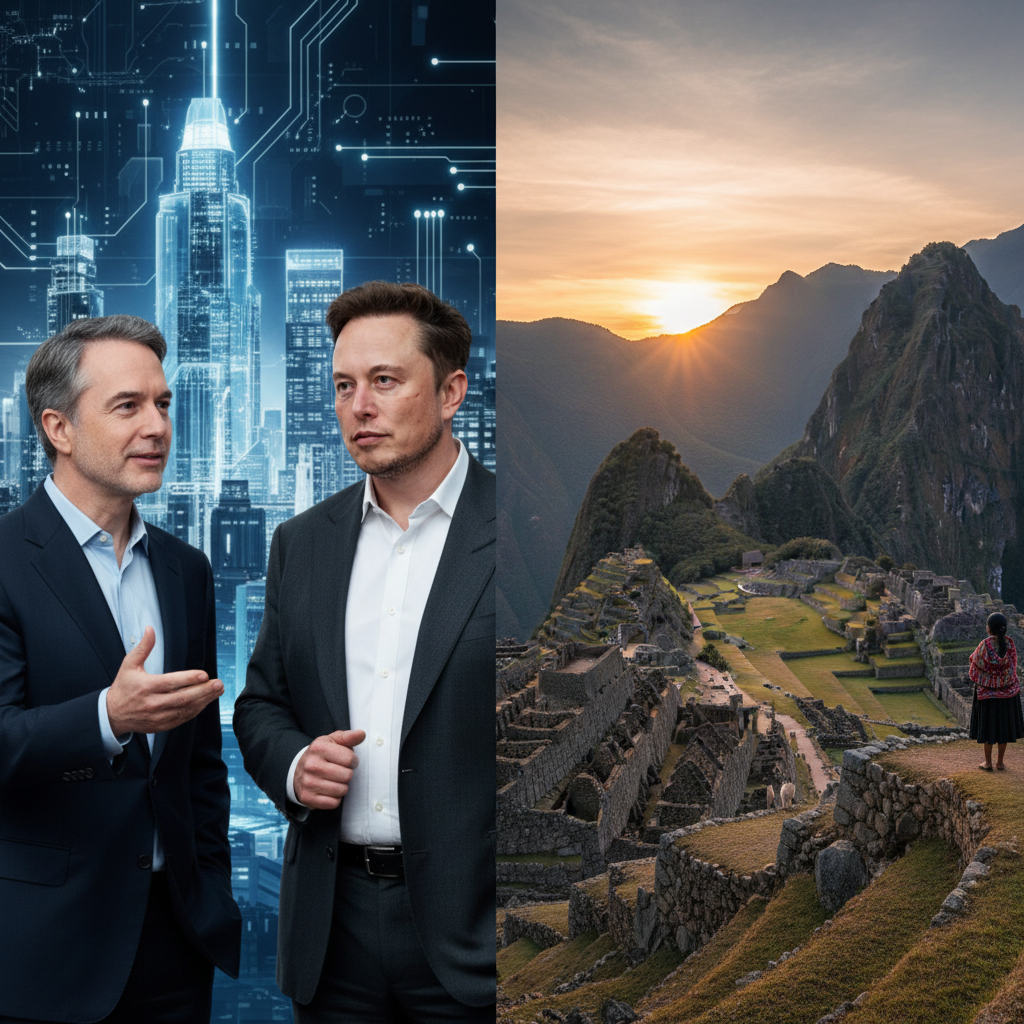
The news arrived in my inbox like a digital tremor, a headline about a legal battle between OpenAI and Elon Musk. At first glance, it felt like another one of those distant Silicon Valley sagas, far removed from the bustling markets of Lima or the quiet majesty of the Sacred Valley. Yet, as I delved deeper, I realized this wasn't just a squabble between tech titans. This is a story about ancient wisdom meeting modern AI, a fundamental disagreement over the very soul of artificial intelligence, and its implications reach far beyond the boardrooms of California, touching the lives of people even in the highlands of Peru.
The Headline Development: A Clash Over AI's Purpose
What precisely happened, you ask? Elon Musk, a co-founder of OpenAI, is suing the company and its CEO, Sam Altman. His core argument is that OpenAI has strayed from its original mission: to develop artificial general intelligence, AGI, for the benefit of humanity, not for profit. He claims that under Altman's leadership, OpenAI has become a for-profit entity, driven by commercial interests and a partnership with Microsoft, rather than its founding non-profit ethos. OpenAI, for its part, has publicly refuted these claims, asserting that its mission remains unchanged and that its commercial structure is a necessary means to achieve its ambitious goals, which require immense financial resources.
This isn't just about money or corporate structure; it's about philosophy. It's about whether the most powerful technology ever created should be a communal good, guided by ethical principles, or a proprietary product, shaped by market forces. The stakes are monumental, determining who controls the future of intelligence itself.
Why Most People Are Ignoring It: The Attention Gap
I understand why many people, especially here in Peru, might not be following this closely. Life here moves to a different rhythm. We are concerned with the price of potatoes in the market, the changing patterns of rain in the Andes, the struggle for better education in our rural communities. Abstract legal battles in a distant land, involving concepts like 'artificial general intelligence' and 'fiduciary duty,' can feel incredibly remote. The daily grind, the vibrant culture, the immediate challenges of development and environmental protection, these are what capture our attention. Furthermore, the language of AI can be intimidating, filled with jargon that obscures its real-world impact. It is easy to dismiss it as a problem for the tech elite, not for the everyday citizen.
But this is precisely why we must pay attention. The decisions made in these courtrooms and boardrooms will ripple across the globe, influencing everything from our jobs to our cultural heritage.
How It Affects YOU: Personal Impact on Readers
Imagine a future where the algorithms that determine your loan eligibility, your access to healthcare, or even the news you see, are shaped by an AI whose core purpose is profit maximization, not human well-being. This is not a distant fantasy. Today, AI models from companies like Google and OpenAI are already influencing these aspects of our lives. If the foundational principles of these powerful systems are compromised, it affects every single one of us.
Consider the agricultural sector, so vital to Peru. We are already seeing the promise of AI in helping farmers predict weather patterns, optimize irrigation, and detect crop diseases. But what if the best AI tools are locked behind exorbitant paywalls, or designed to benefit large corporations over small, indigenous farming communities? What if the data collected from our ancestral lands, used to train these models, becomes a proprietary asset rather than a shared resource for sustainable development? This is a direct impact on our food security, our economy, and our way of life.
For students, for workers, for artists, the implications are equally profound. Will AI be a tool that empowers us to create, to learn, to innovate, or will it be a force that centralizes power, automates away jobs without providing alternatives, and homogenizes culture? The answer hinges on the ethical framework guiding its development.
The Bigger Picture: Societal, Economic, or Political Implications
This legal battle highlights a fundamental tension at the heart of AI development: the conflict between open, collaborative research for public good and proprietary, profit-driven innovation. If AI development becomes solely the domain of a few powerful corporations, the risks are immense. We could see a future where AI exacerbates existing inequalities, where algorithms perpetuate biases, and where the benefits of this transformative technology are concentrated in the hands of a few.
Economically, the control over advanced AI could lead to unprecedented monopolies, stifling competition and innovation in smaller economies like Peru. Politically, the ability to wield such powerful tools could grant undue influence to those who control them, potentially impacting democratic processes and national sovereignty. The very definition of progress, and who benefits from it, is at stake.
As Dr. Elena Quispe, a leading researcher in AI ethics at the Pontificia Universidad Católica del Perú, explained to me,