
The CRM industry, for all its talk of relationships and customer journeys, has always been a bit like a fishing trawler in the North Atlantic: lots of data, lots of effort, but sometimes you just pull up an empty net. For years, companies have been drowning in customer information, struggling to turn it into anything truly actionable. Then came AI, and suddenly, the nets got smarter. Salesforce Einstein AI, in particular, has been at the forefront of this transformation, promising to turn raw data into predictive insights and automated workflows. But what many don't realize is the unseen infrastructure making this possible, and how a small nation like Iceland is playing a surprisingly significant role.
The Technical Challenge: From Data Lakes to Predictive Oceans
The core problem Einstein AI tackles is the sheer volume and complexity of customer data. Traditional CRM systems are excellent at storage and retrieval, but they struggle with proactive intelligence. Sales teams need to know which leads are hot, service agents need instant access to relevant solutions, and marketing departments want to personalize campaigns at scale. This isn't just about dashboards; it's about predicting future behavior, identifying patterns, and automating responses, all in real time.
Consider a typical enterprise with millions of customer interactions: emails, calls, website visits, social media posts, purchase history. Extracting value from this unstructured and structured chaos requires sophisticated machine learning. The challenge lies in building models that are accurate, scalable, and explainable, especially when dealing with sensitive customer data. Furthermore, these models need to be continuously updated and retrained as customer behavior and market conditions evolve. It's a massive computational undertaking, demanding significant processing power and, crucially, efficient cooling.
Architecture Overview: Einstein's Brain in the Cloud
Salesforce Einstein isn't a single product; it's a suite of AI capabilities embedded across the entire Salesforce platform. Its architecture is distributed, cloud-native, and leverages a combination of proprietary and open-source technologies. At its heart, Einstein relies on a multi-tenant architecture, processing data from countless customers while maintaining strict data isolation and security. The core components include:
- Data Ingestion and Harmonization: This layer pulls data from various Salesforce clouds (Sales Cloud, Service Cloud, Marketing Cloud, Commerce Cloud) and external sources, then cleanses, transforms, and unifies it into a consistent format. This often involves data lakes built on technologies like Apache Hadoop or Spark.
- Feature Engineering: Raw data is converted into features that machine learning models can understand. This is where domain expertise meets data science, creating variables like 'customer lifetime value,' 'propensity to churn,' or 'next best action.'
- Model Training and Management: This is the heavy lifting. Einstein uses various machine learning frameworks, including TensorFlow and PyTorch, to train models. These models range from classic supervised learning algorithms for classification and regression to more advanced deep learning models for natural language processing (NLP) and computer vision. Model lifecycle management, including versioning, deployment, and monitoring, is critical here.
- Inference Engine: Once trained, models are deployed to a high-performance inference engine that can make predictions in real time, directly within the Salesforce UI or via APIs.
- Explainability and Trust Layer: Given the ethical implications of AI in CRM, Einstein incorporates tools for model explainability (e.g., Lime, Shap) and bias detection, aiming to provide transparency and build trust with users.
Key Algorithms and Approaches
Einstein employs a diverse set of algorithms, tailored to specific CRM use cases:
- Predictive Lead Scoring: Often uses gradient boosting machines (like XGBoost or LightGBM) or logistic regression to predict the likelihood of a lead converting. Features might include company size, industry, engagement history, and demographic data. The model learns from historical conversions to assign a score.
- Next Best Action Recommendations: Reinforcement learning or collaborative filtering algorithms are common here. For instance, a model might suggest the next best article for a service agent to share, based on the customer's query and past interactions, or recommend a product to a sales rep based on purchase history and similar customer profiles.
- Natural Language Processing (NLP): For sentiment analysis of customer interactions, case routing, or summarization of service tickets, deep learning models like Bert or GPT-style transformers are used. These models are pre-trained on vast text corpora and then fine-tuned on specific CRM datasets. For example, a service ticket might be automatically classified as 'billing issue' or 'technical support' based on the text content.
# Conceptual Pseudocode for Predictive Lead Scoring (Simplified)

def train_lead_score_model(historical_leads, features):
 # features could include: industry, employee_count, website_visits, email_opens, last_activity_days
 # target variable: 'converted' (boolean)

# Preprocess data: handle missing values, encode categorical features
 processed_features = preprocess(features)

# Split data into training and validation sets
 X_train, X_val, y_train, y_val = split_data(processed_features, historical_leads['converted'])

# Initialize a Gradient Boosting Classifier (e.g., LightGBM)
 model = LightGBMClassifier(n_estimators=100, learning_rate=0.1, max_depth=5)

# Train the model
 model.fit(X_train, y_train)

# Evaluate model performance (e.g., AUC, precision, recall)
 predictions = model.predict_proba(X_val)[:, 1]
 evaluate_model(y_val, predictions)

return model

def predict_lead_score(model, new_lead_data):
 processed_new_lead = preprocess(new_lead_data)
 score = model.predict_proba(processed_new_lead)[:, 1] # Probability of conversion
 return score
# Conceptual Pseudocode for Predictive Lead Scoring (Simplified)

def train_lead_score_model(historical_leads, features):
 # features could include: industry, employee_count, website_visits, email_opens, last_activity_days
 # target variable: 'converted' (boolean)

# Preprocess data: handle missing values, encode categorical features
 processed_features = preprocess(features)

# Split data into training and validation sets
 X_train, X_val, y_train, y_val = split_data(processed_features, historical_leads['converted'])

# Initialize a Gradient Boosting Classifier (e.g., LightGBM)
 model = LightGBMClassifier(n_estimators=100, learning_rate=0.1, max_depth=5)

# Train the model
 model.fit(X_train, y_train)

# Evaluate model performance (e.g., AUC, precision, recall)
 predictions = model.predict_proba(X_val)[:, 1]
 evaluate_model(y_val, predictions)

return model

def predict_lead_score(model, new_lead_data):
 processed_new_lead = preprocess(new_lead_data)
 score = model.predict_proba(processed_new_lead)[:, 1] # Probability of conversion
 return score
Implementation Considerations: The Icelandic Advantage
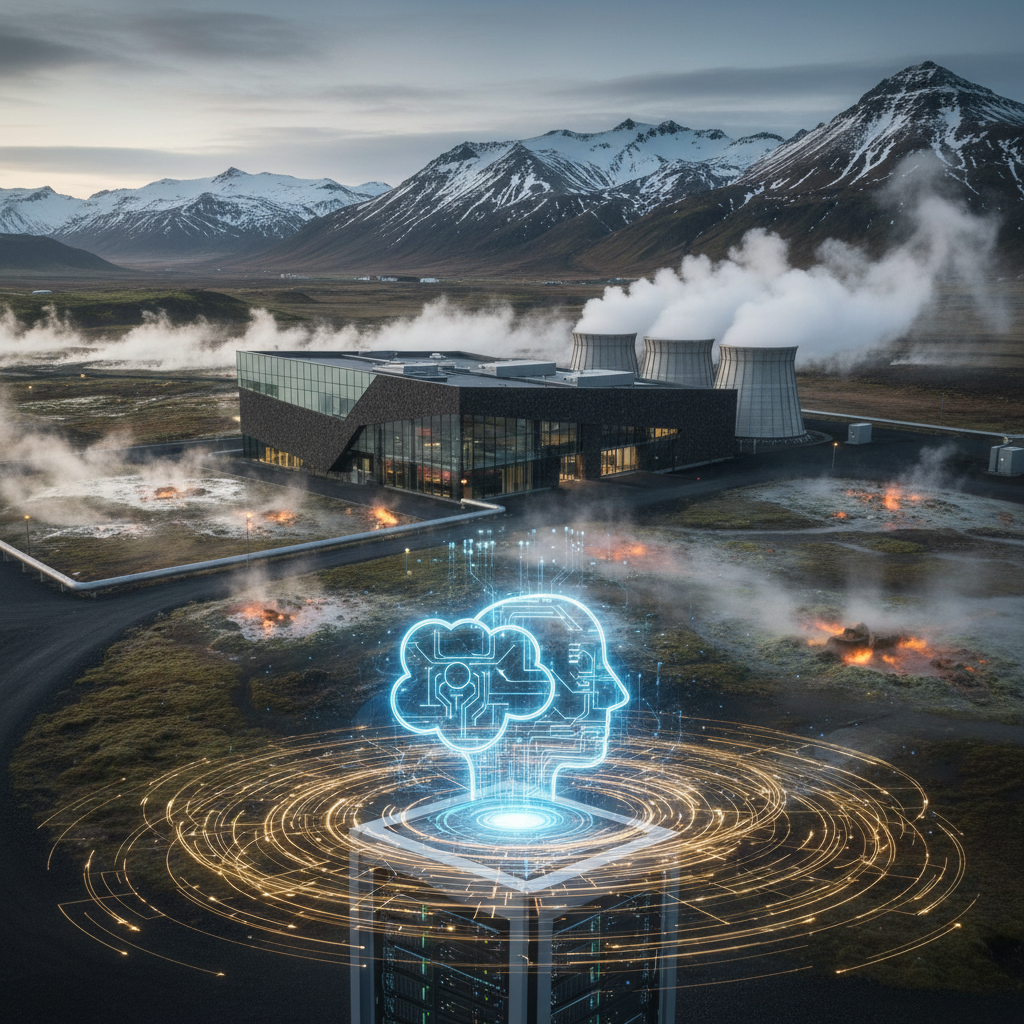
Deploying and maintaining these AI systems at scale presents significant challenges. Compute resources are paramount, and so is energy. This is where Iceland comes into the picture. Our country, with its abundant geothermal and hydroelectric power, offers some of the lowest electricity prices in Europe, coupled with a naturally cool climate perfect for data center operations. This isn't just about cost; it's about sustainability. Running massive AI training jobs on renewable energy significantly reduces the carbon footprint.
Several major data center operators, like Verne Global, have established significant presences here, attracting companies that need high-performance computing with a green conscience. While Salesforce operates its own global infrastructure, the trend towards leveraging regions like Iceland for specific, compute-intensive AI workloads is undeniable. In Iceland, we think differently about this. We see our natural resources not just as a source of power for our homes, but as a strategic asset for the global digital economy. The geothermal approach to computing means less reliance on fossil fuels and lower operational costs for cooling, which can be a substantial portion of a data center's energy budget.
Benchmarks and Comparisons: Einstein's Place in the Cosmos
Compared to bespoke AI solutions or other CRM AI offerings, Einstein's strength lies in its tight integration with the Salesforce platform. This means less data movement, fewer integration headaches, and a unified user experience. While a data science team could build a custom lead scoring model, Einstein provides out-of-the-box capabilities that are continuously improved by Salesforce's own researchers. For instance, Einstein's sentiment analysis models are trained on vast amounts of CRM-specific text, giving them an edge over generic NLP models for business contexts. Salesforce has reported that customers using Einstein for sales forecasting have seen improvements in forecast accuracy by up to 20%, and service agents have reduced average handling time by 15% using Einstein Bots and Next Best Action recommendations.
Competitors like Microsoft Dynamics 365 with its AI capabilities, or SAP's C/4hana with integrated machine learning, offer similar functionalities. The differentiator often comes down to the depth of integration, ease of use for non-data scientists, and the underlying data governance framework. Salesforce's massive ecosystem and AppExchange also contribute to Einstein's broad applicability.
Code-Level Insights: Democratizing AI
For developers, Einstein offers various avenues. The Einstein Platform Services provide APIs for pre-built AI capabilities like Vision and Language, allowing developers to embed AI into custom applications without deep ML expertise. For more advanced use cases, the Einstein Discovery product allows business analysts to build predictive models using a guided interface, abstracting away much of the underlying complexity. For data scientists, the ability to bring your own models (byom) and integrate them with Salesforce data via platforms like Mulesoft or direct API calls is crucial. The focus is on democratizing AI, making it accessible to a wider range of users, not just the elite few with PhDs in machine learning.
Real-World Use Cases: Where the Rubber Meets the Road
- Automated Case Classification and Routing: A major telecommunications company uses Einstein to analyze incoming customer service emails and chats, automatically classifying them by topic and sentiment, then routing them to the most appropriate agent or even resolving simple queries with an Einstein Bot. This has reportedly reduced manual triage time by 30%.
- Personalized Product Recommendations: An e-commerce retailer leverages Einstein to analyze browsing history, purchase patterns, and demographic data to provide highly personalized product recommendations on their website and in marketing emails, leading to a reported 10-15% increase in conversion rates for recommended items.
- Sales Forecasting and Pipeline Management: A global software vendor employs Einstein Forecasting to predict quarterly revenue with greater accuracy, identifying at-risk deals and suggesting actions for sales managers to improve pipeline health. This has led to more reliable resource allocation and strategic planning.
- Proactive Customer Retention: A subscription-based service uses Einstein to predict customer churn risk based on usage patterns, support interactions, and billing history. This allows their customer success team to proactively reach out to at-risk customers with targeted offers or support, reducing churn by a reported 5-7% annually.
Gotchas and Pitfalls: Not All Sunshine and Geothermal Steam
While powerful, Einstein AI isn't a magic bullet. Data quality remains paramount; 'garbage in, garbage out' is still the golden rule. If your CRM data is incomplete, inconsistent, or biased, Einstein's predictions will suffer. Model bias is another significant concern. If historical sales data disproportionately favors certain demographics, the AI might perpetuate those biases, leading to unfair or ineffective outcomes. Continuous monitoring and retraining are essential to mitigate model drift and maintain accuracy. Furthermore, the cost of extensive AI usage, while potentially offset by efficiency gains, can be substantial, especially for smaller organizations. Small nations have big advantages in AI when it comes to infrastructure, but even here, the computational demands are real.
Resources for Going Deeper
For those looking to delve further, Salesforce's own Trailhead platform offers extensive learning modules on Einstein. For a more technical perspective on the underlying machine learning, academic papers on large-scale distributed training and NLP models are invaluable. You can find many relevant papers on arXiv. For broader industry trends and technical analysis, I often consult publications like MIT Technology Review and Ars Technica.
The transformation of the CRM industry by AI, spearheaded by platforms like Salesforce Einstein, is more than just a technological upgrade; it's a fundamental shift in how businesses understand and interact with their customers. And as we continue to push the boundaries of what AI can do, the demand for sustainable, efficient computing will only grow, making places like Iceland increasingly vital to the global AI ecosystem.