
I have always believed that technology, at its core, is a tool for transformation. Here in Colombia, a nation still healing from decades of conflict, we understand the profound weight of history and the desperate need for solutions that build bridges, not walls. When I look at the incredible advancements happening in artificial intelligence, my mind always turns to how these innovations can serve our people, how they can bring justice and equity to communities that have long been overlooked.
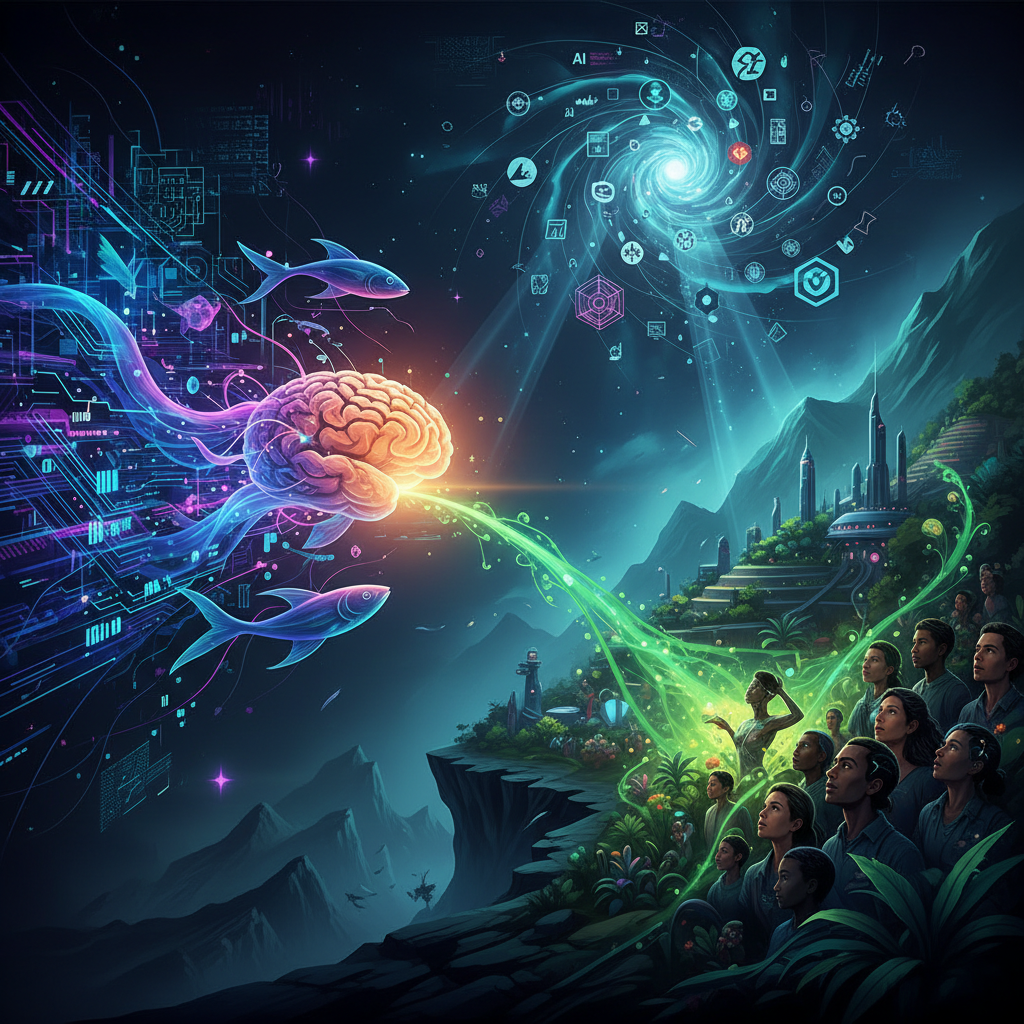
That is why the work of Sakana AI, a Tokyo-based startup, has captured my imagination so completely. They are not just building better algorithms, they are fundamentally rethinking how AI learns and evolves. Instead of the traditional, resource-intensive methods of training massive models, Sakana AI is using principles inspired by nature, by evolution itself, to 'breed' more efficient, more adaptable, and potentially more nuanced AI. They are creating AI models that can self-organize and specialize, much like biological organisms adapt to their environments. This is about more than technology because it's about justice, about finding smarter, more sustainable ways to build a better future.
A Vision for Colombia: Healing and Growth Through Evolutionary AI
Let us fast forward five to ten years. Imagine Colombia, not just as a land of breathtaking beauty and resilient people, but as a global leader in applying evolutionary AI for social good. Sakana AI's approach allows for the creation of smaller, highly specialized AI models that require less computational power and data. This is a game-changer for regions like ours, where access to massive data centers and endless computing resources is often a luxury.
Consider our rural communities, many still grappling with the aftermath of conflict. Today, identifying unexploded ordnance, mapping safe agricultural zones, or even tracking environmental degradation in remote areas is a monumental task. With Sakana AI's evolutionary models, we could deploy specialized, lightweight AI agents on drones or even mobile devices. These agents, having 'evolved' to recognize specific patterns of land use, soil composition, or even the subtle signatures of hidden dangers, could provide real-time, localized intelligence. Think of AI models that, through a process of simulated natural selection, become incredibly adept at distinguishing between natural foliage and camouflaged explosive devices, all while operating on limited power in challenging terrain. This is not science fiction, it is the logical extension of Sakana AI's current trajectory.
Furthermore, consider the immense challenge of preserving our cultural heritage and indigenous languages. Colombia is a tapestry of diverse cultures, many of which are under threat. Evolutionary AI could be used to develop highly efficient language models specifically tailored to lesser-resourced languages, not by training on billions of internet texts, but by evolving to understand the unique grammatical structures and nuances of a specific dialect from a much smaller, curated dataset. This could empower communities to digitize their oral histories, create educational tools in their native tongues, and ensure their voices are heard and preserved for generations. As Dr. Yuta Kikuchi, co-founder of Sakana AI, reportedly stated in a recent interview, 'Our goal is not just to build bigger models, but smarter, more specialized ones that can thrive in diverse environments, much like life itself.' This philosophy resonates deeply with the needs of a country like Colombia.
How We Get There: Milestones on the Path to Transformation
The journey to this future will involve several key milestones. First, we will see Sakana AI continue to refine its core evolutionary algorithms. Their initial success in creating models that can self-organize and perform tasks with remarkable efficiency, as reported by TechCrunch, is just the beginning. The next step is to make these 'breeding' processes even more robust and accessible.
Second, we will witness the emergence of specialized AI 'species' for various applications. Instead of one monolithic AI trying to do everything, we will have a diverse ecosystem of highly optimized models. For Colombia, this means collaborations with local universities and research institutions, like the Universidad de los Andes and Ruta N in Medellín, to adapt these evolutionary AI frameworks to our specific challenges. Imagine local startups, perhaps even some emerging from our vibrant tech scene in Bogotá, leveraging Sakana AI's foundational work to create bespoke solutions for agriculture, healthcare, and peacebuilding.
Third, there will be a significant shift in how AI is deployed. We will move away from solely cloud-based, centralized AI to a more distributed, edge-computing paradigm. This is where Sakana AI's efficiency gains truly shine. Smaller, evolved models can run on less powerful hardware, making advanced AI accessible in remote areas without robust internet infrastructure. This digital inclusion is paramount for a country like Colombia, where connectivity remains a challenge in many regions. As María Fernanda Suárez, former Minister of Mines and Energy and a prominent voice in Colombia's tech sector, has often emphasized, 'Digital transformation must reach every corner of our nation, or it is not true transformation.' Evolutionary AI offers a pathway to that true transformation.
Who Wins and Who Loses: A Balancing Act
In this future, the clear winners will be communities and nations that embrace localized, specialized AI solutions. Colombia, with its rich biodiversity and complex social fabric, stands to gain immensely by adopting these adaptable AI frameworks. Small and medium-sized enterprises, particularly those in sectors like sustainable agriculture, eco-tourism, and artisanal production, could use these tailored AIs to optimize processes, reach global markets, and manage resources more effectively. Researchers and conservationists will find powerful new tools to protect our precious Amazon rainforest and other natural wonders.
However, we must also be vigilant. The 'losers' could be those who cling to outdated, centralized AI paradigms, or those who fail to invest in the necessary infrastructure and education to harness these new capabilities. There is a risk that if we do not actively shape this future, the benefits could still be concentrated in urban centers, exacerbating existing inequalities. We must ensure that the 'evolution' of AI is guided by ethical principles and a commitment to broad access. The government, through entities like the Ministry of ICT, must play a proactive role in fostering an ecosystem where these technologies can flourish equitably. MIT Technology Review has often highlighted the importance of inclusive AI development, a principle we must champion here.
What Readers Should Do Now
For those of us watching from Colombia and across Latin America, the time to act is now. We need to foster stronger collaborations between our academic institutions, our burgeoning startup ecosystem, and global innovators like Sakana AI. We must invest in digital literacy and Stem education, empowering our youth to not just consume technology, but to create it and adapt it to our unique needs. We need policies that encourage responsible AI development, ensuring that these powerful tools serve humanity, not control it.
Colombia's AI story deserves to be heard, and it is a story of resilience, innovation, and a deep commitment to a better tomorrow. Sakana AI's evolutionary approach offers a powerful new chapter, one where technology learns from life itself to help us heal, grow, and build a more just and equitable world. Let us seize this opportunity, not with fear, but with the boundless optimism that defines our spirit. Latin America is rising, and with intelligent, adaptable AI, our ascent will be even more profound.