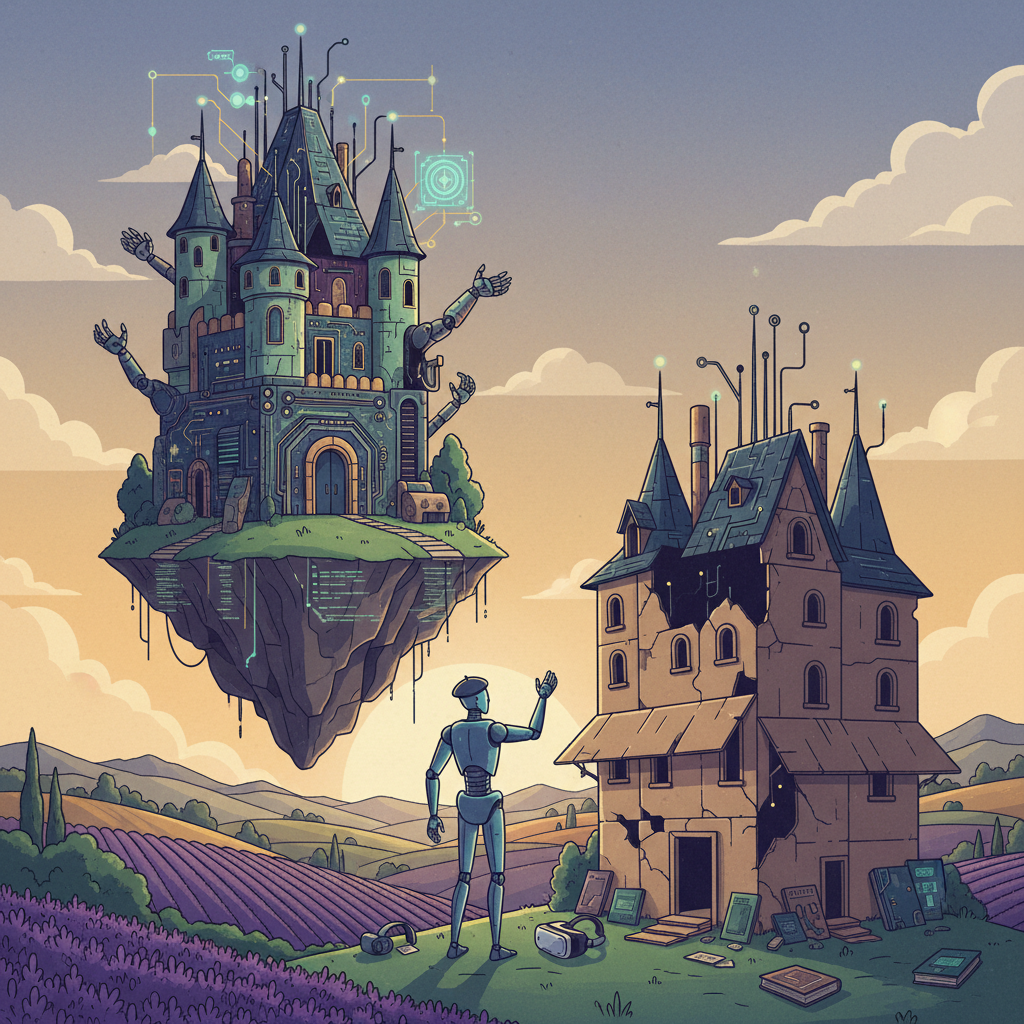

Mon Dieu, the arrogance of Big Tech. Just when we thought we had a moment to breathe, to truly assess the impact of AI on our creative industries, Replit, once a charming coding playground, announces its grand transformation. It is no longer just a place for eager young minds to tinker with Python or JavaScript. Oh no, it is now an 'AI-powered software development platform.' A mouthful, n'est-ce pas? And one that, to my ears, sounds less like progress and more like a subtle, yet insidious, attempt to homogenize the very act of creation.
Let us be clear: Replit, under the guidance of its CEO Amjad Masad, is making a calculated move. They are not merely integrating AI; they are reorienting their entire philosophy around it. Their pitch is seductive: faster development, fewer bugs, democratized coding. Who could argue with such noble goals? Yet, I find myself asking, as I often do when Silicon Valley presents its latest panacea, what are we truly sacrificing at the altar of efficiency? What is lost when the human touch, the nuanced struggle of problem-solving, is outsourced to an algorithm?
This isn't about rejecting technology outright. France says non to Silicon Valley's vision of a purely algorithmic future, not to innovation itself. We embrace tools, yes, but we question their ultimate purpose and impact on human agency. Replit's new direction, with features like Ghostwriter and its deeper integrations with large language models, suggests a future where the developer becomes less of a craftsman and more of a conductor, orchestrating AI to write the symphony. But what if the AI is tone-deaf? What if its compositions lack soul, originality, or the very human imperfections that often lead to groundbreaking solutions?
Consider the numbers. Replit boasts over 20 million users and has raised hundreds of millions of dollars, yet its latest valuation, reportedly around $1.5 billion, hinges heavily on this AI narrative. This is not just about making coding easier; it is about capturing a market, about solidifying a particular vision of software development that prioritizes speed and scale over perhaps, depth and true ingenuity. As Madame Sylvie Dubois, a respected professor of digital ethics at the Sorbonne, recently remarked to me, "The allure of 'AI-powered' often masks a deeper agenda: to reduce complex human tasks to predictable, repeatable processes. We risk turning our developers into mere button-pushers, losing the critical thinking that defines true engineering." Her words echo a sentiment often heard in European tech circles, where the emphasis remains on human skill enhancement, not replacement.
Of course, the proponents of this AI-first approach will argue that it frees developers from mundane tasks, allowing them to focus on higher-level design and creativity. They will point to increased productivity metrics, perhaps a 30% reduction in development time for certain projects, or a 15% decrease in common coding errors. They will say that AI is merely an assistant, a co-pilot, much like Microsoft's Copilot for GitHub. And to some extent, they are not entirely wrong. For boilerplate code, for repetitive tasks, AI can indeed be a boon. But where does the assistance end and the dependence begin? Where is the line between augmentation and atrophy?
My concern, and indeed, the concern of many across Europe, is that this pivot, while seemingly benign, subtly shifts the very definition of what it means to be a developer. It risks creating a generation of coders who are adept at prompting AI, but perhaps less skilled at debugging complex systems from first principles. It fosters a reliance on black-box models, whose inner workings are often opaque, even to their creators. How can we truly innovate, truly push the boundaries of technology, if we do not fully comprehend the foundations upon which we build? The European way is not the American way, and that's the point. We value transparency, understanding, and robust, human-centric design.
Think of it like this: a chef uses tools, yes, the finest knives, the most advanced ovens. But the essence of their art lies in their palate, their intuition, their years of practice, not merely in the efficiency of their equipment. If an AI were to dictate every ingredient, every technique, would the resulting dish truly be a culinary masterpiece, or just a perfectly executed, yet soulless, meal? I suspect the latter. The same applies to code. The elegance, the efficiency, the sheer beauty of a well-crafted algorithm often comes from a human mind grappling with a problem, not from an AI generating the most statistically probable solution.
This is not a Luddite cry against progress. Far from it. It is a demand for thoughtful, human-centered progress. We have seen the dangers of unbridled technological enthusiasm before. The EU AI Act, for all its complexities, is an attempt to inject a dose of reality and responsibility into this headlong rush. We need to ensure that platforms like Replit, as they evolve, do not inadvertently diminish the very skills they claim to empower. We need developers who can still think critically, who can still innovate beyond the suggestions of an algorithm, who can still understand the intricate dance of logic and design. TechCrunch may celebrate every new AI funding round, but we must look beyond the hype.
What Replit is doing is undeniably powerful from a business perspective. It taps into the zeitgeist, promising to solve the developer shortage and accelerate the digital transformation for countless enterprises. But at what cost to the craft? At what cost to the human intellect? We must resist the urge to simply consume whatever Silicon Valley serves up. We must demand more, demand platforms that truly augment human capabilities rather than subtly replacing them. We must insist on tools that empower, not just automate.
Let us not forget the lessons of history. True innovation often springs from the unexpected, from the unconventional, from the very human struggle against perceived limitations. If we let AI dictate every line of code, every design choice, we risk a future where all software begins to look, feel, and function identically, a bland digital monoculture. That, my friends, would be a tragedy far greater than any minor coding inefficiency. We must cultivate a generation of developers who are masters of their craft, not merely proficient users of AI. The future of software, and indeed, of human ingenuity, depends on it. We in Europe, with our rich history of craftsmanship and intellectual rigor, understand this deeply. Wired might focus on the shiny new features, but the deeper implications are what truly matter.
It is time to ask Replit, and indeed all AI-powered development platforms, if they are truly building a better future for developers, or simply building a more efficient factory for code. Are they fostering creativity or merely streamlining production? The distinction, I believe, is everything.