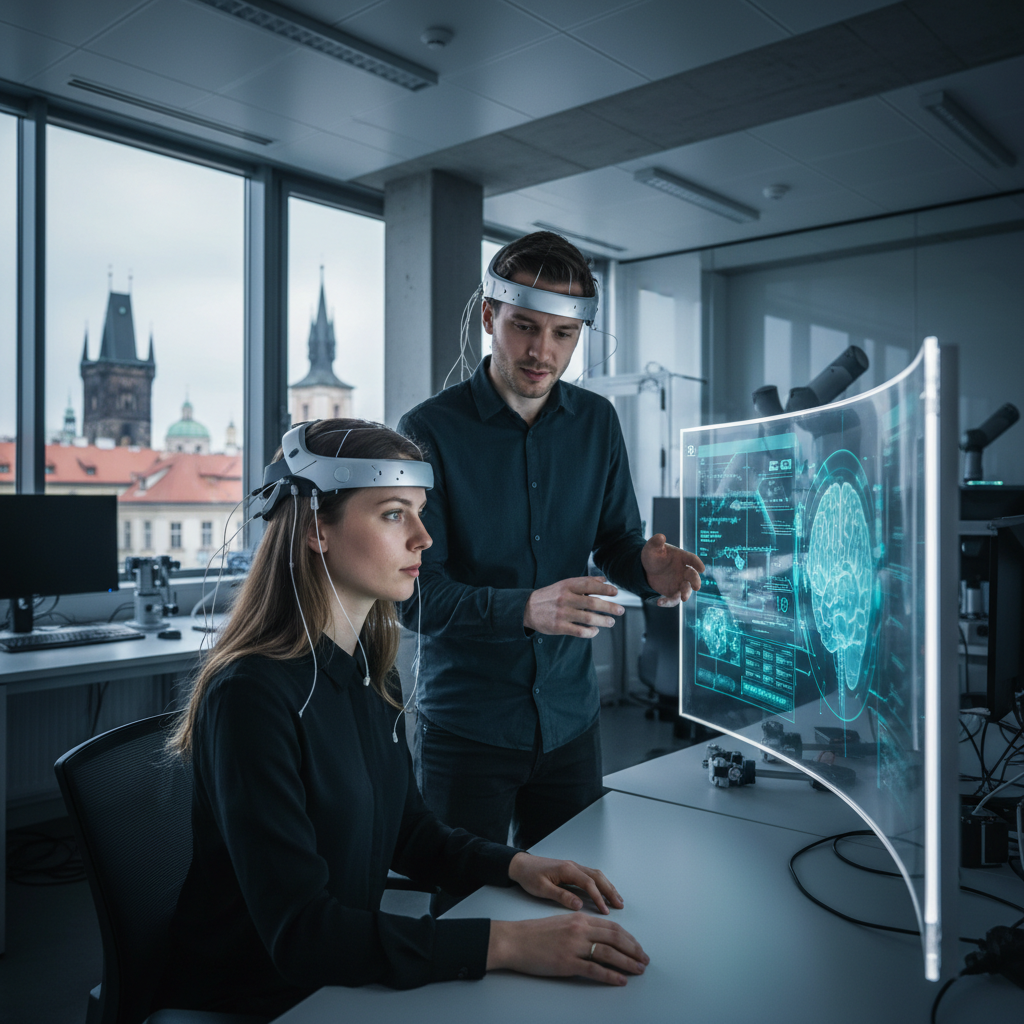

The human brain, that intricate universe nestled within our skulls, has long been the final frontier of scientific exploration. For decades, the notion of directly interfacing with it, of translating thought into action or perception, remained largely within the realm of science fiction. Yet, in April 2026, we stand on the precipice of a profound transformation, one driven by the relentless march of artificial intelligence and the meticulous engineering spirit found in places like my homeland, the Czech Republic.
Brain-computer interfaces, or BCIs, are no longer a distant dream. They are a burgeoning reality, and their potential to restore lost sensory functions, motor control, and even communication for those with severe neurological impairments is nothing short of miraculous. While much of the global discourse often fixates on the more flamboyant pronouncements from companies like Neuralink, the true, data-driven progress is often found in the quiet, methodical work of academic institutions and specialized startups across Europe. Prague's engineering tradition meets modern AI in this critical domain, yielding advancements that are both profound and ethically considered.
Consider the work emanating from the Czech Technical University (CTU) in Prague. Researchers there, often collaborating with medical faculties, are not merely dabbling in theoretical constructs. They are building robust, AI-powered systems designed to give a voice to the voiceless and movement to the paralyzed. Their approach is distinctly European, emphasizing rigorous testing, long-term reliability, and a deep understanding of neurophysiology, rather than a 'move fast and break things' ethos. "We are not just connecting wires to neurons, we are building a bridge between consciousness and the external world, one algorithm at a time," explains Dr. Jan Hruška, head of CTU's Biomedical Engineering Department. "Our focus is on creating stable, intuitive interfaces that genuinely improve a patient's quality of life, not just generating sensational headlines. The Czech approach is methodical and effective, ensuring safety and efficacy are paramount."
One of the most compelling recent breakthroughs involves the use of advanced machine learning models, particularly deep learning architectures, to decode neural signals with unprecedented accuracy. For individuals suffering from 'locked-in syndrome,' where cognitive function is intact but voluntary muscle control is absent, AI-driven BCIs offer a lifeline. Traditional BCIs often relied on simpler signal processing, but the complexity of brain activity demands more sophisticated interpretation. Researchers are now deploying convolutional neural networks (CNNs) and recurrent neural networks (RNNs) to identify patterns in electroencephalography (EEG) or electrocorticography (ECoG) data that correlate with specific intentions or imagined movements. These algorithms, trained on vast datasets of neural activity, can differentiate between nuanced thought commands, enabling users to control prosthetic limbs, communicate via text, or even navigate digital environments.
Let me walk you through the architecture of such a system. Imagine a patient, completely paralyzed, but able to form thoughts. Electrodes, either non-invasive (EEG cap) or invasive (implanted arrays), capture the electrical impulses generated by their brain. This raw, noisy data is then fed into a specialized AI model. This model, often a sophisticated variant of a transformer network, similar to those powering large language models, has been trained to recognize specific neural signatures. For instance, a particular pattern might correspond to the thought of