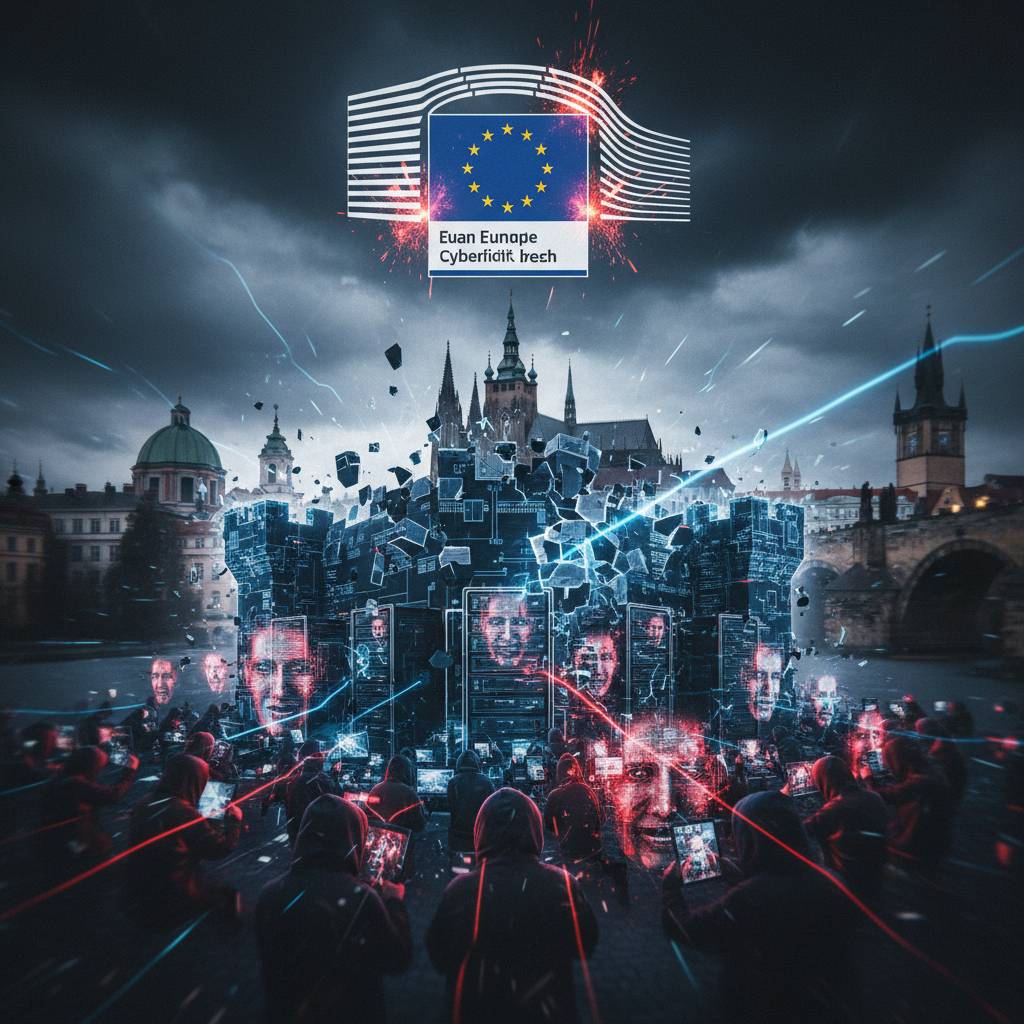
The cobblestone streets of Prague, typically echoing with the measured footsteps of history and the vibrant hum of innovation, now resonate with a different kind of urgency. Today, the Czech capital plays host to an emergency European Union cybersecurity summit, convened in direct response to a burgeoning crisis: a proliferation of highly convincing AI-generated video deepfakes, many reportedly leveraging the sophisticated models developed by Pika Labs. This development has sent a palpable tremor through the digital landscape, forcing a critical re-evaluation of content authenticity and the very foundations of trust in our interconnected world.
For months, the trajectory of generative AI in video creation has been a topic of intense discussion among technologists and policymakers alike. Companies like Pika Labs, alongside competitors such as RunwayML and even giants like Google DeepMind, have been locked in a relentless pursuit to democratize video production, transforming text prompts into cinematic sequences with startling fidelity. The ambition, often articulated as building the 'YouTube of AI-generated content,' promises a creative renaissance, but it also casts a long shadow of potential misuse. That shadow, it appears, has now materialized over Europe.
The breaking point arrived late last week, when several high-profile, politically charged deepfake videos began circulating across various social media platforms, particularly targeting public figures and institutions within the Czech Republic and neighboring Slovakia. These were not the crude, easily detectable forgeries of yesteryear. Instead, they exhibited an unsettling realism, complete with nuanced facial expressions, natural speech patterns, and contextual consistency that defied immediate human detection. Forensic analysis, reportedly conducted by the Czech National Cyber and Information Security Agency, Núkib, pointed to advanced generative models, consistent with the capabilities demonstrated by Pika Labs' latest iterations.
"The sophistication of these fabrications represents a significant escalation in the threat landscape," stated Jakub Koníček, Director of Núkib, at a press conference this morning. "We are no longer dealing with simple visual manipulations. These are narratives crafted with such precision that they can easily deceive, erode public trust, and potentially destabilize democratic processes. Our initial assessment indicates a level of generative fidelity that few actors, state or otherwise, could achieve without access to cutting-edge AI infrastructure." His words carried the weight of a nation suddenly confronted with a digital phantom.
The immediate fallout has been a flurry of diplomatic activity. The European Commission, already grappling with the implementation of its landmark AI Act, has dispatched high-level representatives to Prague. The summit, drawing cybersecurity chiefs, data protection authorities, and digital policy experts from across the 27 member states, aims to forge a united front against this emerging threat. Discussions are expected to center on enhanced detection mechanisms, rapid content takedown protocols, and, crucially, the contentious issue of mandating provenance watermarks for all AI-generated media.
"The Czech approach is methodical and effective, and we are applying that same rigor to this continental challenge," remarked Věra Jourová, Vice President of the European Commission for Values and Transparency, speaking from the historic Černín Palace. "We must protect our information space. While we champion innovation, we cannot allow it to become a weapon against truth. The AI Act provides a framework, but incidents like these demand immediate, actionable strategies that go beyond existing regulations." Her statement underscored the urgent need for adaptive policy in an era of accelerating technological change.
Expert analysis suggests that the current capabilities of platforms like Pika Labs, while revolutionary for creative industries, pose an unprecedented challenge to information integrity. "Imagine a digital puppeteer, capable of animating any figure, speaking any words, in any scenario, all at the touch of a button," explained Dr. Jana Pospíšilová, a leading AI ethics researcher at Charles University in Prague. "That is the power we are now contending with. The race to build the YouTube of AI-generated video content is not merely a commercial endeavor, it is a societal experiment with profound implications. The ease of access to such powerful tools means that the barrier to creating highly persuasive disinformation has effectively vanished." Dr. Pospíšilová's analogy painted a stark picture of the new reality.
The technical architecture behind these generative video models is a complex tapestry of neural networks, often involving diffusion models and transformer architectures, trained on colossal datasets of real-world video. Let me walk you through the architecture briefly. These models learn not just the appearance of objects and people, but also their dynamics, how they move, how light interacts with them, and the subtle nuances of human expression. When a user provides a text prompt, the model essentially synthesizes a new video sequence frame by frame, maintaining temporal consistency and photorealistic detail. The sheer computational power required for training these models is immense, often relying on thousands of NVIDIA GPUs. However, the inference, or generation, phase is becoming increasingly efficient, making these tools accessible to a broader user base.
What happens next is critical. The EU summit is expected to propose a series of measures, including potential sanctions for platforms that fail to implement robust content provenance systems. There is also a strong push for greater transparency from AI developers regarding their training data and model capabilities. The debate around mandatory digital watermarks, or cryptographic signatures embedded within AI-generated content, is likely to be particularly heated. While such measures could aid in detection, they also raise concerns about censorship and the potential for surveillance.
For the average citizen, the implications are profound. The ability to discern truth from fabrication becomes increasingly challenging, demanding a new level of media literacy. Educational initiatives, similar to those combating traditional disinformation, will be paramount. However, the speed and scale of AI-generated content demand a more systemic solution.
Why should readers care? Because the integrity of our shared reality is at stake. When video, long considered a relatively reliable form of evidence, can be manufactured with such ease and conviction, the very foundations of journalism, legal proceedings, and democratic discourse begin to crumble. This is not merely a technical problem for engineers in Silicon Valley or a regulatory headache for bureaucrats in Brussels. This is a fundamental challenge to how we perceive and interact with the world, a challenge that demands immediate and concerted action from governments, tech companies, and individuals alike. The future of information, much like the delicate Bohemian crystal, requires careful handling, lest it shatter into irreparable fragments.
As the discussions continue behind closed doors in Prague, the world watches, hoping that the collective wisdom of Europe can forge a path forward. The stakes could not be higher, for the race to build the YouTube of AI-generated video content has inadvertently opened a Pandora's Box of digital deception. For more on the broader implications of AI in digital media, you can find further analysis on The Verge's AI section or Reuters' technology coverage. The need for robust cybersecurity measures, especially concerning content authenticity, is a recurring theme in the digital age, as highlighted in discussions around Anthropic's Claude: Can a Digital Constitution Save Us, or Is It Just a Silicon Valley Mythos? [blocked]. The challenge is not to stifle innovation, but to guide it responsibly, ensuring that the tools we create serve humanity, rather than undermine its most precious asset: truth.