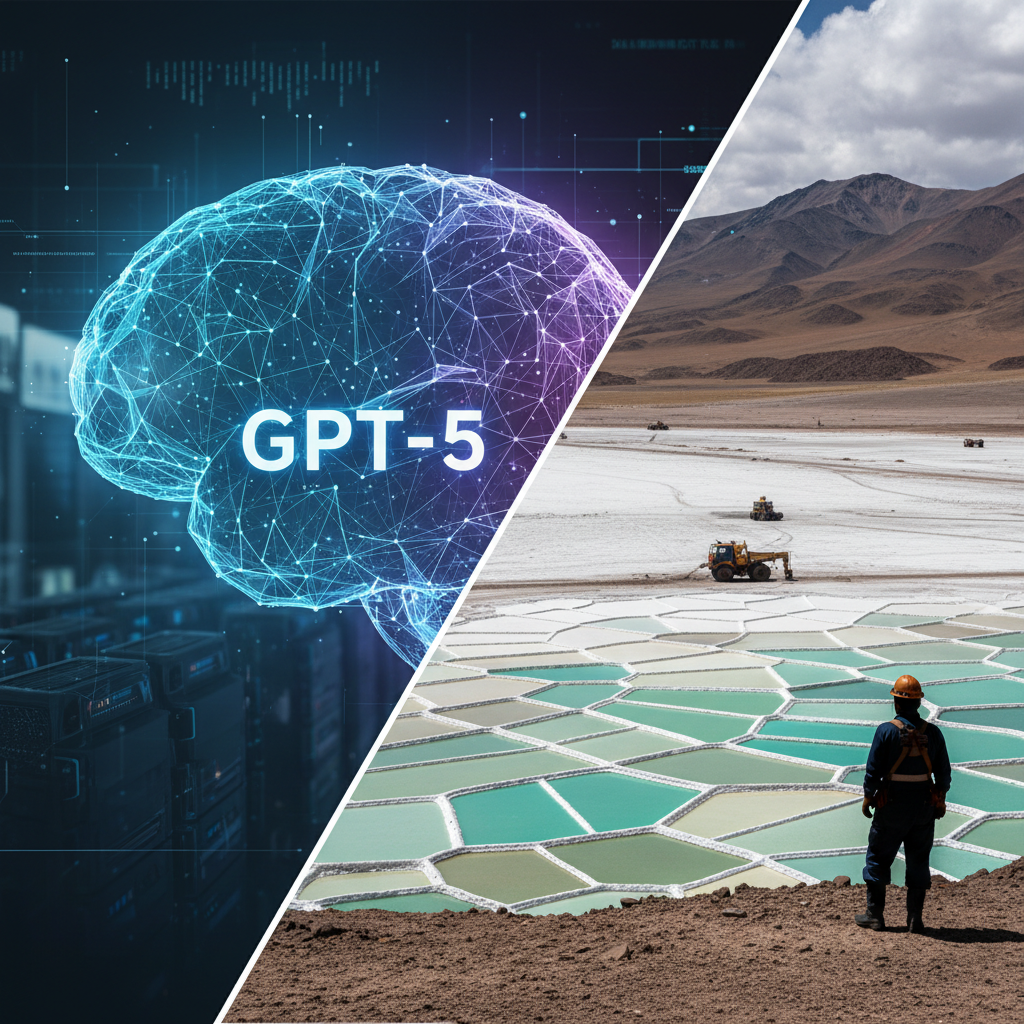
The digital world, much like the air at El Alto, is often thin on substance and thick with expectation. So when OpenAI, led by Sam Altman, recently unveiled preliminary benchmarks for its anticipated GPT-5 model, the global tech community, as expected, erupted in a cacophony of predictions. From Silicon Valley to the bustling markets of La Paz, the chatter centers on whether this new iteration marks a genuine leap or merely a more polished version of what we already have. For a nation like Bolivia, deeply invested in the global lithium economy and grappling with its own development challenges, the question is not just about raw processing power, but about relevance.
OpenAI's internal testing, leaked to select industry analysts, suggests GPT-5 could achieve a 20% to 30% improvement in complex reasoning tasks and a significant reduction in hallucination rates compared to its predecessor, GPT-4 Turbo. These figures, while impressive on paper, warrant a closer look. Dario Amodei's Anthropic, with its Claude 3.5 series, has consistently pushed the envelope in safety and contextual understanding, often outperforming OpenAI in specific enterprise applications. Google's Gemini Ultra, meanwhile, continues to leverage its vast data ecosystem, showing particular strength in multimodal integration, a feature increasingly critical for diverse global users. The competition is fierce, a technological race that often feels distant from our daily realities here in the Andes.
"The benchmarks are always impressive, are they not?" remarked Dr. Elena Quispe, Director of the Bolivian Institute of AI Research, during a recent discussion in Cochabamba. "But we must ask, what problem does this solve for a farmer in the Altiplano, or a miner in Potosí? The real innovation is not just in the algorithm, but in its accessibility and utility. We need tools that understand Quechua and Aymara, not just perfect English prose." Her point is salient. The global AI narrative often overlooks the specific needs of regions where infrastructure is nascent and digital literacy varies widely.
Consider the energy demands alone. Training and running models like GPT-5 require immense computational resources, translating into substantial energy consumption. Bolivia, with its burgeoning lithium industry, is at the heart of the battery supply chain that powers these very technologies. Yet, our own access to stable, affordable energy can be a bottleneck for local technological development. It is a paradox, to be sure. We provide the raw materials, but the refined intelligence often feels out of reach.
Data from the Bolivian Ministry of Digital Transformation indicates that only 65% of the population has consistent internet access, with significant disparities between urban and rural areas. This digital divide is not merely an inconvenience; it is a fundamental barrier to leveraging advanced AI. A model, however sophisticated, is only as useful as its deployment environment allows. For us, let's talk about what actually works at 4,000 meters, not just what performs well in a data center in California.
Microsoft's Copilot, integrating OpenAI's models, has shown promise in boosting productivity for office workers globally. However, its effectiveness relies heavily on a user base already proficient with complex software suites and stable connectivity. For small businesses in La Paz, often operating on limited budgets and with older hardware, the cost-benefit analysis of such subscriptions is far from clear. "We've experimented with some AI tools for customer service," shared Ricardo Mamani, owner of a textile export business in El Alto. "The initial setup was complex, and the ongoing costs were prohibitive for a small operation like ours. We need solutions that are robust, easy to integrate, and affordable, not just cutting-edge." His pragmatic assessment reflects a common sentiment.
Meanwhile, companies like NVIDIA continue to dominate the hardware landscape, with their latest Blackwell architecture promising even greater processing power for AI workloads. Jensen Huang's vision of accelerated computing is undoubtedly transformative for the industry. However, the cost of these specialized GPUs remains a significant barrier for research institutions and startups in developing nations. Building local AI capacity requires more than just software; it demands foundational hardware investment, a challenge often compounded by import duties and logistical complexities.
Bolivia's challenges require Bolivian solutions. This is not a romantic notion but a practical necessity. Our unique linguistic diversity, our rich cultural heritage, and our specific economic drivers demand AI applications tailored to our context. For instance, AI could revolutionize agricultural planning in the Andean valleys, predict weather patterns for quinoa harvests, or assist in the sustainable management of our vast mineral resources. However, this requires local data, local expertise, and models trained on our specific conditions.
There is a growing movement within Bolivian universities, such as the Universidad Mayor de San Andrés, to develop open source AI initiatives. These efforts aim to create models that are culturally sensitive, linguistically diverse, and economically viable for local deployment. "We are exploring federated learning approaches to protect data privacy while still benefiting from collective intelligence," explained Dr. Sofia Vargas, a lead researcher at UMSA's new AI Ethics Lab. "Our goal is to build AI that serves our communities, not just AI that is imposed upon them. This means focusing on practical applications for public health, education, and resource management." This grassroots approach, while slower, promises more sustainable and equitable outcomes.
The global AI race, with OpenAI, Google, and Anthropic at the forefront, continues to push the boundaries of what is technologically possible. Their advancements are undeniable, driving innovation at an astonishing pace. Yet, from our vantage point in Bolivia, the true measure of these breakthroughs will not be in their benchmark scores alone. It will be in their ability to translate into tangible improvements for people in diverse environments, to address real-world problems, and to empower communities that have historically been on the periphery of technological progress. Until then, the promise of GPT-5, however powerful, remains a distant peak on the horizon, waiting to see if its benefits can truly descend to the valleys below. For more insights into global AI developments, readers might consult Reuters Technology or TechCrunch for ongoing updates.