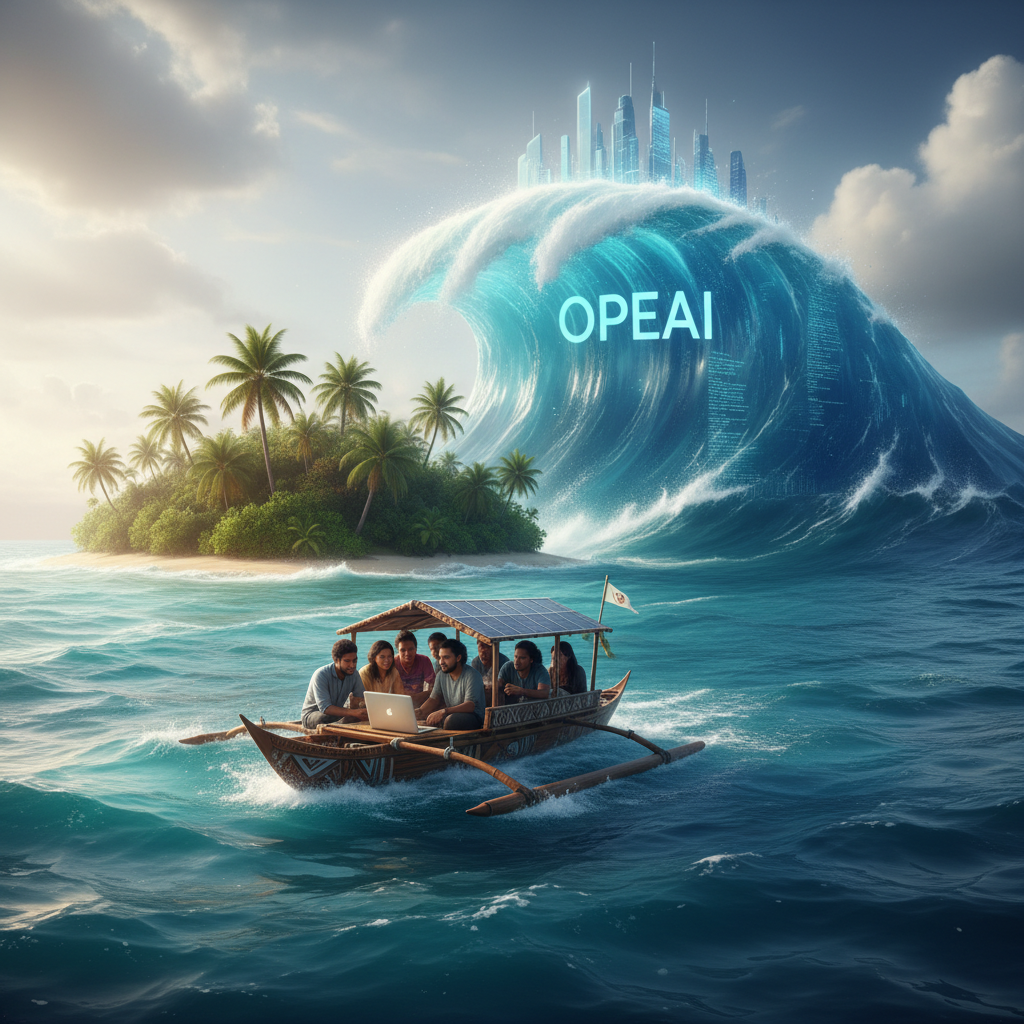

The news hit our shores like a king tide, a powerful force that demands attention: OpenAI, the company behind ChatGPT, is now valued at over $100 billion. One hundred billion. That number, whispered from Silicon Valley boardrooms, echoes differently here in Fiji, where our daily concerns often revolve around the next cyclone season or the price of fuel. It makes you wonder, doesn't it, what such immense capital means for the rest of the AI world, particularly for the smaller, agile startups trying to make a difference in places like ours?
For years, we've watched the AI space explode. From the initial buzz around large language models to the current frenzy of multimodal AI, it has been a relentless march of innovation. But this latest valuation of OpenAI, potentially making it one of the world's most valuable private tech companies, shifts the ground beneath everyone's feet. It is not just about a number, it is about concentration of power, talent, and resources. When one player commands such a colossal war chest, what space is left for the others?
“The sheer scale of OpenAI’s valuation is a double-edged sword for the ecosystem,” explains Dr. Alani Waqalevu, a Senior Economist at the University of the South Pacific, specializing in technology policy. “On one hand, it validates the immense potential of AI and attracts more investment into the sector globally. On the other, it creates an almost insurmountable barrier for entry for many. How do you compete with that kind of financial muscle, especially when you are a small team in a developing nation?”
Indeed, the data suggests a growing disparity. According to a recent report by Reuters, venture capital funding for AI startups outside the top five global hubs has seen a noticeable slowdown in growth compared to the exponential rise in funding for established giants. This is not just anecdotal; it is a trend that worries those of us who believe in distributed innovation. In Fiji, we face the future with clear eyes, and that future requires practical, localized AI solutions, not just those dictated by distant tech behemoths.
Here in the Pacific, our AI landscape is nascent but vibrant, focused on immediate, tangible problems. We are not chasing general artificial intelligence; we are chasing climate resilience, sustainable fisheries, and accessible healthcare. Consider the work being done by startups like 'Veilomani AI', a small team in Suva developing AI models to predict localized flood patterns with higher accuracy, using satellite data and historical weather records. Their budget for an entire year might be less than what OpenAI spends on coffee in a week. How do they attract top talent or secure the computational resources needed to scale their impact when the gravitational pull of the giants is so strong?
“It is a constant battle for visibility and resources,” says Mereoni Vunisa, co-founder of Veilomani AI. “We are competing for the same limited pool of skilled engineers, many of whom are lured away by the promise of Silicon Valley salaries and the prestige of working for a company like OpenAI or Google DeepMind. We offer purpose, community, and the chance to make a direct impact on our home, but the financial disparity is undeniable.”
This is where the 'trickle-down' theory of innovation gets tested. The argument often made is that the breakthroughs from the likes of OpenAI will eventually become accessible and benefit everyone. While there is truth to the idea that foundational models, once developed, can be fine-tuned for specific applications, the control over these models, their underlying architecture, and their future direction remains firmly in the hands of a few. This creates a dependency that small nations, particularly those with data sovereignty concerns, must navigate carefully.
We have seen this play out before in other tech sectors. The internet, initially envisioned as a decentralized network, has become increasingly centralized around a handful of platforms. The same risk exists for AI. When a few companies hold the keys to the most powerful AI models, they effectively dictate the terms of engagement for everyone else. This could stifle independent research, limit diverse perspectives in AI development, and ultimately lead to solutions that are not tailored to the specific needs of communities far removed from Silicon Valley.
For instance, while OpenAI’s GPT models are incredibly powerful, their training data is predominantly English-centric and reflects a global North perspective. This can lead to biases and a lack of understanding when applied to local languages, cultural nuances, or specific environmental challenges in the Pacific. A model trained on European agricultural data will not understand the intricacies of taro farming in a Fijian village. This is why local innovation is not just a nice-to-have, it is a necessity.
“The challenge for our region is to leverage the advancements from these global players while simultaneously nurturing our own AI capabilities,” states Ratu Semi Koro, Director of Fiji’s Department of Climate Change and Disaster Management. “We need to be smart about how we integrate global tools, but also invest in our local talent and data infrastructure. The Pacific way of problem-solving means adapting what works, but always with our unique context in mind.”
This means fostering an environment where local AI startups can thrive. It requires government policies that support data collection and ownership, educational programs that build AI literacy and technical skills, and access to affordable computational resources. Perhaps more importantly, it requires a shift in mindset, recognizing that 'small' does not mean 'insignificant' when it comes to innovation. Small island, big challenges, smart solutions, that is our mantra.
Consider the potential for collaboration. Instead of viewing the giants as solely competitors, perhaps there are avenues for partnerships that benefit both sides. Could OpenAI, with its vast resources, offer grants or computational credits specifically for developing AI solutions in climate-vulnerable regions? Could they establish regional hubs that empower local developers to fine-tune models for specific local contexts? The benefits of such initiatives could extend beyond philanthropy, offering valuable diverse data and use cases that even the largest AI companies might overlook.
The conversation around OpenAI's valuation is not just about financial markets; it is about the future of innovation, equity, and access in the AI age. For us in Fiji, it is a reminder that while the global tech tides may be rising, we must continue to build our own seawalls of innovation, ensuring that AI serves our communities, not just the bottom line of distant corporations. The path forward requires vigilance, strategic investment in local talent, and a commitment to ensuring that AI’s immense power is harnessed for the benefit of all, not just the privileged few. Wired has often highlighted the ethical implications of AI centralization, and this valuation only amplifies those concerns for regions like ours. We must ensure our voices are heard in this global dialogue, advocating for an AI future that is inclusive and equitable. For a deeper dive into how local AI can address specific challenges, consider reading about NVIDIA's Brain Chips and Fiji's Future: Why Neuromorphic Computing Isn't Just for Silicon Valley [blocked].