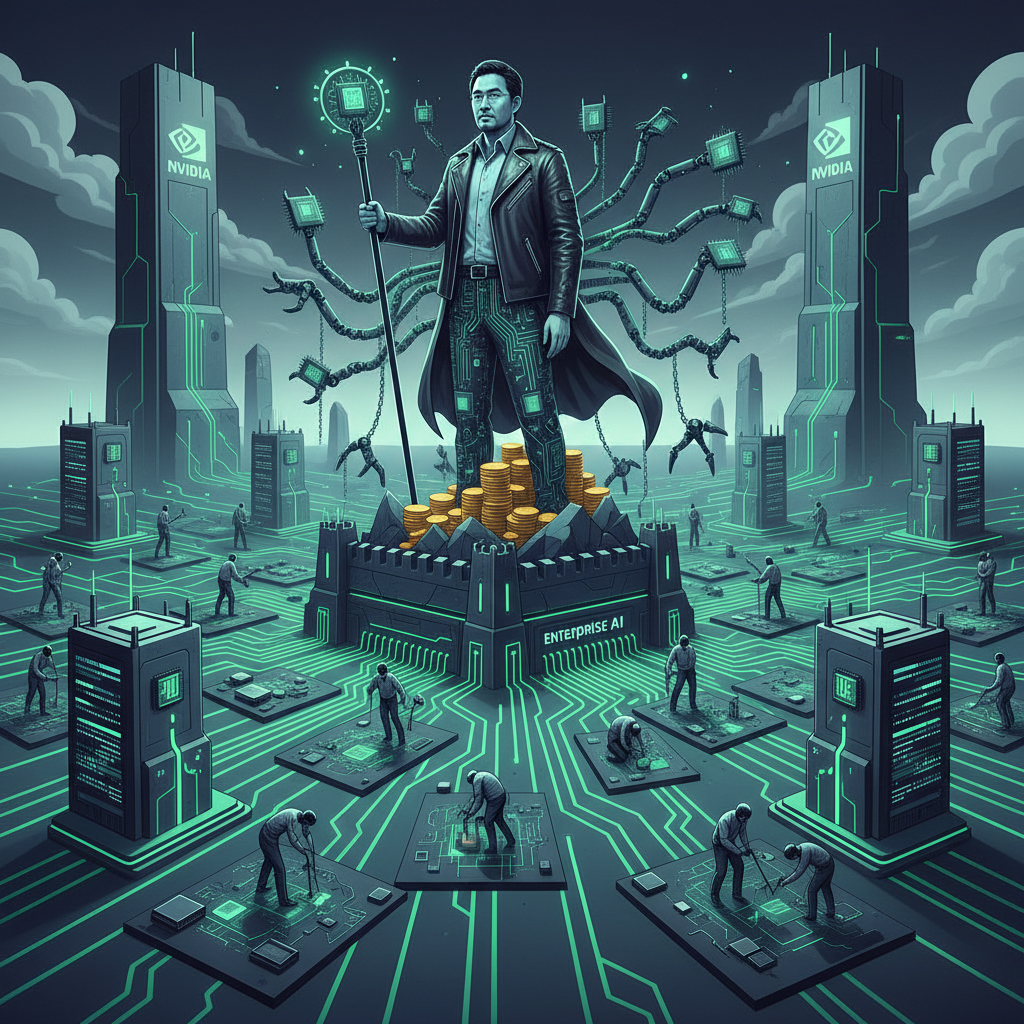

The year is 2026, and the air crackles with the energy of artificial intelligence. From Istanbul to Silicon Valley, every conversation, every investment, every dream seems to revolve around AI. Yet, beneath this glittering surface, a stark, uncomfortable truth is solidifying: AI is not just creating wealth, it is concentrating it with a speed and scale that should alarm us all. We are witnessing the birth of a new digital feudalism, where a handful of tech lords like Jensen Huang of NVIDIA, Sam Altman of OpenAI, and Satya Nadella of Microsoft are amassing fortunes that dwarf nation states, while the global workforce, including so many in my own country, Turkey, faces an uncertain future.
Let us be frank. The narrative pushed by many in the West, that AI will lift all boats, is a fantasy. It is a convenient myth for those already at the top. Look at the numbers. NVIDIA, the undisputed king of AI hardware, has seen its market capitalization soar past a trillion dollars. Its CEO, Jensen Huang, is now among the world's wealthiest individuals, his vision and execution undeniably brilliant. But what about the millions of workers whose jobs are being automated, whose skills are being devalued, or whose wages are stagnating as AI-driven productivity gains accrue almost entirely to capital owners? This is not progress for everyone, it is a massive transfer of wealth upwards, a digital Ottoman approach to empire-building, but one where the spoils are hoarded by a select few, not distributed to build a collective future.
I have seen the potential of AI firsthand in Turkey. Our defense industry, our burgeoning gaming sector, our ambitious fintech startups, they are all leveraging AI to innovate and compete on the global stage. Istanbul's tech ambitions are massive and realistic, a testament to our youthful energy and entrepreneurial spirit. We are building the future at the crossroads, blending Eastern ingenuity with Western technology. Yet, even here, the shadow of this growing wealth disparity looms large. The engineers and data scientists who build these systems are well compensated, yes, but the vast majority of the population, from factory workers to call center employees, are increasingly vulnerable.
Consider the recent reports. A study by the International Monetary Fund, for instance, indicated that AI could impact nearly 40 percent of global jobs, with advanced economies facing even higher exposure. While some argue that new jobs will emerge, history teaches us that transitions are rarely smooth or equitable. The Luddites of the Industrial Revolution were not simply afraid of technology; they were fighting for their livelihoods against a system that sought to replace them without providing a viable alternative. Are we so different today? Are we so naive as to believe that this time it will be different, that the invisible hand of the market will magically ensure fairness?
The argument often presented is that AI will create entirely new industries, new roles, and new opportunities. This is partially true, of course. The demand for AI trainers, prompt engineers, and ethical AI specialists is growing. However, these are often highly specialized roles requiring advanced education, leaving a significant portion of the existing workforce behind. Furthermore, the capital required to build and deploy advanced AI systems is immense, favoring established giants like Google, Microsoft, and OpenAI, who can invest billions in research, development, and infrastructure. This creates an insurmountable barrier for smaller players and exacerbates the concentration of power.
Take the example of OpenAI. Backed by Microsoft's colossal investment, it has developed models like GPT-4 that are redefining what machines can do. Sam Altman's vision for artificial general intelligence is bold, even inspiring to some. But who truly benefits from this vision? Is it the content creators whose work was scraped to train these models without compensation? Is it the artists and writers whose livelihoods are threatened by AI-generated output? Or is it the venture capitalists and tech executives whose portfolios swell with every new breakthrough? The answer, regrettably, is often the latter.
Some might counter that this is simply the nature of technological progress, that innovation always creates winners and losers. They might point to the efficiency gains, the potential for medical breakthroughs, or the enhancement of human creativity. And yes, these are real possibilities. AI could indeed help us solve some of humanity's most pressing problems, from climate change to disease. But this potential is being undermined by a fundamental flaw in its current implementation: a relentless focus on profit maximization for a select few, rather than societal well-being for all. As Professor Daron Acemoglu of MIT, a brilliant mind I greatly admire, has often argued, the direction of technological change is not predetermined; it is a choice. We are choosing a path that prioritizes automation over augmentation, capital over labor, and concentration over distribution.
What is to be done, then? We cannot simply halt technological progress. That would be foolish and ultimately futile. Instead, we must actively shape its trajectory. Governments, particularly those in emerging tech hubs like Turkey, have a critical role to play. We need robust policies that ensure a more equitable distribution of AI's benefits. This means investing heavily in education and retraining programs to equip our workforce with the skills needed for the AI era. It means exploring universal basic income or other social safety nets to cushion the impact of job displacement. It means implementing progressive taxation on AI-driven profits to fund these initiatives. It means fostering an ecosystem where open-source AI can truly thrive, democratizing access to these powerful tools, rather than allowing them to be monopolized by a few corporations. The MIT Technology Review often highlights the ethical dilemmas and societal impacts of AI, and their insights are crucial for guiding policy.
Furthermore, we need to demand greater transparency and accountability from the tech giants. If AI models are trained on public data, then the public should derive some benefit from their commercialization. We need to rethink intellectual property rights in the age of generative AI. We need international cooperation to establish global norms and regulations that prevent a race to the bottom, where countries compete by offering the least protection to their workers.
This is not just an economic issue; it is a moral one. The promise of AI should be to elevate humanity, not to create a new class of digital serfs. The current trajectory, where a few individuals and corporations accumulate unprecedented wealth and power, while the majority struggles, is unsustainable and unjust. We, in Turkey, understand the importance of building a strong, inclusive society. Our history, our culture, our very location at the crossroads of civilizations, compels us to seek balance and fairness. We must ensure that as AI reshapes our world, it does so for the benefit of all, not just the privileged few. The future is not yet written, and we still have the power to choose a different path. Let us choose wisely, before the digital feudal lords solidify their reign. For more on the economic implications of AI, Reuters Technology provides excellent coverage.