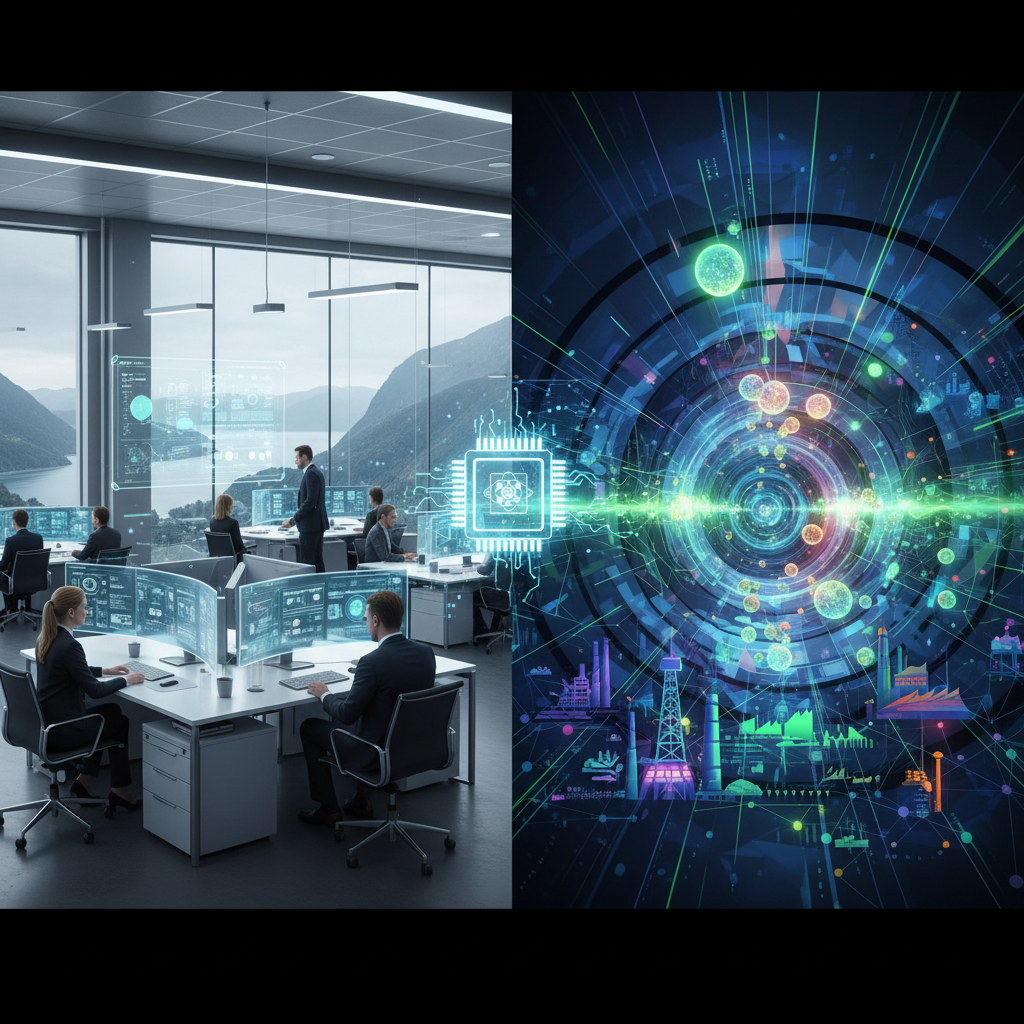

The hum of the Large Hadron Collider, a symphony of scientific ambition, has long echoed from the Swiss French border, pushing the boundaries of human knowledge. Yet, the true acceleration of discovery today is increasingly found not just in the colossal rings of Cern, but in the intricate dance of algorithms and data, powered by artificial intelligence. This profound integration of AI into particle physics, particularly through advanced computational hardware from companies like NVIDIA, is not merely an academic pursuit; it is fundamentally reshaping industrial landscapes and workforce demands, even here in Norway.
Consider the bustling port city of Bergen, far from the subatomic collisions. Here, a company named FjordTech Solutions, historically a developer of advanced sonar for Norway's maritime industry, found itself at a crossroads. Their expertise in processing vast streams of acoustic data, once their competitive edge, was becoming insufficient for the new generation of complex, multi modal sensor arrays. "We were drowning in data, not discovering patterns," recounts Dr. Elara Knudsen, FjordTech's Chief Technology Officer. "The sheer volume of information from our latest subsea exploration systems, combined with the need for real time anomaly detection, demanded a paradigm shift. We looked to the methods employed at Cern, surprisingly, and saw a path forward."
The data is unequivocal. A recent report from DataGlobal Hub indicates that enterprises leveraging AI for scientific data analysis, particularly those using GPU accelerated platforms, report an average 27% increase in research and development efficiency over the past two years. For companies like FjordTech, this translates directly into faster product development cycles and reduced operational costs. Adoption rates for AI driven data pipelines in Norway's high tech manufacturing sector have surged by 35% since early 2024, mirroring trends seen in global physics research.
At the heart of this revolution is the ability of AI, specifically deep learning models, to sift through petabytes of raw detector data from experiments like those at Cern, identifying rare events or subtle patterns that would be impossible for human analysis alone. Imagine trying to find a single, specific snowflake in an avalanche, but with millions of avalanches occurring every second. That is the challenge of particle physics. AI provides the sophisticated filters and pattern recognition capabilities to make sense of this chaos. NVIDIA's Cuda platform, for instance, has become the de facto standard for accelerating these complex computations, allowing physicists to simulate particle interactions and reconstruct events with unprecedented speed and accuracy. This is where MIT Technology Review often highlights the synergy between academic research and industrial application.
Winners in this new era are clear. Companies like FjordTech, which invested early in retraining their engineers in machine learning frameworks and acquiring powerful NVIDIA GPU clusters, are now leading their respective fields. Their new 'Hydro-AI' platform, which uses neural networks trained on simulated and real world particle physics data, can differentiate between natural seismic activity and potential resource deposits with 92% accuracy, a significant leap from their previous 70%. "Our engineers, many of whom previously focused on traditional signal processing, are now fluent in TensorFlow and PyTorch," Dr. Knudsen explains. "This internal upskilling has been critical. It's not just about buying the technology; it's about cultivating the expertise."
Conversely, some traditional engineering firms, slow to embrace AI, are struggling. Stavanger Offshore Systems, a long standing competitor to FjordTech, saw its market share decline by 18% in the last fiscal year. Their reliance on older, rule based expert systems proved too rigid and slow for the dynamic data environments now common. "We underestimated the pace of change," admitted Lars Erikson, CEO of Stavanger Offshore Systems, in a recent earnings call. "The investment in AI seemed too speculative, too academic. We were wrong. The Nordic model extends to technology, demanding adaptability and forward thinking, and we lagged."
Worker perspectives are, predictably, mixed. For those like Ingrid Solberg, a 34 year old data scientist at FjordTech, the shift has been invigorating. "I used to spend weeks manually tuning parameters for anomaly detection. Now, with AI, I'm designing experiments, validating models, and focusing on the higher level scientific questions," she shares. "It's less about brute force data wrangling and more about creative problem solving. My job has become significantly more intellectually stimulating." This sentiment is echoed by a recent survey of Norwegian tech workers, where 68% reported increased job satisfaction after integrating AI tools into their workflows, citing greater focus on strategic tasks.
However, for others, particularly those with decades of experience in traditional engineering roles, the transition has been challenging. Olaf Johansen, a 58 year old geophysicist, expressed his concerns. "I've spent my career interpreting sonar readings by eye, understanding the nuances of the seabed. Now, the AI tells me what it sees, and I'm asked to simply verify," he says with a hint of melancholy. "It feels like my experience is being devalued, replaced by an algorithm. The company offers retraining, yes, but learning deep neural networks at my age is not like learning a new software package; it's a whole new way of thinking." This highlights a critical societal challenge: ensuring a just transition for all workers in the face of rapid technological advancement.
Expert analysis reinforces the dual nature of this transformation. Dr. Bjorn Halvorsen, a leading AI ethicist at the University of Oslo, emphasizes the need for proactive policy. "Norway's approach to AI is rooted in trust, transparency, and human centric design. As AI permeates even the most fundamental sciences, we must ensure that these principles guide its adoption in industry," Dr. Halvorsen asserts. "It's not enough to simply implement AI; we must understand its societal implications, its impact on employment, and its potential for bias in scientific interpretation. We must invest in comprehensive reskilling programs and robust ethical frameworks to support our workforce through this shift." The importance of ethical considerations in AI development is a topic frequently covered by The Verge.
What is coming next? The convergence of AI and particle physics is only accelerating. We are seeing the emergence of 'AI for Science' initiatives, where large language models and generative AI are being trained on vast scientific literature and experimental data to hypothesize new particles, design novel experiments, and even automate parts of the scientific discovery process. Imagine an AI proposing a new theoretical framework for dark matter, or designing a more efficient fusion reactor. This is no longer science fiction. Companies like Google DeepMind and OpenAI are actively exploring these frontiers, pushing the boundaries of what AI can achieve in fundamental research.
The implications for Norway are profound. With our rich natural resources, particularly in energy and maritime sectors, the ability to leverage AI for advanced scientific discovery can unlock unprecedented efficiencies and sustainable practices. It is a future where the precision of a particle accelerator's data analysis, powered by AI, can inform the optimal placement of an offshore wind turbine or the most efficient method for carbon capture. The challenge, as always, will be to adapt, to educate, and to ensure that this technological tide lifts all boats, not just the fastest ones. The fjord, after all, teaches us that deep currents can reshape the landscape over time, but the surface must remain navigable for all. For more on how AI is impacting various industries, you can explore articles on TechCrunch.