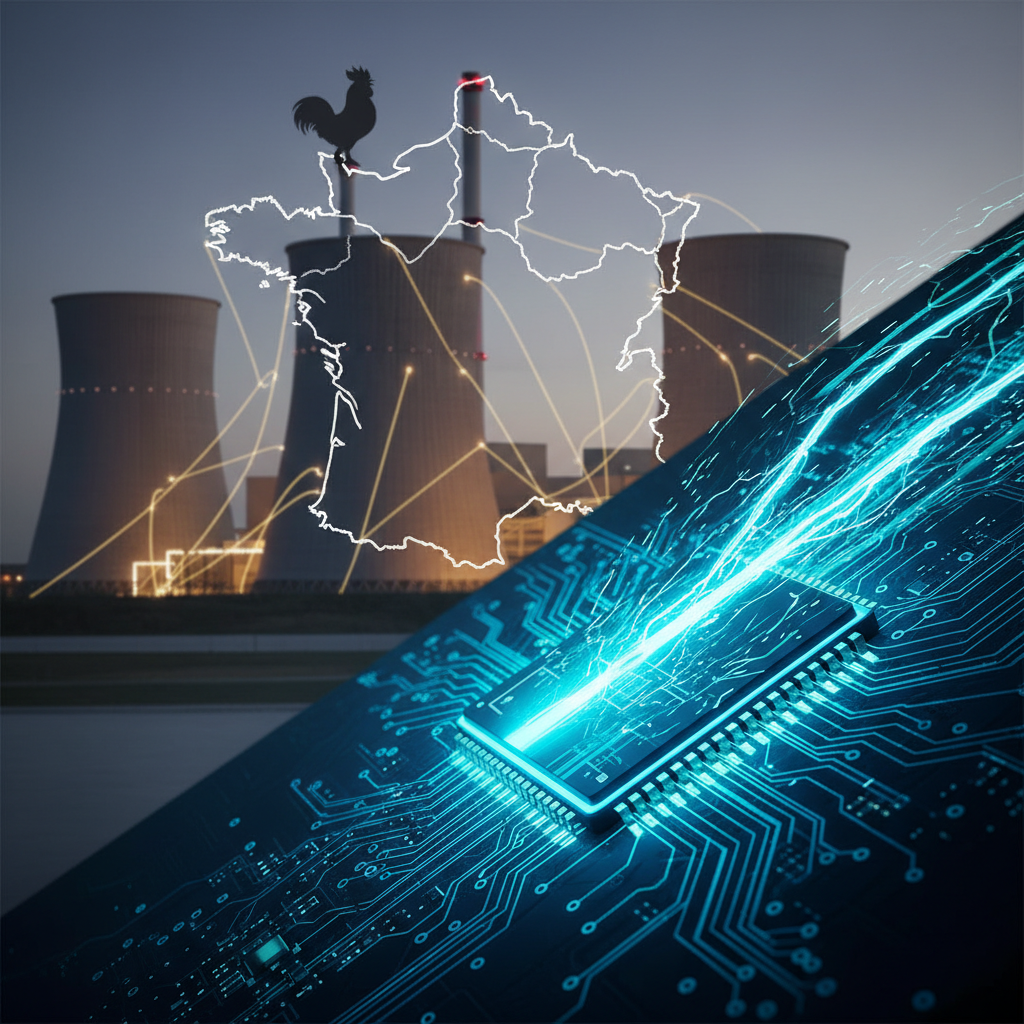

Mon Dieu, the arrogance of Big Tech. While the titans of Silicon Valley, from Jensen Huang at NVIDIA to Sam Altman at OpenAI, wax poetic about the transformative power of artificial intelligence, a far more terrestrial crisis looms large: the insatiable energy demands of their digital empires. We are not talking about a quaint increase in consumption, no, we are discussing an exponential surge that threatens to overwhelm grids and undermine our collective climate goals. It is a crisis that Europe, and particularly France, must confront with clear eyes and a firm resolve.
For too long, we have watched from across the Atlantic as American companies dictate the terms of technological progress. Now, their ambition, fueled by ever-larger language models and increasingly complex AI systems, is literally draining the planet. Data centers, the silent behemoths housing these computational marvels, are becoming voracious energy consumers. Reports suggest that by 2030, AI data centers could consume as much electricity as entire countries, perhaps even surpassing the energy usage of nations like Sweden or the Netherlands. This is not merely a technical challenge; it is an existential one, and one that demands a uniquely European response.
Consider France, a nation that has historically prided itself on energy independence, thanks largely to our robust nuclear power infrastructure. For decades, our nuclear plants have provided a stable, low-carbon base load, a stark contrast to the fossil fuel reliance of many other countries. But even our formidable grid, which generates approximately 70 percent of its electricity from nuclear sources, faces unprecedented pressure from the burgeoning AI sector. The demand for GPUs, those specialized chips primarily from NVIDIA, is skyrocketing, and each one hums with a thirst for power. Training a single large language model can consume energy equivalent to several European households for a year. Multiply that by the hundreds of models being developed concurrently by Google, Meta, and others, and the scale of the problem becomes terrifyingly clear.
“We cannot simply build more nuclear reactors to fuel every speculative AI endeavor,” stated Agnès Pannier-Runacher, France's Minister for Energy Transition, in a recent address to the French Senate. “Our energy policy must balance innovation with sustainability, and that means scrutinizing the true cost of this digital gold rush.” Her words resonate deeply. The European way is not the American way and that is the point. We prioritize sustainability, privacy, and ethical development, not just speed and scale at any cost.
This energy crisis is not abstract. It manifests in very real terms: increased strain on power grids, higher electricity prices, and a greater carbon footprint if the energy is not sourced renewably. While some tech giants tout their commitments to renewable energy, the sheer volume of demand means that often, fossil fuels are still filling the gap. This is particularly concerning as France, like the rest of Europe, strives to meet ambitious climate targets. The paradox is stark: AI is often presented as a tool to combat climate change, yet its development is becoming a significant contributor to the problem.
What are the alternatives? France says non to Silicon Valley's vision of unrestrained growth. One path forward involves a greater emphasis on energy-efficient AI. Researchers at institutions like Inria, France's national research institute for digital science and technology, are exploring methods for training and deploying AI models with significantly reduced energy consumption. This includes optimizing algorithms, developing more efficient hardware, and exploring federated learning approaches that reduce the need for massive, centralized data centers. “The focus must shift from brute-force computation to intelligent, efficient design,” explained Dr. Cécile Guérin, a leading AI researcher at Inria. “We need algorithms that think smarter, not just consume more.”
Moreover, there is a growing movement for what we might call 'sovereign AI' in Europe, driven by companies like Mistral AI, a French startup that has gained significant traction for its open source models. Their approach, while still requiring substantial computational resources, aims to foster a more decentralized and transparent AI ecosystem. This contrasts sharply with the proprietary, black-box models favored by many US tech giants. A decentralized approach could, in theory, distribute the energy load more effectively and encourage local, more sustainable energy solutions.
The European Union's AI Act, a landmark piece of legislation, also plays a crucial role here. While its primary focus is on ethics and safety, its very existence encourages a more thoughtful, regulated approach to AI development. This regulatory framework, however imperfect, provides a lever for demanding greater transparency and accountability from AI developers regarding their environmental impact. It is a starting point, a declaration that unchecked technological progress is no longer acceptable.
We must also consider the physical infrastructure. The construction of new data centers, often located in regions with cheap land and access to cooling, has its own environmental costs. The water consumption for cooling these facilities is another hidden burden. A report by the Reuters news agency highlighted how some data centers consume billions of liters of water annually, exacerbating water scarcity in certain areas. This is not just about electricity; it is about the entire ecological footprint.
So, what is the French response to NVIDIA's power hunger and Silicon Valley's relentless pursuit of scale? It is a multi-pronged strategy. Firstly, we must invest heavily in research for energy-efficient AI, supporting our brilliant scientists and engineers at institutions like the Cnrs and the CEA. Secondly, we must continue to advocate for stronger European regulations that mandate environmental impact assessments for large-scale AI deployments. Thirdly, and perhaps most importantly, we must champion a vision of AI that serves humanity and the planet, not just corporate bottom lines. This means fostering local AI ecosystems, promoting open source alternatives, and prioritizing applications that genuinely contribute to societal well-being and sustainability.
The future of AI cannot be built on an unsustainable foundation of limitless energy consumption. It is time for Europe to lead by example, to show that innovation can thrive without sacrificing our planet. The choice is clear: either we passively fuel Silicon Valley's ever-growing appetite, or we forge our own path, a path of intelligent, sustainable, and truly European AI. The stakes, mes amis, could not be higher. For more on the broader implications of AI's environmental impact, one might consult articles on MIT Technology Review. The conversation is only just beginning, and we must ensure our voice is heard. The future of our grid, and indeed our climate, depends on it. For a deeper dive into the technical challenges of AI, Ars Technica often provides excellent analysis.