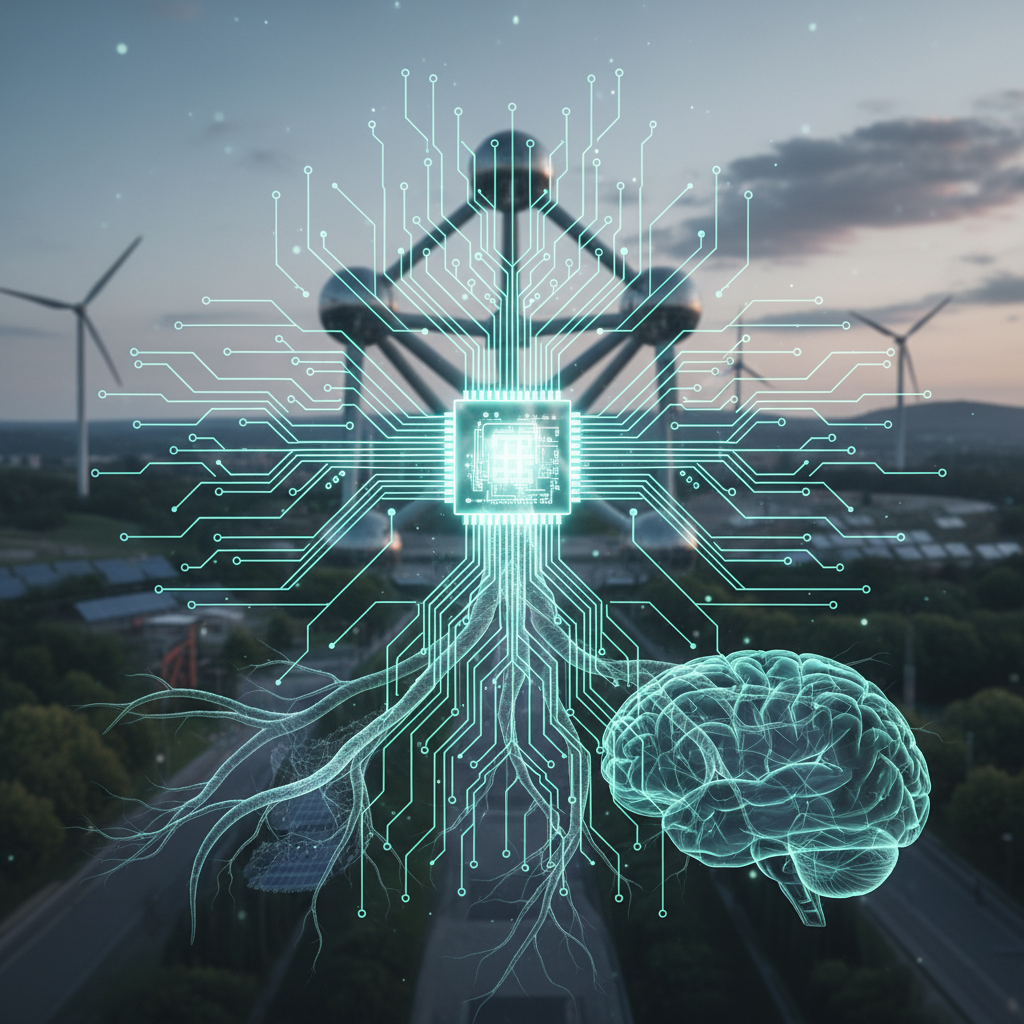

The relentless pursuit of artificial intelligence has pushed the boundaries of conventional computing to their limits. We stand at a crossroads, where the sheer energy consumption and latency inherent in traditional Von Neumann architectures threaten to stifle the very progress we seek. This is precisely the technical challenge neuromorphic computing purports to solve, a paradigm shift that promises to unlock AI at unprecedented scales and efficiencies. But as a journalist from Belgium, I am compelled to ask: does this actually work, or is it merely another wave of Silicon Valley hyperbole crashing upon European shores?
Neuromorphic computing fundamentally re-imagines chip design, moving away from the separate processing and memory units of Von Neumann architectures. Instead, it aims to integrate computation and memory, mirroring the brain's parallel, event-driven processing. This 'in-memory computing' approach drastically reduces data movement, which is the primary energy drain in conventional systems. The goal is not just faster AI, but vastly more energy-efficient AI, a critical consideration as data centers globally consume an ever-increasing share of our energy grids.
Architecture Overview: A Synapse-Inspired Design
At the heart of neuromorphic systems are 'spiking neural networks' (SNNs), which are fundamentally different from the artificial neural networks (ANNs) prevalent today. Unlike ANNs, where neurons transmit continuous values, SNNs communicate via discrete 'spikes' or events. These spikes are only transmitted when a neuron's membrane potential crosses a certain threshold, mimicking biological neurons. This event-driven nature means that not all parts of the chip are active all the time, leading to significant power savings.
Key architectural components include:
- Neurons: Modeled as integrate-and-fire units, accumulating input until a threshold is reached, then firing a spike.
- Synapses: Represented by non-volatile memory elements, such as resistive random-access memory (rram) or phase-change memory (PCM), which store synaptic weights directly at the intersection of input and output lines. This co-location of memory and processing is crucial.
- Communication Fabric: An asynchronous, event-driven network that routes spikes between neurons, often employing sparse communication to minimize energy.
Consider a conceptual model where each neuron core on a chip might contain thousands of digital neurons and millions of synapses. These cores are interconnected, allowing for complex network topologies. Companies like Intel with their Loihi platform, IBM with NorthPole, and emerging players like BrainChip with Akida, are all exploring variations of this architecture. NVIDIA, with its deep expertise in parallel processing, is also reportedly investing heavily in this space, leveraging its GPU foundations for hybrid approaches, though their direct neuromorphic chip remains largely under wraps. The sheer scale of investment suggests a belief in its transformative potential, yet the practical hurdles remain substantial.
Key Algorithms and Approaches
Training SNNs is a significant challenge. Traditional backpropagation, the workhorse of ANNs, is difficult to apply directly to event-driven, non-differentiable SNNs. Several approaches are being explored:
- Conversion from ANNs: Train a conventional ANN and then convert its weights and activations into an SNN. This is a common starting point, leveraging existing ANN training pipelines. However, it often results in performance degradation or increased latency.
- Spike-Timing Dependent Plasticity (stdp): A biologically inspired unsupervised learning rule where the change in synaptic weight depends on the relative timing of pre- and post-synaptic spikes. If a presynaptic spike consistently precedes a postsynaptic spike, the connection strengthens. This is ideal for on-chip, online learning.
Conceptual Stdp Update Rule:
Δw = A_pos * exp(-Δt / τ_pos) if Δt > 0
Δw = A_neg * exp(Δt / τ_neg) if Δt < 0
where Δw is weight change, Δt is time difference between spikes, and A_pos, A_neg, τ_pos, τ_neg are learning parameters.
- Surrogate Gradients: A more recent technique that approximates the non-differentiable spike function with a differentiable surrogate, allowing for backpropagation-like training in SNNs. This bridges the gap between SNNs and deep learning frameworks.
Implementation Considerations and Trade-offs
Developing with neuromorphic hardware requires a fundamental shift in thinking. The event-driven nature means that traditional batch processing, common in deep learning, is less efficient. Instead, continuous, real-time data streams are ideal. This lends itself well to edge computing applications where power consumption is paramount.
- Programming Models: Tools like Intel's Lava framework provide a Python-based API for developing SNNs, allowing researchers to abstract away some of the low-level hardware details. However, the ecosystem is nascent compared to PyTorch or TensorFlow. Intel's Loihi platform is a prime example of a dedicated neuromorphic research chip.
- Data Representation: Input data often needs to be converted into spike trains. This can involve rate coding (where spike frequency encodes information) or temporal coding (where spike timing carries meaning).
- Scalability: While individual neuromorphic cores are efficient, scaling these systems to rival the computational power of large GPU clusters for complex, general-purpose AI tasks remains an open challenge. The memory capacity and inter-core communication bandwidth are critical bottlenecks.
Benchmarks and Comparisons
When comparing neuromorphic chips to GPUs, the metrics shift. GPUs excel at dense matrix multiplications, which are the backbone of ANNs. Neuromorphic chips shine in sparse, event-driven tasks. For example, Intel's Loihi 2 has demonstrated significant energy efficiency gains, up to 1000x, for specific tasks like gesture recognition and keyword spotting compared to conventional CPUs or GPUs, particularly at low power budgets. IBM's NorthPole chip, unveiled recently, also boasts impressive energy efficiency for inference tasks, showing 25 times better energy efficiency than conventional GPUs on certain benchmarks, as reported by Reuters.
However, these benchmarks are often for specific, constrained problems. For large language models or complex computer vision tasks, GPUs from NVIDIA, AMD, and others still dominate due to their mature software ecosystem and raw parallel processing power for dense operations. The EU's approach deserves more credit than it gets in fostering research into these alternative architectures, recognizing the strategic importance of energy-efficient AI for sustainable digital transformation.
Code-Level Insights: Bridging the Gap
For developers, engaging with neuromorphic computing often involves specialized libraries. For instance, the snnTorch library in Python allows for the creation and training of SNNs using PyTorch's infrastructure, providing a familiar interface for deep learning practitioners. This helps in experimenting with surrogate gradient methods. Similarly, BrainChip's Akida offers a meta-learning framework that allows users to train models in TensorFlow or PyTorch and then convert them for deployment on their neuromorphic hardware.
# Conceptual SNN layer using snnTorch
import snntorch as snn
import torch.nn as nn

class SimpleSNN(nn.Module):
 def __init__(self):
 super().__init__()
 self.fc1 = nn.Linear(784, 100)
 self.lif1 = snn.Leaky(beta=0.9) # Leaky Integrate and Fire neuron
 self.fc2 = nn.Linear(100, 10)
 self.lif2 = snn.Leaky(beta=0.9)

def forward(self, x):
 mem1 = self.lif1.init_leaky()
 mem2 = self.lif2.init_leaky()
 spk_out = []
 for step in range(num_steps): # Iterate over time steps for spike generation
 cur1 = self.fc1(x[step])
 spk1, mem1 = self.lif1(cur1, mem1)
 cur2 = self.fc2(spk1)
 spk2, mem2 = self.lif2(cur2, mem2)
 spk_out.append(spk2)
 return torch.stack(spk_out)
# Conceptual SNN layer using snnTorch
import snntorch as snn
import torch.nn as nn

class SimpleSNN(nn.Module):
 def __init__(self):
 super().__init__()
 self.fc1 = nn.Linear(784, 100)
 self.lif1 = snn.Leaky(beta=0.9) # Leaky Integrate and Fire neuron
 self.fc2 = nn.Linear(100, 10)
 self.lif2 = snn.Leaky(beta=0.9)

def forward(self, x):
 mem1 = self.lif1.init_leaky()
 mem2 = self.lif2.init_leaky()
 spk_out = []
 for step in range(num_steps): # Iterate over time steps for spike generation
 cur1 = self.fc1(x[step])
 spk1, mem1 = self.lif1(cur1, mem1)
 cur2 = self.fc2(spk1)
 spk2, mem2 = self.lif2(cur2, mem2)
 spk_out.append(spk2)
 return torch.stack(spk_out)
This snippet illustrates the time-series nature of SNNs, where processing occurs over multiple steps, generating spikes at each step. It is a departure from the single-pass inference of traditional ANNs.
Real-World Use Cases
While still largely in research and specialized applications, neuromorphic computing is finding traction in several domains:
- Edge AI for Sensor Data: Processing data from IoT sensors, such as microphones for keyword spotting or accelerometers for gesture recognition, with minimal power. Imagine smart devices in Belgian homes or industrial sensors in Flanders operating for years on a single battery, performing real-time inference. For instance, BrainChip's Akida has been deployed in sensor fusion applications for automotive and smart home devices, demonstrating low-power, always-on capabilities.
- Event-Based Vision: Coupled with event cameras (DVS cameras) that only record pixel changes, neuromorphic chips can process high-speed visual data with extremely low latency and power, ideal for robotics or autonomous vehicles. This has immense potential for logistics and port operations in Antwerp, where rapid, efficient object detection is critical.
- Bio-inspired Robotics: Enabling robots to learn and adapt in real-time, mimicking biological learning processes. This could be particularly relevant for advanced manufacturing in Wallonia, where flexible automation is increasingly sought after.
- Medical Diagnostics: Real-time analysis of biological signals, such as EEG or ECG, for early detection of anomalies, offering personalized healthcare solutions. The medical technology sector in Belgium, with its strong research institutions, could greatly benefit from this.
Gotchas and Pitfalls
Despite the promise, the path to widespread adoption is fraught with challenges. The ecosystem for neuromorphic computing is still immature. Software tools are specialized, and the developer community is small compared to the vast deep learning landscape. Furthermore, the optimal mapping of complex AI tasks onto spiking neural networks is not always straightforward, often requiring significant algorithm redesign. The lack of standardized benchmarks across different neuromorphic platforms also makes direct comparisons difficult, hindering broader industry acceptance. Belgian pragmatism meets AI hype, and the former demands concrete, reproducible results.
As Professor Pieter Van der Meer, a leading researcher in advanced computing at KU Leuven, often states, "The theoretical elegance of neuromorphic architectures is undeniable, but the engineering challenges in scaling and programmability are immense. We are still in the early innings of understanding how to harness this power effectively." Indeed, the journey from laboratory breakthroughs to commercial viability is long and arduous.
Resources for Going Deeper
For those keen to delve further, I recommend exploring the following:
- Academic Papers: Search for recent publications on spiking neural networks, neuromorphic hardware, and event-based computing on platforms like arXiv or through journals like Nature Machine Intelligence.
- Open-Source Frameworks: Experiment with
snnTorchfor PyTorch-based SNNs orLavafrom Intel. - Industry Research: Follow the work of Intel Labs, IBM Research, and BrainChip for their latest advancements.
In conclusion, neuromorphic computing represents a compelling vision for the future of AI, particularly in an era demanding greater energy efficiency and real-time processing. While NVIDIA and others are undoubtedly pouring resources into this domain, the transition from theoretical potential to practical, widespread application is far from complete. Brussels has questions and so should you about the tangible benefits and the long road ahead for this brain-inspired technology to truly reshape our digital landscape. The vision is clear, but the implementation requires rigorous scrutiny and sustained innovation, not just optimistic pronouncements. We must ensure that the pursuit of efficiency does not overshadow the need for robust, verifiable performance. The European Union, with its focus on sustainable and ethical AI, has a unique opportunity to shape this emerging field, moving beyond mere imitation to true innovation grounded in responsible development.