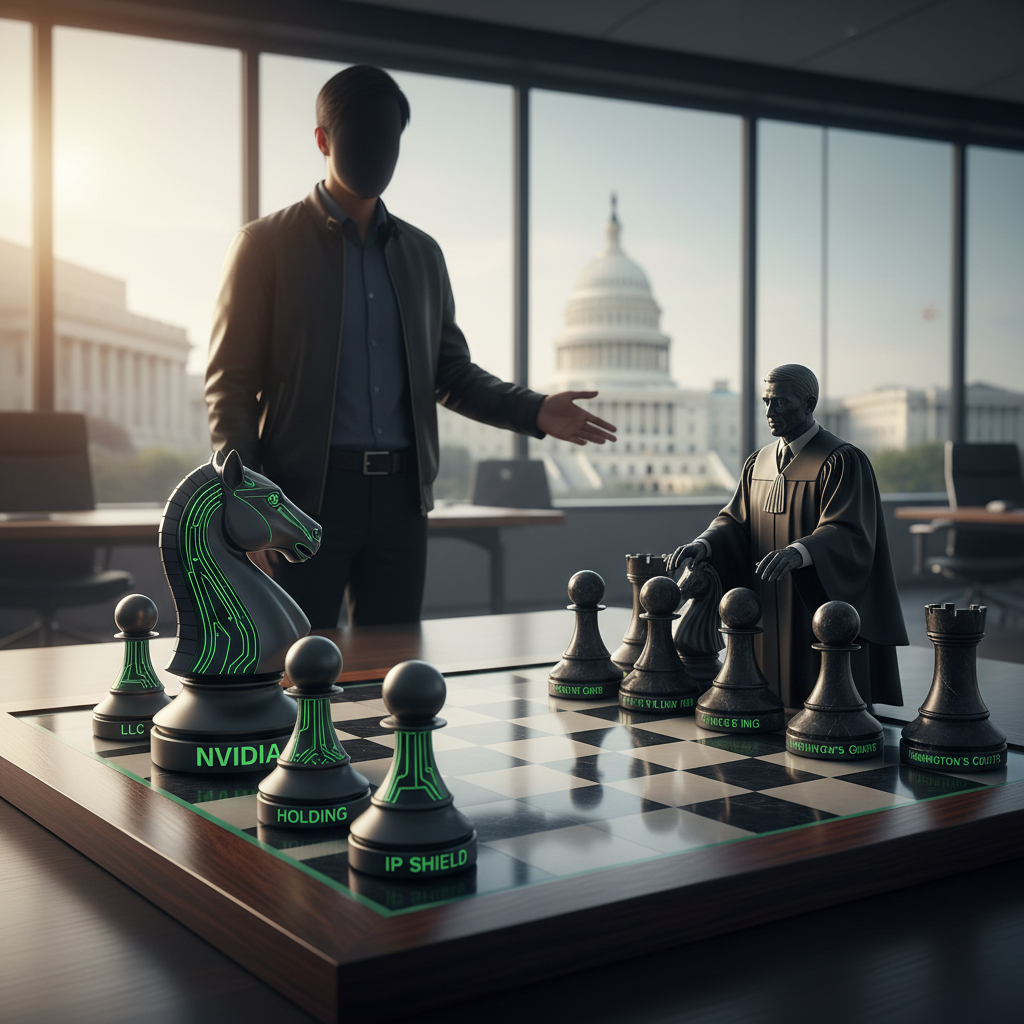

The digital frontier is expanding at an unprecedented pace, driven by the relentless march of artificial intelligence. From autonomous vehicles navigating our streets to diagnostic tools influencing medical decisions, AI's integration into the fabric of American life is undeniable. Yet, beneath the veneer of innovation, a critical question festers: who is responsible when these sophisticated systems cause harm? This is not a hypothetical query; it is a legal and ethical quagmire that corporations, particularly those at the bedrock of AI development like NVIDIA, are actively attempting to navigate, or perhaps, circumvent.
The Strategic Move: Shifting the Blame Downstream
NVIDIA, a titan in the AI hardware and software ecosystem, has been quietly but aggressively pursuing a strategy to minimize its direct liability for AI-induced harms. My investigation reveals a multi-pronged approach centered on contractual clauses, licensing agreements, and a carefully orchestrated lobbying effort in Washington D.C. The core of this strategy is to push the onus of responsibility onto downstream developers, integrators, and end-users. By framing their powerful GPUs and Cuda software platform as mere 'tools' or 'enablers,' NVIDIA seeks to distance itself from the operational failures or ethical lapses of AI applications built upon its technology. This isn't just shrewd business; it's a profound redefinition of corporate responsibility in a rapidly evolving technological landscape.
Context and Motivation: The Billion-Dollar Stakes
The motivation behind NVIDIA's strategy is clear: the financial and reputational stakes are astronomical. As AI systems become more autonomous and their decisions more impactful, the potential for catastrophic failures, biases, or unintended consequences grows exponentially. A single high-profile incident involving an AI system powered by NVIDIA hardware, particularly in sectors like defense, healthcare, or transportation, could trigger a wave of lawsuits, regulatory investigations, and public backlash that could cripple even a company of NVIDIA's stature. Consider the burgeoning market for autonomous weapons systems, many of which rely on NVIDIA's processing power. Or the increasing deployment of AI in critical infrastructure. The potential for a 'black swan' event, where an AI system causes widespread damage or loss of life, is a tangible fear, not just for the public, but for corporate legal departments.
According to a recent report by the Government Accountability Office, the U.S. government alone is projected to spend over $50 billion on AI-related contracts by 2030, a significant portion of which will involve hardware and software from companies like NVIDIA. The specter of liability claims tied to these lucrative contracts is a powerful incentive for pre-emptive legal maneuvering. "The legal frameworks we have, largely designed for mechanical failures or human error, are simply inadequate for autonomous AI systems," states Dr. Evelyn Reed, a leading expert in AI law at Georgetown University. "Companies are scrambling to define their exposure before the courts or Congress do it for them, and NVIDIA is certainly at the forefront of that effort."
Competitive Analysis: A Race to the Bottom?
NVIDIA is not alone in grappling with the AI liability question, but its dominant position in the hardware market gives its strategy outsized influence. Competitors like AMD and Intel, while also developing AI-focused hardware, do not possess the same ecosystem lock-in that NVIDIA enjoys with its Cuda platform. This allows NVIDIA to dictate terms more forcefully to its partners and customers. Software giants like Google, Microsoft, and OpenAI, who develop foundational AI models, face a different set of challenges. Their liability concerns often revolve around data provenance, model bias, and the 'black box' nature of large language models. OpenAI, for instance, has been proactive in publishing safety guidelines and developing internal red-teaming protocols, but their terms of service also heavily emphasize user responsibility for appropriate application of their APIs.
"The lobbying records tell a different story than the public pronouncements of ethical AI development," observed Marcus Thorne, a senior analyst specializing in tech policy at the Center for Public Integrity. "While some companies advocate for clear regulatory guardrails, others, particularly those with deep pockets, are pushing for frameworks that favor producers over consumers, effectively creating legal safe harbors for themselves. Washington's AI policy is shaped by these players, often behind closed doors."
My investigation reveals that NVIDIA's lobbying expenditures in Washington D.C. have surged by over 70% in the last three years, targeting key committees and agencies responsible for technology regulation and defense procurement. This financial investment underscores the strategic importance of shaping the legislative environment to their advantage.
Strengths and Weaknesses of NVIDIA's Approach
Strengths:
- Market Dominance: NVIDIA's near-monopoly in high-performance GPUs and its proprietary Cuda platform provide significant leverage. Developers and enterprises are heavily invested in the NVIDIA ecosystem, making it difficult to switch to alternatives, even if liability terms are unfavorable.
- Contractual Fortification: By embedding stringent liability waivers and indemnification clauses in their licensing agreements, NVIDIA aims to legally transfer risk to its customers. These clauses often stipulate that the customer is solely responsible for the design, testing, deployment, and consequences of any AI application built using NVIDIA's products.
- Lobbying Power: A robust lobbying presence allows NVIDIA to influence nascent AI legislation and regulatory guidance, potentially shaping definitions of 'manufacturer,' 'developer,' and 'operator' in ways that favor hardware providers.
- 'Tool' Metaphor: The argument that GPUs and software libraries are merely 'tools' and not 'products' in the traditional sense is a powerful legal defense, akin to arguing that a hammer manufacturer is not liable for how a carpenter uses their tool.
Weaknesses:
- Public Perception and Trust: An overly aggressive stance on liability could backfire, eroding public trust and inviting greater regulatory scrutiny. In an era where corporate responsibility is increasingly scrutinized, a perception of dodging accountability could be damaging.
- Evolving Legal Precedent: The legal landscape for AI is still in its infancy. Courts may not uphold broad liability waivers, especially in cases of severe harm or where a fundamental flaw in the underlying technology can be proven. The 'tool' metaphor may not hold up when the 'tool' is capable of autonomous decision-making.
- Regulatory Backlash: If industry self-regulation is perceived as insufficient or self-serving, Congress or federal agencies like the FTC or Nist could impose stricter liability standards, potentially through new legislation or expanded interpretations of existing product liability laws.
- Dependency on Downstream Success: While shifting liability, NVIDIA still relies on the success and widespread adoption of AI applications. If developers face insurmountable liability risks, it could stifle innovation and indirectly impact NVIDIA's market.
Verdict and Predictions: A Shifting Sands Game
NVIDIA's strategy is undeniably astute from a purely legal and financial perspective, seeking to protect its bottom line in a highly uncertain future. However, it operates within a dynamic environment where public expectations, technological capabilities, and legal precedents are all in flux. The 'tool' argument, while compelling for basic hardware, becomes increasingly tenuous as AI systems exhibit greater autonomy and complexity. When a self-driving car, powered by NVIDIA's Drive platform, makes a fatal decision, can the company truly claim its chips were merely passive components?
My investigation reveals that this question is precisely what keeps legal teams awake at night, from Silicon Valley to K Street. "The current legal vacuum benefits those with the resources to shape the narrative," states Dr. Julianna Chen, a former federal prosecutor now specializing in tech litigation. "But American courts have a long history of adapting to new technologies, from railroads to pharmaceuticals. Eventually, a precedent will be set, and it may not be favorable to those who sought to completely externalize their risks."
I predict that while NVIDIA's initial efforts to limit direct liability will see some success, particularly in the short term, the long-term trajectory will involve a more nuanced distribution of responsibility. As AI becomes more embedded and its societal impact more profound, public pressure and legislative action will likely push for greater accountability from foundational technology providers. We may see the emergence of new legal doctrines, perhaps akin to 'strict liability' for inherently dangerous products, applied to certain classes of AI systems. The concept of 'AI safety by design' could transition from a best practice to a legal requirement, placing obligations on companies like NVIDIA to build in safeguards from the ground up.
Ultimately, the question of who is responsible when AI causes harm is not just a legal puzzle; it is a societal reckoning. The outcome will shape not only the future of AI development but also the very nature of corporate accountability in the 21st century. The moves made today by industry giants like NVIDIA are not just business decisions; they are foundational blueprints for the ethical and legal architecture of our AI-powered future. The American public, and indeed the world, deserves transparency and accountability, not just innovation. The legal battles ahead will be as complex and transformative as the technology itself. For more insights into the evolving regulatory landscape, readers can consult resources like MIT Technology Review and Reuters Technology News. The future of AI liability is not a settled matter, it is a battleground, and the stakes could not be higher.