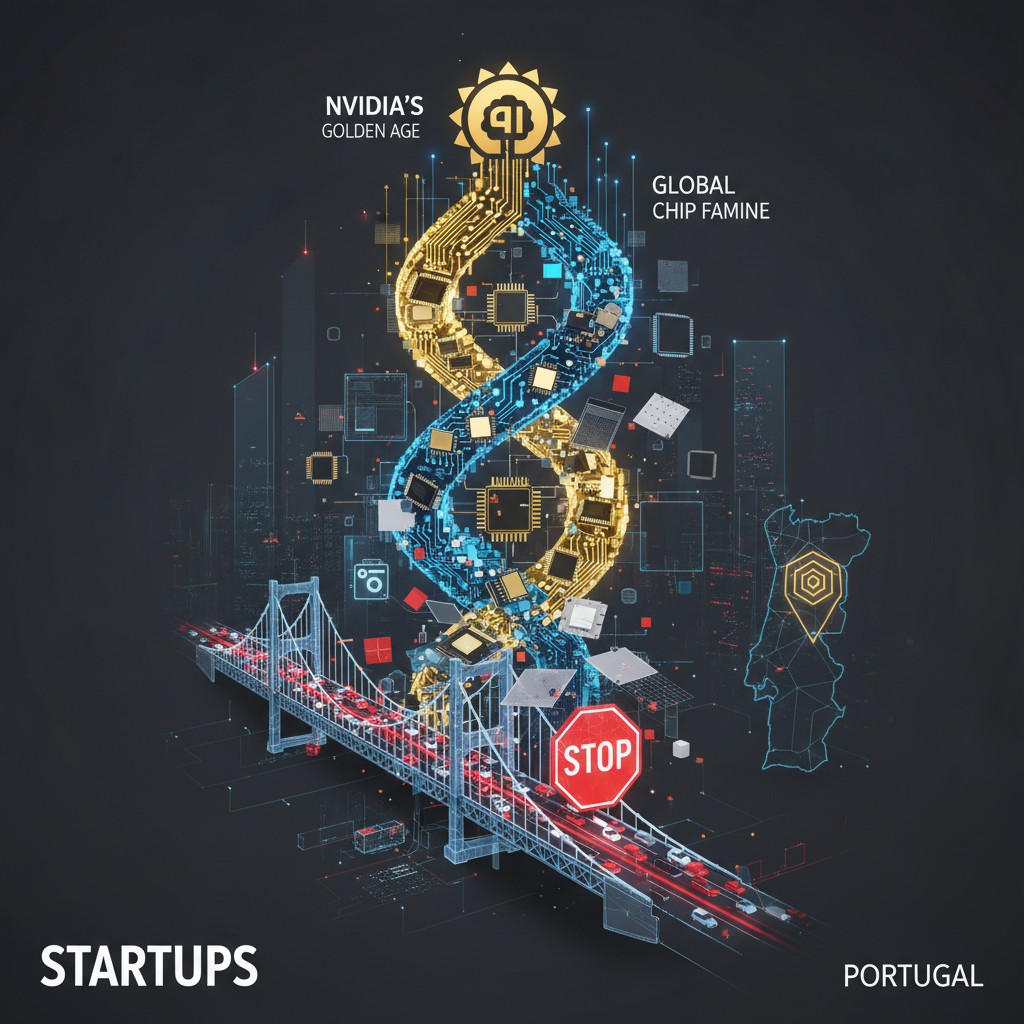
Let us be honest, when we talk about artificial intelligence these days, we often imagine sleek algorithms, dazzling breakthroughs, and perhaps even a robot serving us a proper bica at a café. What we rarely picture, however, is a microscopic piece of silicon, painstakingly etched in a factory halfway across the world, holding the entire digital future hostage. Yet, here we are, in April 2026, and the global semiconductor shortage is not just a nuisance; it is the elephant in the room that is eating all the pastéis de nata and leaving nothing for the rest of us.
Is this a passing cloud, a mere blip on the radar of technological progress, or are we staring down the barrel of a new normal, where the very foundation of AI, the humble chip, becomes a scarce and fiercely guarded resource? This is not some abstract problem for Silicon Valley, mind you. This is a very real, very tangible issue that reaches into every corner of the globe, including our sun-drenched shores in Portugal.
For those of us who remember the early days of the internet, or even the dot-com bust, the idea of a physical bottleneck in a digital age might seem quaint, almost anachronistic. But history, like a good Portuguese stew, often repeats itself with new ingredients. Back in the day, the constraint was often bandwidth, then storage. Now, it is the raw computational power, the very brains of our AI systems, that is proving elusive. The demand for specialized AI chips, particularly those from giants like NVIDIA, has skyrocketed beyond all reasonable projections. Every new large language model, every generative AI breakthrough, every self-driving car prototype, they all scream for more, more, more of these precious semiconductors.
Consider the numbers, if you will. Industry analysts at Bloomberg Technology estimate that the lead times for certain high-end AI chips have stretched to over 50 weeks, a staggering figure that makes planning for startups and even established tech behemoths a nightmare. The global market for AI chips alone is projected to reach well over 100 billion dollars by the end of the decade, a testament to their critical importance. Yet, the manufacturing capacity, concentrated in a handful of facilities, primarily in Taiwan and South Korea, simply cannot keep pace. It is like trying to fill the Tagus river with a single garden hose; admirable effort, but ultimately futile.
I spoke with Dr. Sofia Costa, a leading expert in supply chain logistics at the Instituto Superior Técnico in Lisbon, about this predicament. "We are seeing a perfect storm," she explained, her voice tinged with a pragmatic weariness. "Geopolitical tensions, the lingering effects of the pandemic on manufacturing, and an unprecedented surge in demand for AI applications have converged. It is not just about building new fabs, which takes years and billions of euros, it is about the entire ecosystem, from raw materials to specialized equipment. The resilience simply isn't there yet." Her assessment makes it clear that this is not a simple fix.
From a startup perspective, the situation is even more dire. Imagine you are a brilliant young team in Porto, developing a groundbreaking AI solution for sustainable agriculture, a field where Portugal punches above its weight. You have secured funding, you have the talent, but then you hit a wall: you cannot get the GPUs you need to train your models. This is not a hypothetical scenario; it is the lived reality for many. "We had to scale back our initial training runs by nearly 30 percent," confessed Miguel Santos, CEO of AgroInteligência, a promising agricultural AI startup based in Alentejo. "The cost of acquiring the few chips we could find was astronomical, eating into our runway. It feels like we are competing with OpenAI and Google for the same handful of components, and guess who wins that fight?" His frustration was palpable, a sentiment echoed by many in Lisbon's burgeoning tech scene.
This scarcity creates a hierarchy, a digital caste system if you will. The titans, the NVIDIAs, the Googles, the OpenAIs, they can afford to buy up entire allocations, securing their future at the expense of smaller players. This consolidates power and innovation in the hands of a few, potentially stifling the very diversity and disruptive spirit that makes the tech world so exciting. It is a bit like the old days of the Portuguese fishing industry, where the big trawlers could corner the market, leaving the small, nimble sardine boats struggling. And we all know how important the sardine is to our culture. The sardine can of European tech is actually a treasure chest, but it is getting harder to open.
Some argue that this is merely a temporary market correction, a natural consequence of rapid innovation. "The market will adjust," posits Dr. Elena Petrova, a senior analyst at Gartner, speaking from a recent virtual conference. "New fabrication plants are coming online in the US and Europe, albeit slowly. There will be a rebalancing, and we might even see more localized supply chains emerge as a strategic imperative." While her optimism is welcome, the timeline for these new fabs is measured in years, not months, and the investment required is colossal, often requiring significant government subsidies, as seen with initiatives in Germany and the US.
My verdict? This is no mere fad; it is the new normal, at least for the foreseeable future. The insatiable demand for AI, coupled with the complex, capital-intensive, and geographically concentrated nature of semiconductor manufacturing, means that chip scarcity will remain a defining characteristic of the AI landscape for years to come. We are not just talking about a few months of inconvenience; we are talking about fundamental shifts in how AI research is conducted, how startups are funded, and how national strategies for technological sovereignty are shaped. Lisbon's tech scene is like a good port wine, complex and improving with age, but even the finest vintage needs the right conditions to mature. Without the foundational hardware, even the most brilliant ideas risk remaining just that: ideas.
What does this mean for us? It means a renewed focus on efficiency, on optimizing existing hardware, and perhaps even a push towards more specialized, less power-hungry AI architectures. It means European initiatives, like the EU Chips Act, become not just aspirational but absolutely critical. It means that while the big players continue to dominate, there will be an even greater premium on innovative software solutions that can do more with less. The future of AI, it seems, will not just be about who has the smartest algorithms, but who can actually get their hands on the chips to run them. And that, my friends, is a reality we all need to digest, perhaps with a strong coffee and a dose of Portuguese resilience. For more on the broader impact of AI on industry, you might want to read this piece on MIT Technology Review. The path ahead is challenging, but then again, when has true innovation ever been easy?