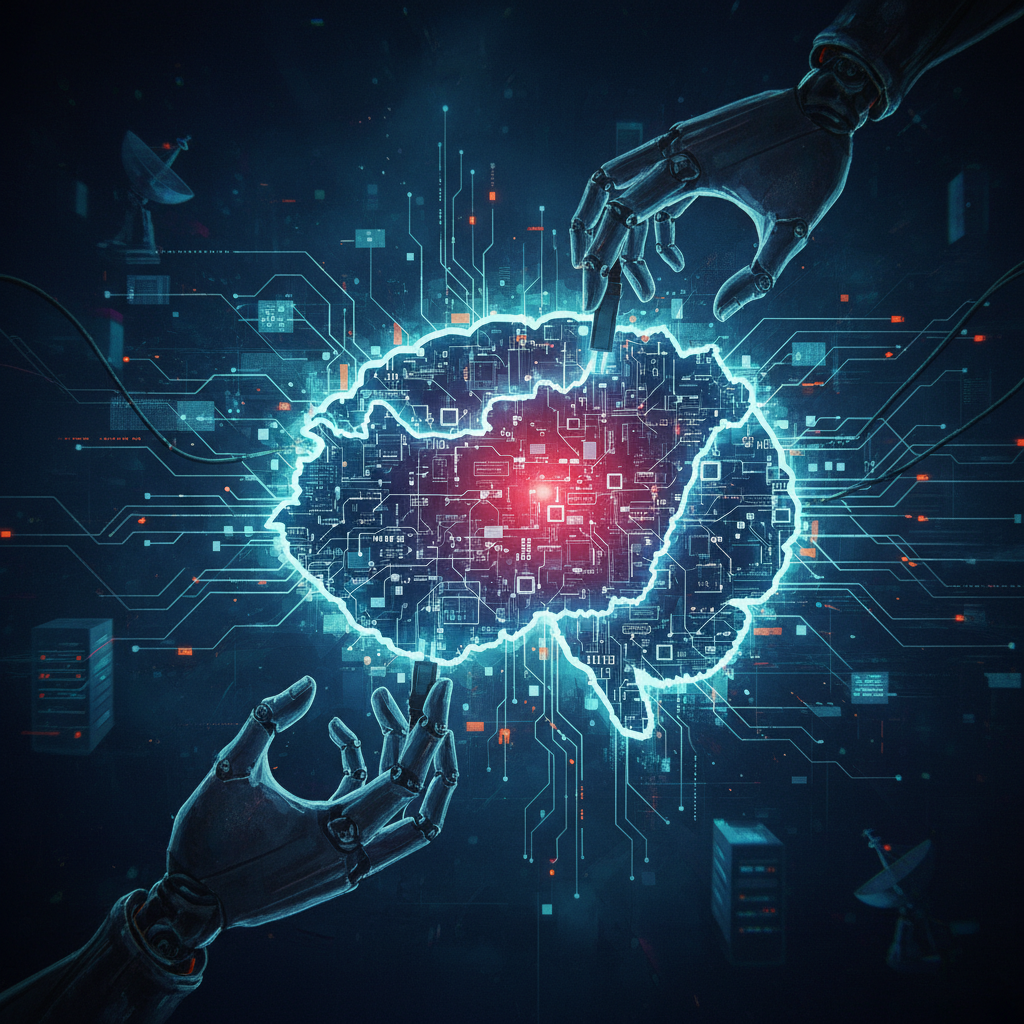

Let us be honest. When the tech titans talk about 'mimicking the human brain,' most people hear 'faster AI' or 'more efficient computing.' They envision a future of seamless integration, smart cities, and perhaps even a personal robot butler that understands their every whim. But I, Ferencz Nagŷ, see something else entirely: a subtle, insidious erosion of sovereignty, a transfer of cognitive power to a handful of corporations and nations. This is not just about silicon and circuits, my friends, it is about control.
The latest buzz around neuromorphic computing, exemplified by efforts from giants like Intel with their Loihi chips and IBM's TrueNorth, and of course, NVIDIA's relentless push into specialized AI hardware, presents a fascinating, yet deeply unsettling, paradox. These chips, designed to process information in a way that mirrors the brain's neural pathways, promise unparalleled efficiency for certain AI tasks. Imagine AI that learns continuously, adapts on the fly, and consumes a fraction of the energy of today's power-hungry GPUs. Sounds like a dream, does it not? For Hungary, and for Europe, it could very well become a nightmare if we are not careful.
The Risk Scenario: A Cognitive Colonialism
My primary concern is this: as neuromorphic computing becomes the gold standard for advanced AI, particularly for real-time, edge-based applications, what happens if the underlying architecture, the very 'brain' of our future, is exclusively controlled by non-European entities? We are already dependent on NVIDIA for the vast majority of high-performance AI accelerators. Their Cuda platform is practically a lingua franca for AI development. Now, imagine that dependency extended to the very conceptualization of AI intelligence. If the most advanced, brain-like AI systems are proprietary, developed, and deployed by a few dominant players, then our ability to innovate, to secure our data, and to even understand how these systems make decisions becomes severely compromised. It is a form of cognitive colonialism, where the intellectual infrastructure of our digital future is outsourced, leaving us as mere consumers, not creators.
Technical Explanation: Beyond Von Neumann
To understand the gravity of this, one must grasp what neuromorphic computing truly entails. Traditional computers, the Von Neumann architecture we have used for decades, separate processing from memory. Data constantly shuffles between the CPU and RAM, creating a bottleneck, the 'Von Neumann bottleneck,' that limits speed and consumes significant power. This is why training large language models requires server farms that glow like small suns.
Neuromorphic chips, however, fundamentally rethink this. They integrate memory and processing, much like biological neurons. Each 'neurosynaptic core' contains both memory and computational units, allowing for parallel processing and event-driven communication. Instead of precise numerical calculations, they excel at pattern recognition, associative learning, and sparse, asynchronous communication. Think of it less like a calculator and more like a sensory organ. Companies like Intel have demonstrated their Loihi chips with thousands of these cores, enabling tasks like gesture recognition or anomaly detection with drastically reduced power consumption compared to traditional GPUs. NVIDIA, while perhaps not exclusively 'neuromorphic' in the purest sense, is certainly pushing towards more specialized, brain-inspired architectures to optimize AI workloads, blurring the lines between traditional and novel approaches. The goal is clear: build AI that is not just powerful, but also efficient and adaptive, much like the human brain. This is where the allure, and the danger, lies.
Expert Debate: Efficiency Versus Ethics
On one side, you have the proponents, often from the very companies developing these technologies. They highlight the incredible efficiency gains. "Neuromorphic systems offer a path to truly ubiquitous AI, enabling intelligence on devices with minimal power budgets, from smart sensors to autonomous vehicles," stated Dr. Mike Davies, Director of Intel's Neuromorphic Computing Lab, in a recent industry conference. He emphasizes the potential for breakthroughs in areas like robotics and real-time decision-making, where current AI struggles with latency and energy demands. This is undoubtedly true, the technical promise is immense.
However, others raise critical questions. "While the efficiency is undeniable, we must ask about the interpretability and control of these complex, brain-inspired systems," argues Professor Joanna Bryson, an ethicist and AI researcher from the Hertie School. "If we do not understand how a system arrives at a decision, especially one that mimics biological processes, how can we ensure it aligns with our values or even diagnose failures? The black box problem becomes even more opaque." Her point is salient. If these chips are designed to learn and adapt in ways that are less explicit than traditional algorithms, auditing their behavior becomes a monumental task.
From a European perspective, particularly from a place like Hungary, the debate takes on an additional layer of urgency. "Budapest has a message for Brussels: digital sovereignty is not an abstract concept, it is about the physical infrastructure and the intellectual property that underpins our future," I have often said. The EU AI Act is a commendable first step, attempting to regulate AI based on risk. But how do you regulate a 'brain' that is constantly re-wiring itself, especially if that 'brain' is manufactured and controlled thousands of kilometers away? This is not just about data privacy, it is about cognitive autonomy.
Real-World Implications for Hungary and Europe
For Hungary, a nation that has consistently advocated for national interests and digital independence, the implications are profound. Imagine our critical infrastructure, from energy grids to defense systems, relying on AI powered by neuromorphic chips whose inner workings are proprietary secrets of foreign corporations. Our ability to secure these systems, to audit them for biases or vulnerabilities, or even to adapt them to local needs, would be severely hampered. We risk becoming digital vassals, dependent on the technological largesse of others.
Furthermore, there is the brain drain. If the cutting-edge research and development in neuromorphic computing is concentrated in Silicon Valley or Shenzhen, where will our brightest minds go? Hungary has excellent universities, like the Budapest University of Technology and Economics, producing world-class engineers and researchers. But without access to the latest hardware, the most advanced architectures, and the funding to compete, we risk losing these talents to foreign shores. This is a critical issue for our long-term economic and technological competitiveness. We cannot afford to be left behind, but neither can we afford to surrender our future.
Consider the ongoing efforts by the European Commission to foster European champions in microelectronics, such as the European Chips Act. This initiative aims to double Europe's share in global chip production to 20% by 2030, with investments reaching 43 billion euros. While commendable, much of this focus has been on traditional silicon manufacturing and advanced packaging. The question is, are we investing enough in novel architectures like neuromorphic computing? Or are we playing catch-up in a game whose rules are constantly being rewritten by others? This is where the rubber meets the road, as they say. The Hungarian perspective nobody wants to hear is that we need to be proactive, not reactive, in shaping our technological destiny.
What Should Be Done: A Call for European Cognitive Autonomy
So, what is the path forward? We cannot simply ban neuromorphic computing; that would be akin to forbidding the invention of the wheel. The answer lies in strategic investment, collaboration, and a fierce commitment to digital sovereignty.
First, Europe, and Hungary within it, must aggressively invest in indigenous neuromorphic research and development. This means funding academic institutions, fostering startups, and creating incentives for companies to build these advanced architectures within our borders. We need our own Intel Loihi, our own NVIDIA equivalent, focused on European values and security standards. This is not about protectionism, it is about self-preservation.
Second, we need open standards and transparent development. If proprietary black boxes become the norm for brain-inspired AI, then trust and security will remain elusive. The European Union should push for international agreements that mandate a degree of transparency in the design and auditing of high-risk AI systems, especially those with neuromorphic underpinnings. This includes demanding access to architectural details and validation methodologies, not just for the software layer, but for the hardware itself.
Third, and perhaps most crucially, we must cultivate a diverse ecosystem of AI talent and infrastructure. This means investing in Stem education from primary school through PhD programs, creating attractive career opportunities, and building state-of-the-art research facilities. We need to ensure that our brightest minds see a future here, contributing to European innovation, rather than being lured away by foreign tech giants. This is a battle for minds, not just markets.
The promise of neuromorphic computing is immense, offering a future of highly efficient, adaptive AI. But the risks of ceding control over this foundational technology are equally vast. If we allow ourselves to become mere consumers of foreign-made digital brains, we will find that our digital sovereignty, our ability to control our own future, has been silently, subtly, and irrevocably eroded. Contrarian? Maybe. Wrong? Prove it. The time for Europe to act is now, before the neurons of our future are all wired by someone else. For more on the broader implications of AI hardware, one might consider the discussions found on MIT Technology Review. The stakes are too high to simply watch and wait. And for those interested in the latest AI advancements and their societal impacts, Wired's AI section often provides insightful perspectives.