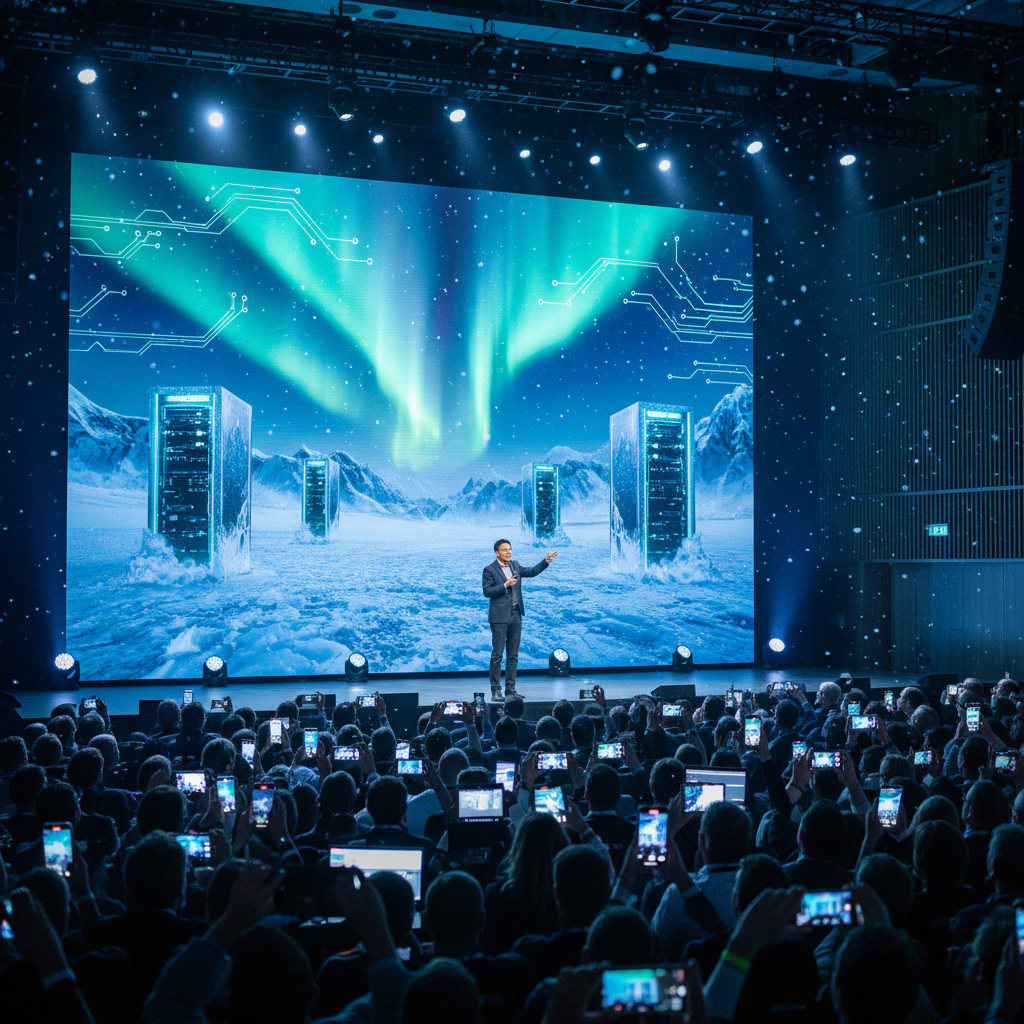
The chill of the Nordic spring was met with a different kind of heat this week, as NVIDIA CEO Jensen Huang delivered a pivotal keynote address from Helsinki. His pronouncements, centered on a multi-billion euro investment into Finland's burgeoning AI infrastructure, mark a significant turning point, not just for the nation but for Europe's strategic positioning in the global AI ecosystem. This is not merely about data centers, it is about the fundamental architecture of future intelligence, and Finland finds itself at the epicenter.
Huang, speaking at a specially convened European AI Summit in the Finnish capital, unveiled plans for what he termed the 'Arctic AI Nexus,' a network of high-performance computing facilities powered by NVIDIA's latest Blackwell platform. The initial investment, projected at 3.5 billion euros over the next three years, aims to establish Finland as a critical hub for AI research, development, and deployment, leveraging its stable political climate, abundant renewable energy, and robust digital infrastructure. This is a clear signal that NVIDIA sees more than just cold weather in the North; it sees a strategic advantage.
“Finland’s unique combination of geothermal and hydro power, coupled with its advanced fiber optic networks, makes it an ideal location for the next generation of AI supercomputing,” Huang stated, his words echoing through the Helsinki Convention Centre. “We are not just building data centers; we are building the foundational compute for Europe’s AI future, and Finland will be at its core.”
The announcement comes amidst a global scramble for AI compute power, with nations and corporations alike vying for dominance. NVIDIA, already a trillion-dollar entity, holds a near-monopoly on the high-end GPUs essential for training large language models and complex AI systems. This move into Finland solidifies its footprint in a region known for its pragmatism and technological prowess. Nokia taught us something about reinvention, and now Finland is applying those lessons to the AI era.
Reactions from Finnish officials were swift and overwhelmingly positive. Mika Lintilä, Finland’s Minister of Economic Affairs, emphasized the long-term benefits. “This investment is a testament to Finland’s commitment to sustainable technological leadership,” Lintilä told DataGlobal Hub. “It will create thousands of high-skilled jobs, attract further foreign investment, and cement our reputation as a trusted partner in advanced computing. Our digital government initiatives already rely on robust infrastructure, and this elevates our capabilities significantly.”
Indeed, Finland's approach is quietly revolutionary. For years, the nation has cultivated an environment conducive to technological innovation, underpinned by one of the world's leading education systems and a deep-seated culture of engineering excellence. The gaming industry, exemplified by global giants like Supercell and Rovio, has fostered a generation of highly skilled software developers and data scientists, providing a ready talent pool for NVIDIA’s ambitious plans.
However, the scale of NVIDIA's ambition also brings questions. The energy demands of these new facilities will be immense, even with Finland's renewable energy focus. While the country boasts a high percentage of clean energy, primarily from hydro and nuclear sources, the sheer volume of power required for exascale AI compute could strain existing grids or necessitate rapid expansion. “We must ensure that this growth is truly sustainable and does not compromise our national energy security,” cautioned Dr. Elina Virtanen, an energy policy expert at Aalto University. “The ‘sauna principle of AI development, slow heat, lasting results’ must apply here too, meaning careful planning and integration.”
Expert analysis suggests this move is a strategic play by NVIDIA to diversify its geographical footprint and cater to European data sovereignty concerns. With the EU AI Act now in full effect, having compute infrastructure within the bloc, governed by European regulations, becomes increasingly attractive for companies developing sensitive AI applications. “This isn’t just about hardware; it’s about geopolitics and regulatory alignment,” explained Professor Antti Saarinen, a data governance specialist at the University of Helsinki. “NVIDIA is positioning itself as a crucial enabler for European AI independence, offering a powerful alternative to reliance on US or Asian-based cloud providers for core AI training.”
The implications for Finland's academic and research sectors are profound. The University of Oulu, a leader in Arctic technology and 6G research, stands to benefit from enhanced access to cutting-edge GPU resources. Similarly, institutions like VTT Technical Research Centre of Finland will find new avenues for collaboration, accelerating breakthroughs in fields from materials science to personalized medicine. This localized access to high-performance computing is expected to catalyze a new wave of Finnish AI startups, building on the nation's strong entrepreneurial spirit.
What happens next? The immediate focus will be on site selection and the commencement of construction. NVIDIA has indicated a preference for locations with existing infrastructure and proximity to renewable energy sources, suggesting areas in Southern and Central Finland are prime candidates. The Finnish government, for its part, is expected to fast-track necessary permits and provide incentives to ensure the project's smooth execution. The long-term impact will be measured not just in economic output, but in Finland’s enhanced capacity to innovate and compete on the global stage.
For readers, this development underscores a fundamental shift in the AI landscape. The race for AI dominance is no longer confined to Silicon Valley boardrooms; it is a global competition for compute power, talent, and strategic location. Finland, with its quiet confidence and pragmatic approach, has positioned itself as an indispensable player. The Nordic nation's commitment to ethical AI and sustainable development will now be tested on a scale previously unseen, as it becomes a cornerstone of NVIDIA's trillion-dollar ecosystem. The world will be watching to see if this Arctic ambition can truly deliver lasting, impactful results for the future of artificial intelligence. More details on NVIDIA's broader strategy can be found at NVIDIA AI and further European AI developments are often covered by Reuters Technology. For those interested in the broader societal implications of such large-scale AI infrastructure, Wired's AI section offers extensive analysis.