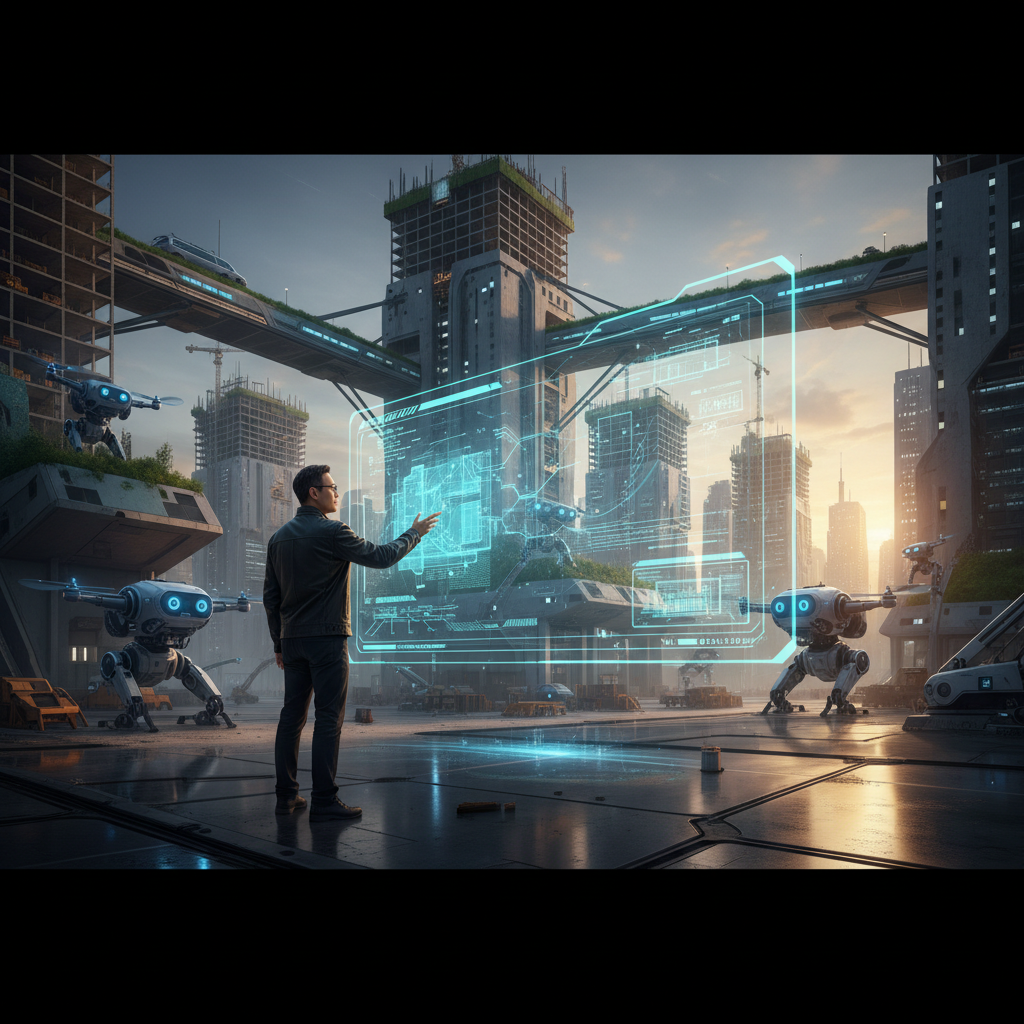

Let's be real, the construction industry in the USA, for all its grit and muscle, has been notoriously slow to embrace the digital revolution. For decades, it felt like we were still sketching blueprints on parchment while Silicon Valley was launching rockets to Mars. But now, suddenly, everyone's buzzing about AI transforming everything from how we design skyscrapers to how we keep workers safe on a job site. And guess what? The usual suspects, like NVIDIA, are right there, ready to sell us the shovels for this new digital gold rush.
But before we start handing out participation trophies, let's get into the nitty-gritty. This isn't about some vague 'AI will make things better' mantra. This is a technical deep dive into how AI is actually being deployed, what algorithms are at play, and more importantly, what are the real-world implications beyond the marketing hype. Because, frankly, Silicon Valley has a blind spot the size of Texas when it comes to understanding the complex, human-centric realities of industries like construction.
The Technical Challenge: Building a Smarter, Safer, Faster World
The problems in construction are complex and multifaceted. We're talking about massive projects, tight margins, intricate designs, dangerous environments, and a workforce that's often overlooked by the high-tech crowd. AI promises to tackle three core areas: building design optimization, safety monitoring, and project management. Each presents unique computational hurdles.
For design optimization, the challenge is multi-objective: minimizing material use, maximizing structural integrity, optimizing energy efficiency, and adhering to strict building codes. Traditionally, this involves iterative human-driven CAD work and finite element analysis (FEA). Safety monitoring demands real-time, robust anomaly detection in dynamic, often chaotic environments. Project management, meanwhile, grapples with scheduling complexities, resource allocation, and risk prediction across thousands of interdependent tasks.
Architecture Overview: The AI Stack for Construction
At a high level, an AI-driven construction system typically involves several interconnected components. Data acquisition is paramount, pulling from BIM (Building Information Modeling) models, IoT sensors on equipment and wearables, drone imagery, and historical project data. This raw data feeds into a centralized cloud platform, often leveraging services from AWS, Google Cloud, or Microsoft Azure, where the heavy computational lifting happens. Edge computing devices, powered by NVIDIA Jetson modules for instance, handle real-time processing for safety applications directly on site.
For design, we're looking at a feedback loop: architect input -> AI model generation/optimization -> engineer review -> iteration. For safety, it's sensor input -> edge inference -> alert system. For project management, it's data ingestion -> predictive analytics -> dashboard/recommendation engine.
Key Algorithms and Approaches
-
Building Design Optimization: Generative design is the star here. Algorithms like Generative Adversarial Networks (GANs) or Variational Autoencoders (VAEs) can explore vast design spaces, proposing novel structural forms or material configurations that meet performance criteria. Coupled with Reinforcement Learning (RL), an agent can learn to optimize designs based on simulated performance metrics, such as structural load, thermal efficiency, or constructability. For example, an RL agent might be rewarded for designs that reduce steel tonnage by 15% while maintaining a safety factor of 2.0 under specified seismic loads. Parametric modeling tools often integrate with these AI engines, allowing designers to set constraints and objectives, then letting the AI generate optimal geometries.
-
Safety Monitoring: This is heavily reliant on Computer Vision (CV) and Deep Learning. Object detection models, often based on architectures like yolo (You Only Look Once) or Mask R-cnn, are trained on vast datasets of construction site imagery to identify workers, heavy machinery, personal protective equipment (PPE) compliance, and hazardous conditions like open trenches or falling debris. Pose estimation models can track worker movements, detecting falls or unsafe postures. Anomaly detection, using autoencoders or one-class SVMs, can flag unusual events that deviate from normal site activity. The challenge is robust performance in varying lighting, weather, and occlusions. Think about a worker without a hardhat in a dimly lit corner of a new build, the system needs to flag that instantly.
-
Project Management: Here, Predictive Analytics and Machine Learning reign supreme. Recurrent Neural Networks (RNNs) or Transformer models can analyze historical project data, weather patterns, material supply chain fluctuations, and labor availability to forecast project timelines and costs with greater accuracy. Graph Neural Networks (GNNs) are emerging for modeling complex interdependencies between tasks and resources. For resource allocation, optimization algorithms like genetic algorithms or simulated annealing can find near-optimal schedules. Imagine an AI predicting a 3-day delay on a critical path item due to an impending snowstorm and automatically suggesting a re-sequencing of non-weather-dependent tasks and re-allocating crane time. According to a recent report, such AI systems can reduce project delays by up to 20% Reuters.
Implementation Considerations and Gotchas
Deploying these systems isn't just about writing code. Data quality is a massive hurdle. Construction data is often siloed, inconsistent, and incomplete. Training robust CV models requires enormous, well-annotated datasets, which are expensive to acquire for diverse construction scenarios. Bias in training data can lead to algorithmic discrimination, for example, a PPE detection system that performs poorly on workers with specific skin tones or body types. Uncomfortable truth time: the industry's historical lack of diversity means this is a very real concern.
Latency is critical for safety applications. A fall detection system that alerts minutes after an incident is useless. This drives the need for edge computing and optimized inference models. Integration with legacy systems is another headache. Many construction firms still rely on decades-old software for scheduling and accounting. These aren't just technical problems; they're organizational and cultural ones.
Benchmarks and Comparisons
Traditional methods rely on human expertise, spreadsheets, and basic project management software. AI offers significant improvements in speed, scale, and pattern recognition. For design, AI can explore millions of permutations in hours, something a human designer couldn't do in a lifetime. For safety, continuous, tireless monitoring far surpasses intermittent human inspections. For project management, AI's ability to process vast datasets and predict cascading effects is unmatched by manual methods.
Companies like Autodesk, Bentley Systems, and Trimble are all integrating AI capabilities into their platforms, often leveraging NVIDIA's powerful GPUs for processing. Google's DeepMind and Microsoft's AI research divisions are also exploring applications, though perhaps less directly in the construction vertical itself. The competitive edge often comes down to proprietary datasets and the ability to fine-tune general AI models for specific construction contexts.
Code-Level Insights
For CV, popular frameworks include TensorFlow and PyTorch. Libraries like OpenCV are essential for pre-processing image and video data. For object detection, pre-trained models from Hugging Face's Transformers library or PyTorch Hub can be fine-tuned. For RL, Stable Baselines3 offers robust implementations of algorithms like PPO or SAC. Data scientists might use Pandas and Scikit-learn for initial data analysis and traditional ML tasks in project management, transitioning to deep learning frameworks for more complex predictive models.
Example for a simple PPE detection pipeline (conceptual):
import cv2
import torch
from torchvision.models.detection import fasterrcnn_resnet50_fpn_v2, FasterRCNN_ResNet50_FPN_V2_Weights

# Load pre-trained model for object detection
weights = FasterRCNN_ResNet50_FPN_V2_Weights.DEFAULT
model = fasterrcnn_resnet50_fpn_v2(weights=weights, box_score_thresh=0.9)
model.eval()

# Define classes for detection (simplified)
COCO_INSTANCE_CATEGORY_NAMES = [
 '__background__', 'person', 'bicycle', 'car', 'motorcycle', 'airplane', 'bus',
 'train', 'truck', 'boat', 'traffic light', 'fire hydrant', 'N/A', 'stop sign',
 'parking meter', 'bench', 'bird', 'cat', 'dog', 'horse', 'sheep', 'cow',
 'elephant', 'bear', 'zebra', 'giraffe', 'N/A', 'backpack', 'umbrella', 'N/A',
 'N/A', 'handbag', 'tie', 'suitcase', 'frisbee', 'skis', 'snowboard', 'sports ball',
 'kite', 'baseball bat', 'baseball glove', 'skateboard', 'surfboard', 'tennis racket',
 'bottle', 'N/A', 'wine glass', 'cup', 'fork', 'knife', 'spoon', 'bowl', 'banana',
 'apple', 'sandwich', 'orange', 'broccoli', 'carrot', 'hot dog', 'pizza', 'donut',
 'cake', 'chair', 'couch', 'potted plant', 'bed', 'N/A', 'dining table', 'N/A',
 'N/A', 'toilet', 'N/A', 'tv', 'laptop', 'mouse', 'remote', 'keyboard', 'cell phone',
 'microwave', 'oven', 'toaster', 'sink', 'refrigerator', 'N/A', 'book', 'clock',
 'vase', 'scissors', 'teddy bear', 'hair drier', 'toothbrush'
]

# Add custom classes for construction PPE (e.g., hardhat, safety vest)
CUSTOM_CLASSES = ['hardhat', 'safety_vest']
ALL_CLASSES = Coco_instance_category_names + Custom_classes

def detect_ppe(image_path):
 img = cv2.imread(image_path)
 img_rgb = cv2.cvtColor(img, cv2.COLOR_BGR2RGB)
 transform = weights.transforms()
 input_tensor = transform(img_rgb)

with torch.no_grad():
 prediction = model([input_tensor])

# Process prediction to identify PPE and workers
 # This would involve mapping bounding boxes to custom classes
 # and checking for overlap/proximity to 'person' detections.
 # For brevity, actual processing logic is omitted.
 print(f
import cv2
import torch
from torchvision.models.detection import fasterrcnn_resnet50_fpn_v2, FasterRCNN_ResNet50_FPN_V2_Weights

# Load pre-trained model for object detection
weights = FasterRCNN_ResNet50_FPN_V2_Weights.DEFAULT
model = fasterrcnn_resnet50_fpn_v2(weights=weights, box_score_thresh=0.9)
model.eval()

# Define classes for detection (simplified)
COCO_INSTANCE_CATEGORY_NAMES = [
 '__background__', 'person', 'bicycle', 'car', 'motorcycle', 'airplane', 'bus',
 'train', 'truck', 'boat', 'traffic light', 'fire hydrant', 'N/A', 'stop sign',
 'parking meter', 'bench', 'bird', 'cat', 'dog', 'horse', 'sheep', 'cow',
 'elephant', 'bear', 'zebra', 'giraffe', 'N/A', 'backpack', 'umbrella', 'N/A',
 'N/A', 'handbag', 'tie', 'suitcase', 'frisbee', 'skis', 'snowboard', 'sports ball',
 'kite', 'baseball bat', 'baseball glove', 'skateboard', 'surfboard', 'tennis racket',
 'bottle', 'N/A', 'wine glass', 'cup', 'fork', 'knife', 'spoon', 'bowl', 'banana',
 'apple', 'sandwich', 'orange', 'broccoli', 'carrot', 'hot dog', 'pizza', 'donut',
 'cake', 'chair', 'couch', 'potted plant', 'bed', 'N/A', 'dining table', 'N/A',
 'N/A', 'toilet', 'N/A', 'tv', 'laptop', 'mouse', 'remote', 'keyboard', 'cell phone',
 'microwave', 'oven', 'toaster', 'sink', 'refrigerator', 'N/A', 'book', 'clock',
 'vase', 'scissors', 'teddy bear', 'hair drier', 'toothbrush'
]

# Add custom classes for construction PPE (e.g., hardhat, safety vest)
CUSTOM_CLASSES = ['hardhat', 'safety_vest']
ALL_CLASSES = Coco_instance_category_names + Custom_classes

def detect_ppe(image_path):
 img = cv2.imread(image_path)
 img_rgb = cv2.cvtColor(img, cv2.COLOR_BGR2RGB)
 transform = weights.transforms()
 input_tensor = transform(img_rgb)

with torch.no_grad():
 prediction = model([input_tensor])

# Process prediction to identify PPE and workers
 # This would involve mapping bounding boxes to custom classes
 # and checking for overlap/proximity to 'person' detections.
 # For brevity, actual processing logic is omitted.
 print(f