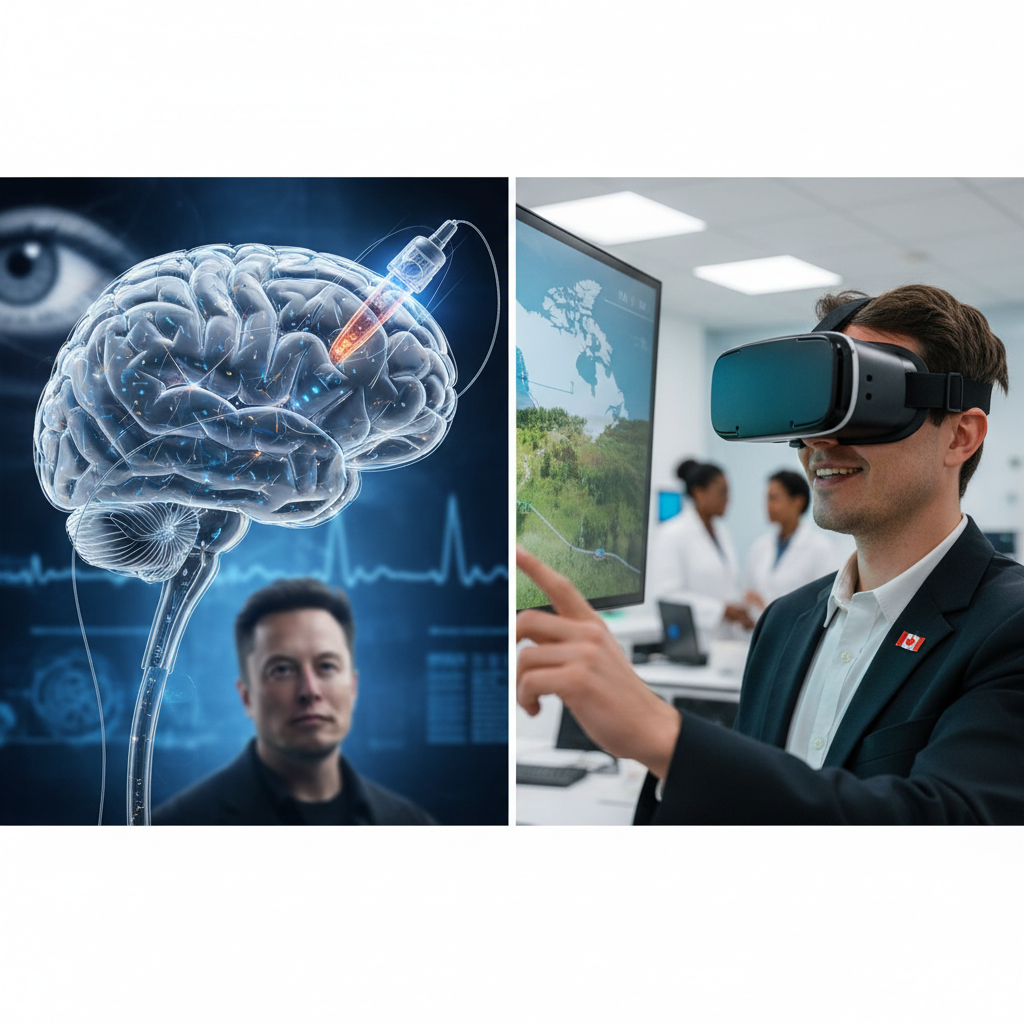

Bienvenue, mes amis, to a world where the lines between thought and action are blurring faster than a hockey puck on fresh ice. For years, the idea of directly connecting our brains to machines felt like something ripped straight from a cyberpunk novel. But today, in April 2026, it is not just a concept, it is a rapidly accelerating reality, particularly in the realm of restoring sight, speech, and movement. And while the headlines often shout about one particular tech titan, I want to tell you about the quiet, persistent innovation happening right here in North America, especially in Canada.
Let us start with the big splash, shall we? Elon Musk's Neuralink has certainly captured the world's imagination, and a substantial amount of venture capital, with its bold claims. Their recent demonstrations, showing a patient controlling a computer cursor with their thoughts, were undeniably impressive. The sheer ambition to restore functionality to those with severe paralysis is commendable, and the progress is real. According to their public statements, Neuralink is pushing for FDA approval for broader human trials, aiming to move beyond basic cursor control to more complex interactions, potentially even addressing conditions like blindness or deafness. It is a future where a small chip, no bigger than a loonie, could unlock immense potential.
But here is where my Canadian pragmatism kicks in. While the spectacle is captivating, the foundational research, the deep dive into how our brains actually work and how AI can interpret those signals, often happens away from the glaring spotlights. Montreal's AI scene is world-class, here's the proof. Our researchers, often working in collaboration with institutions like Mila, the Quebec AI Institute, are making strides that are less about flash and more about fundamental understanding and ethical implementation. They are not just building the car, they are designing the engine and the road map for safe travel.
Consider the work being done on restoring speech. For individuals who have lost the ability to speak due to neurological conditions like ALS or stroke, the prospect of communicating freely again is nothing short of miraculous. Researchers at the University of California San Francisco, for instance, have shown remarkable progress in decoding brain activity into speech. Their system, powered by sophisticated AI algorithms, can translate brain signals into words on a screen with impressive accuracy and speed. This is not just selecting pre-programmed phrases, this is synthesizing novel sentences based on intended speech. It is like having a direct line from your thoughts to a digital voice, bypassing the damaged vocal cords entirely. The research is fascinating, and it is built on years of neuroscientific understanding and advanced machine learning models that can sift through the neural static to find the signal.
Then there is the restoration of movement. For someone living with paralysis, regaining even a small degree of control over a limb or a prosthetic device can be life-altering. Companies like Blackrock Neurotech, based out of Utah, have been quietly working in this space for years, developing implantable microelectrode arrays that allow individuals to control robotic arms or computer interfaces with their thoughts. Their systems have enabled patients to perform complex tasks, from drinking coffee to operating a tablet. This is not just a party trick, it is about restoring independence and dignity. The AI here acts as a sophisticated interpreter, learning the unique neural signatures associated with different movements and translating them into commands for external devices. It is a dance between biology and silicon, orchestrated by intelligent algorithms.
And what about sight? This is perhaps one of the most ambitious frontiers. Imagine a camera feeding visual information directly into the brain, bypassing damaged optic nerves or retinas. While still in its early stages, research in this area is gaining momentum. Companies like Second Sight, though facing their own financial hurdles, have demonstrated the potential of retinal implants to restore some form of vision to the blind. The next generation of these devices, heavily reliant on AI for image processing and neural stimulation, aims for even greater clarity and functionality. It is like giving the brain a new set of eyes, albeit digital ones, and teaching it to interpret a whole new language of light and shadow.
So, what does this all mean for us, beyond the headlines and the scientific papers? It means a profound shift in how we approach neurological disorders and disabilities. It means hope for millions. But it also means we need to have serious conversations about ethics, accessibility, and the very definition of human experience. Who gets access to these life-changing technologies? How do we ensure they are safe, secure, and not subject to manipulation? These are not trivial questions, and they are ones that Canadian researchers, with our strong emphasis on responsible AI, are actively grappling with.
Take the work being done at institutions like the University of Toronto and Western University, for instance. They are not just focused on the technical prowess of BCIs, but also on the long-term implications for patient well-being, data privacy, and societal integration. As Dr. Karen Davis, a leading neuroscientist at the Krembil Brain Institute in Toronto, often emphasizes,