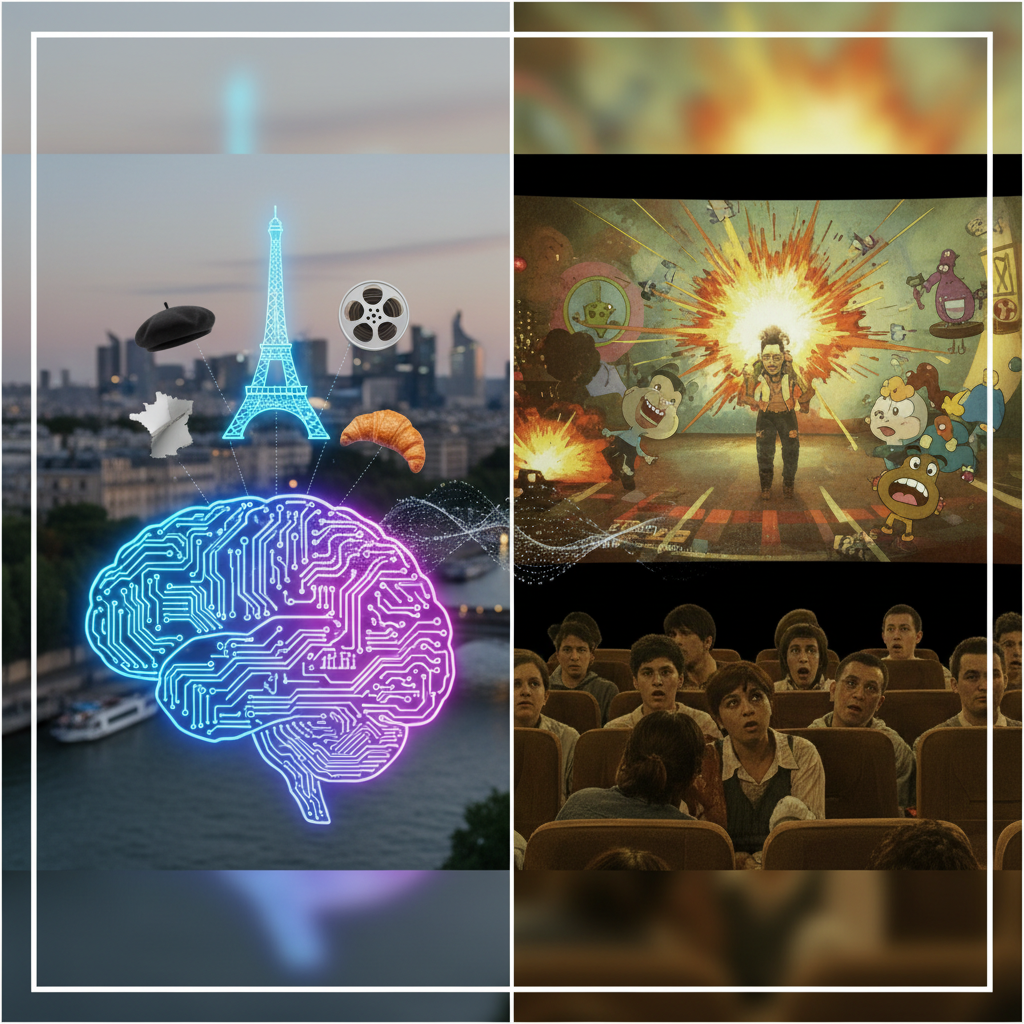

Mon Dieu, the arrogance of Big Tech. We are told, with a straight face, that Netflix's algorithms are simply giving us what we want. They are optimizing for our preferences, personalizing our experience, and making our lives easier. But from my vantage point here in France, I see something far more insidious: a subtle, yet relentless, cultural colonization by code, masquerading as convenience. Netflix, with its vast data troves and sophisticated AI, is not merely recommending; it is shaping, influencing, and perhaps, ultimately, eroding the very diversity of cultural expression we hold so dear in Europe.
Let us not be naive. The streaming giant, with its reported 269 million global subscribers as of early 2024, is a behemoth. Its content strategy, increasingly driven by artificial intelligence, is designed to maximize engagement and minimize churn. This means identifying patterns in viewing habits, predicting what will resonate with specific demographics, and then commissioning or acquiring content to fill those algorithmic gaps. It is a brilliant business model, I grant you, but one that often prioritizes lowest common denominator appeal over artistic merit or cultural specificity. We see this in the proliferation of generic action films, predictable rom-coms, and reality television that transcends borders precisely because it lacks any deep roots.
In France, we have a long and proud tradition of cinema, one that is fiercely protected and supported by public funds. Our exceptions culturelles are not mere quirks; they are fundamental to our identity. We believe in art for art's sake, in challenging narratives, and in stories that reflect the nuanced tapestry of human experience, not just what an algorithm determines will keep our eyes glued to the screen for another hour. So, when Netflix's AI pushes a globally palatable, English-language production over a critically acclaimed French drama, it is not just a preference; it is a statement about what is valued.
Consider the data. A study by the European Audiovisual Observatory in 2023 highlighted that while Netflix has increased its European content, the visibility and promotion of this content within the platform's recommendation system often lags behind its American counterparts. This is not accidental. The algorithms are trained on global data, and the sheer volume of American and English-language content often means it has a built-in advantage in terms of engagement metrics. As Professor Jean-Marc Lallier, a media sociologist at Sciences Po, recently articulated, "The algorithm is not neutral. It reflects the biases of the data it consumes and the objectives it is designed to achieve. For Netflix, that objective is global scalability, not necessarily cultural preservation." This is precisely where France says non to Silicon Valley's vision.
The European way is not the American way and that's the point. Our regulatory frameworks, like the EU AI Act, aim to address some of these concerns, albeit broadly. The Act, which is expected to be fully implemented by 2026, focuses on high-risk AI systems, transparency, and human oversight. While recommendation systems like Netflix's might not fall into the highest risk category, the spirit of the regulation underscores a fundamental European concern about algorithmic power. We are not just concerned with safety; we are concerned with societal impact, with the subtle erosion of choice and the homogenization of culture.
Netflix has made efforts, of course. They have invested in local productions, like the hugely popular "Lupin" or "Call My Agent!" which have found global audiences. This is commendable. However, the motivation behind these investments often seems to be about diversifying their catalog to attract new subscribers and comply with local content quotas, rather than a genuine shift in their core algorithmic philosophy. The AI still learns from the global pool, and the global pool still largely favors certain types of content.
What is truly fascinating is how some European creators are attempting to subvert or at least navigate this algorithmic landscape. They are learning the language of metadata, understanding how keywords and genres can influence visibility, and even experimenting with narrative structures that are more algorithm-friendly without sacrificing artistic integrity. It is a delicate dance, a negotiation between art and analytics. But should artists be forced to cater to a machine, or should the machine adapt to the rich tapestry of human creativity?
Take the example of Cinelytic, an AI platform that helps studios predict box office success and audience appeal. While not directly a Netflix product, it exemplifies the broader trend. It uses AI to analyze scripts, cast, and market trends to inform creative decisions. While such tools can optimize production and reduce risk, they also carry the danger of fostering a self-fulfilling prophecy, where only content deemed 'safe' by the algorithm gets made. This is a chilling prospect for cultural innovation. According to The Verge, the industry's reliance on such predictive analytics is only growing, making it harder for truly original, algorithm-defying content to emerge.
Some argue that the algorithm simply reflects our collective taste, that if French audiences prefer American blockbusters, then Netflix is merely responding to demand. I reject this premise. Taste is not static; it is shaped by exposure, by education, by cultural discourse. If an algorithm consistently prioritizes certain types of content, it subtly, yet powerfully, steers our preferences. It creates a feedback loop where the algorithm learns what we have watched, and then recommends more of the same, potentially limiting our exposure to new, challenging, or culturally distinct works.
This is not a call to abandon AI. That would be foolish. AI has immense potential, even in the creative industries. Imagine AI tools that could help discover niche European talent, or recommend content based on deeper cultural resonance rather than superficial viewing habits. Imagine an AI that champions diversity, not just in terms of representation, but in terms of narrative structure, artistic style, and philosophical depth. This is the promise, but it requires a conscious, ethical design choice, one that prioritizes human values over pure engagement metrics.
Until then, we must remain vigilant. We must continue to support our local cinemas, our independent filmmakers, and our public broadcasters. We must demand transparency from these algorithmic gatekeepers. We must remember that culture is not a commodity to be optimized, but a living, breathing expression of our shared humanity. And sometimes, a truly great film is one that the algorithm would never have predicted you would love, but one that changes you nonetheless. That, my friends, is a battle worth fighting, even against the most sophisticated of machines. The future of our cultural landscape depends on it, here in France and across Europe. For more on the broader implications of AI in media, one might consult resources like Wired's AI section. We must ask ourselves, are we truly in control of our viewing habits, or are we merely passengers on an algorithmic journey designed by others? The answer, I fear, is becoming clearer every day. For a deeper dive into how AI is shaping content creation itself, articles on MIT Technology Review often provide illuminating perspectives. The question isn't whether AI is powerful, but how we choose to wield that power, and for whose benefit.