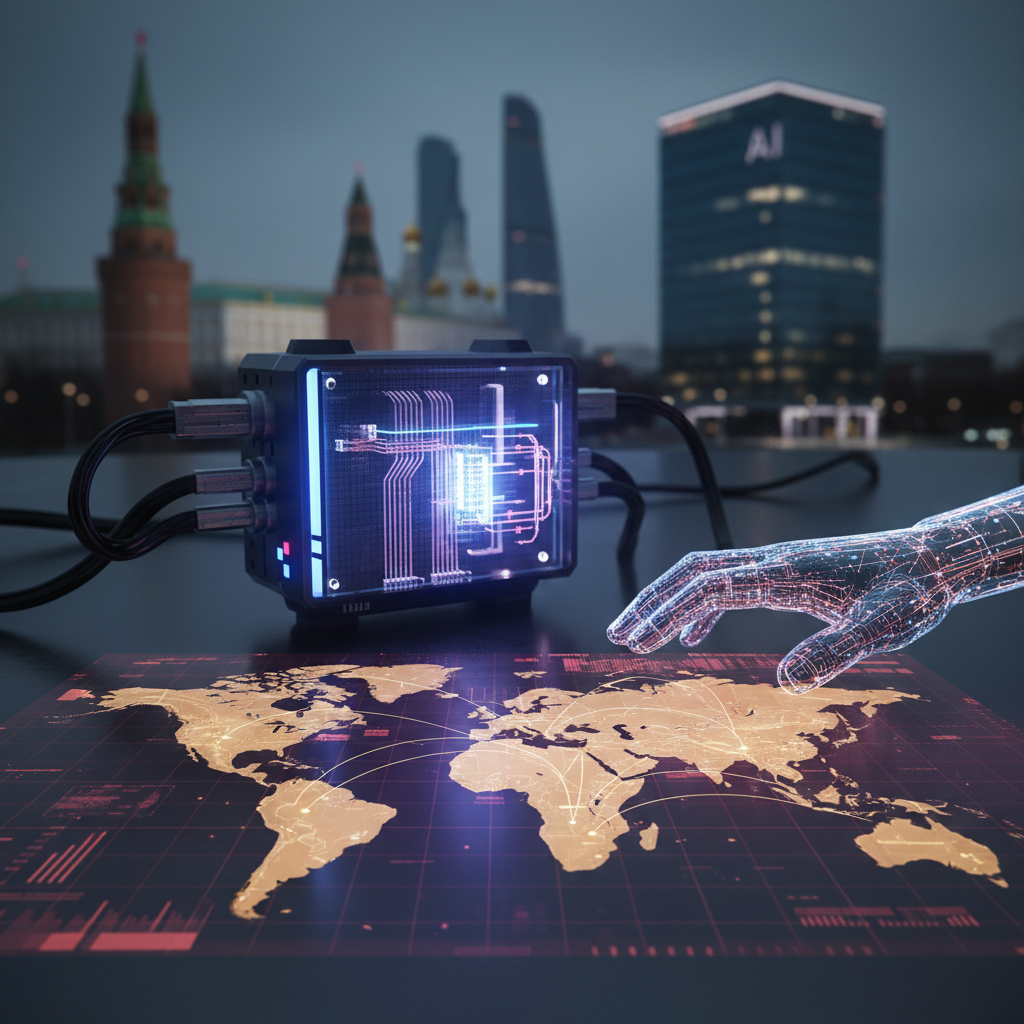

The pursuit of groundbreaking materials, particularly those promising room-temperature superconductivity or revolutionary battery densities, has long been the holy grail of physics and engineering. For nations like Russia, navigating a complex geopolitical landscape, this quest is not merely academic; it is a matter of strategic imperative. My investigation into AI-powered materials discovery, specifically within the context of Russian scientific endeavors, reveals a fascinating and often opaque intersection of cutting-edge research, national security, and economic resilience.
For decades, the search for novel materials has been a laborious, trial-and-error process, often relying on intuition and serendipity. However, the advent of artificial intelligence, particularly advanced machine learning algorithms, has fundamentally altered this paradigm. These AI systems can sift through vast databases of existing materials, predict the properties of hypothetical compounds, and even suggest synthesis pathways with unprecedented speed and accuracy. The potential to accelerate the discovery of materials like high-temperature superconductors, which could revolutionize energy transmission, or advanced battery chemistries, critical for electric vehicles and grid storage, is immense. This is not lost on Moscow.
While much of the global spotlight shines on the AI advancements of Silicon Valley giants or Chinese tech behemoths, Russia has been quietly cultivating its own capabilities, particularly in areas deemed critical for national interests. The focus is less on consumer applications and more on foundational science and defense. "The development of materials science, particularly with AI augmentation, is a cornerstone of our technological sovereignty," stated Dr. Anatoly Chubais, a prominent figure in Russia's scientific and economic circles, speaking at a closed-door symposium earlier this year. "We cannot afford to be spectators in this race." This sentiment echoes through the corridors of institutions like the Kurchatov Institute and various academic centers across the country.
My sources in the tech sector confirm that despite the challenges posed by international sanctions, which restrict access to certain advanced computing hardware and specialized software, Russian researchers are making notable progress. They are leveraging domestic supercomputing infrastructure and a strong tradition in theoretical physics and mathematics. The strategy appears to be twofold: first, to develop proprietary AI models tailored for materials science, and second, to focus on data-rich, high-impact areas where traditional methods have stalled. Superconductors and battery materials fit this description perfectly.
Consider the elusive room-temperature superconductor. Its discovery would transform global energy infrastructure, eliminating energy loss in power grids and enabling entirely new technologies. While breakthroughs like LK-99, a purported room-temperature superconductor, generated immense excitement globally last year before its properties were largely debunked, the pursuit continues with renewed vigor. Russian scientists, working within institutions like the Skolkovo Institute of Science and Technology, are reportedly employing sophisticated AI algorithms to explore vast compositional spaces, searching for stable, high-performance superconducting phases. These efforts often involve quantum chemistry simulations, a computationally intensive field where AI can significantly reduce the time required for accurate predictions.
The Kremlin's digital strategy reveals a clear understanding that dominance in AI-driven materials discovery translates directly into geopolitical leverage. A nation that can independently develop superior battery technology, for instance, gains a significant advantage in the burgeoning electric vehicle market and in military applications. Similarly, breakthroughs in superconductors could underpin next-generation quantum computing, advanced propulsion systems, and highly efficient energy systems, all critical for future power projection. The investment, though not always transparently disclosed, is substantial. Public records indicate a steady increase in funding for scientific research in AI and materials science, often channeled through state-affiliated corporations and universities.
One of the key challenges for Russia, however, remains access to cutting-edge AI hardware, particularly high-performance GPUs from companies like NVIDIA. While domestic alternatives are being developed, they often lag behind the global leaders. This necessitates creative solutions, including optimizing algorithms for existing hardware and focusing on theoretical advancements that can be implemented with less demanding computational resources. "We are forced to be more ingenious," a researcher at the Russian Academy of Sciences, who preferred to remain anonymous, told me. "The constraints push us to innovate in ways that might be overlooked by those with unlimited resources. Sometimes, necessity is the mother of invention, even in AI."
The impact of this research extends beyond the laboratory. The potential for AI to accelerate the discovery of materials with specific, tailored properties could fundamentally alter supply chains and reduce reliance on foreign imports. For battery materials, this means finding alternatives to scarce elements or developing more efficient, longer-lasting chemistries. For example, research into solid-state electrolytes, crucial for safer and higher-density batteries, is reportedly a priority. AI models are being trained on vast datasets of material structures and electrochemical properties to predict optimal compositions and processing techniques.
However, the path is fraught with ethical considerations and practical hurdles. The 'black box' nature of some advanced AI models can make it difficult to understand why a particular material is predicted to have certain properties, complicating the validation process. Furthermore, the synthesis of novel materials predicted by AI still requires sophisticated experimental facilities and skilled personnel, areas where Russia, like many nations, faces its own set of challenges.
Moscow's AI ambitions tell a bigger story than just scientific curiosity; they speak to a broader national strategy of self-reliance and technological leadership. The race for AI-powered materials discovery is a global one, with significant investments from the United States, China, and European nations. Google DeepMind has made strides in using AI for materials science, as have various startups and research institutions globally. The competition is fierce, and the stakes are incredibly high. For Russia, success in this domain could provide a critical advantage, bolstering its industrial base and securing its position in a future defined by advanced materials and intelligent systems.
The implications of these developments are profound. If Russian scientists, aided by AI, can unlock the secrets of new superconductors or battery technologies, it could shift global power dynamics, create new economic opportunities, and fundamentally alter the energy landscape. The quiet laboratories and supercomputing centers across Russia are not just pursuing scientific breakthroughs; they are shaping the contours of tomorrow's world. This is a story that demands continued scrutiny, for the future of technological leadership may well be forged in the crucible of AI-driven materials science. For further reading on global AI trends in materials, one might consult MIT Technology Review or Nature Machine Intelligence. The broader landscape of AI innovation is also frequently covered by TechCrunch.
While the world watches the more visible AI battles, the quiet, persistent work in materials discovery continues, a testament to the enduring power of scientific inquiry, now amplified by artificial intelligence. The next great technological leap may not come from a flashy consumer product, but from a seemingly mundane material, meticulously designed by algorithms and brought to life in a laboratory. The question remains: who will get there first, and what will be the true cost of this scientific triumph?