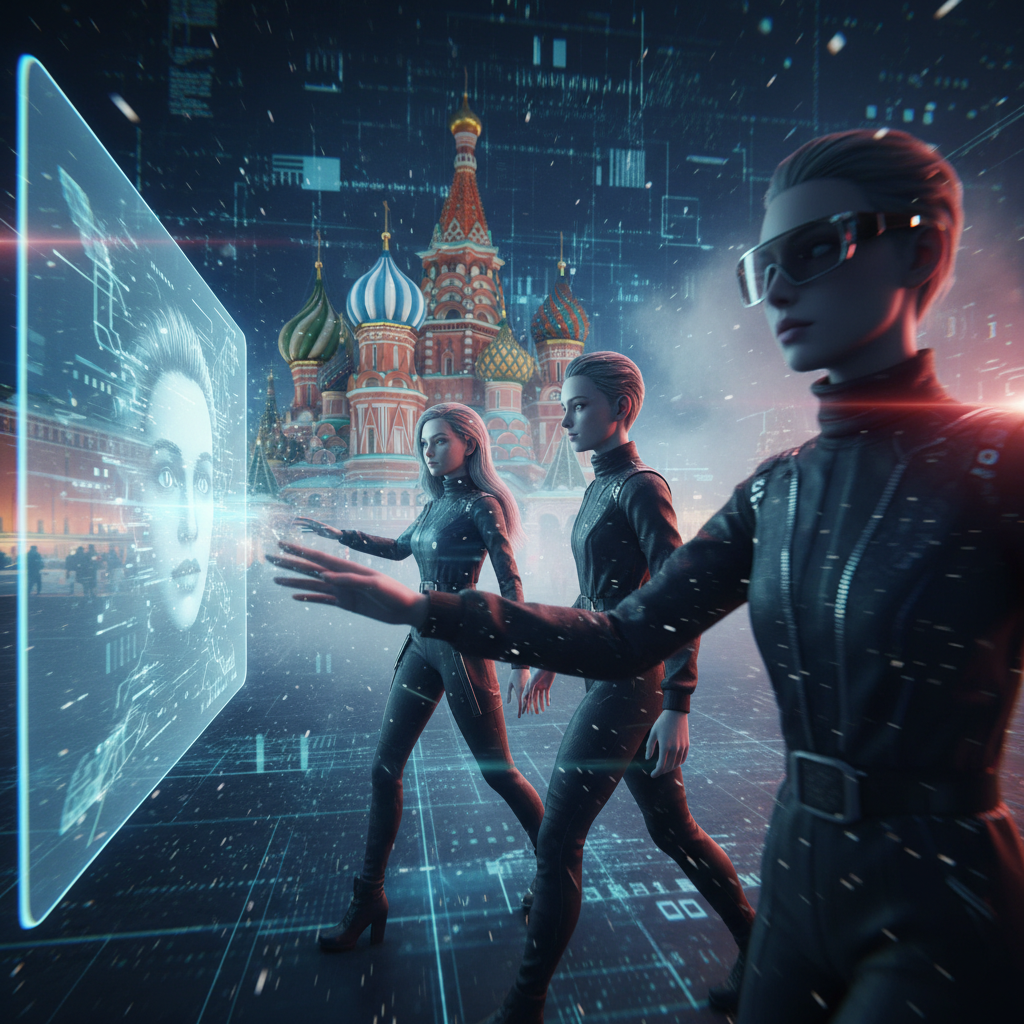
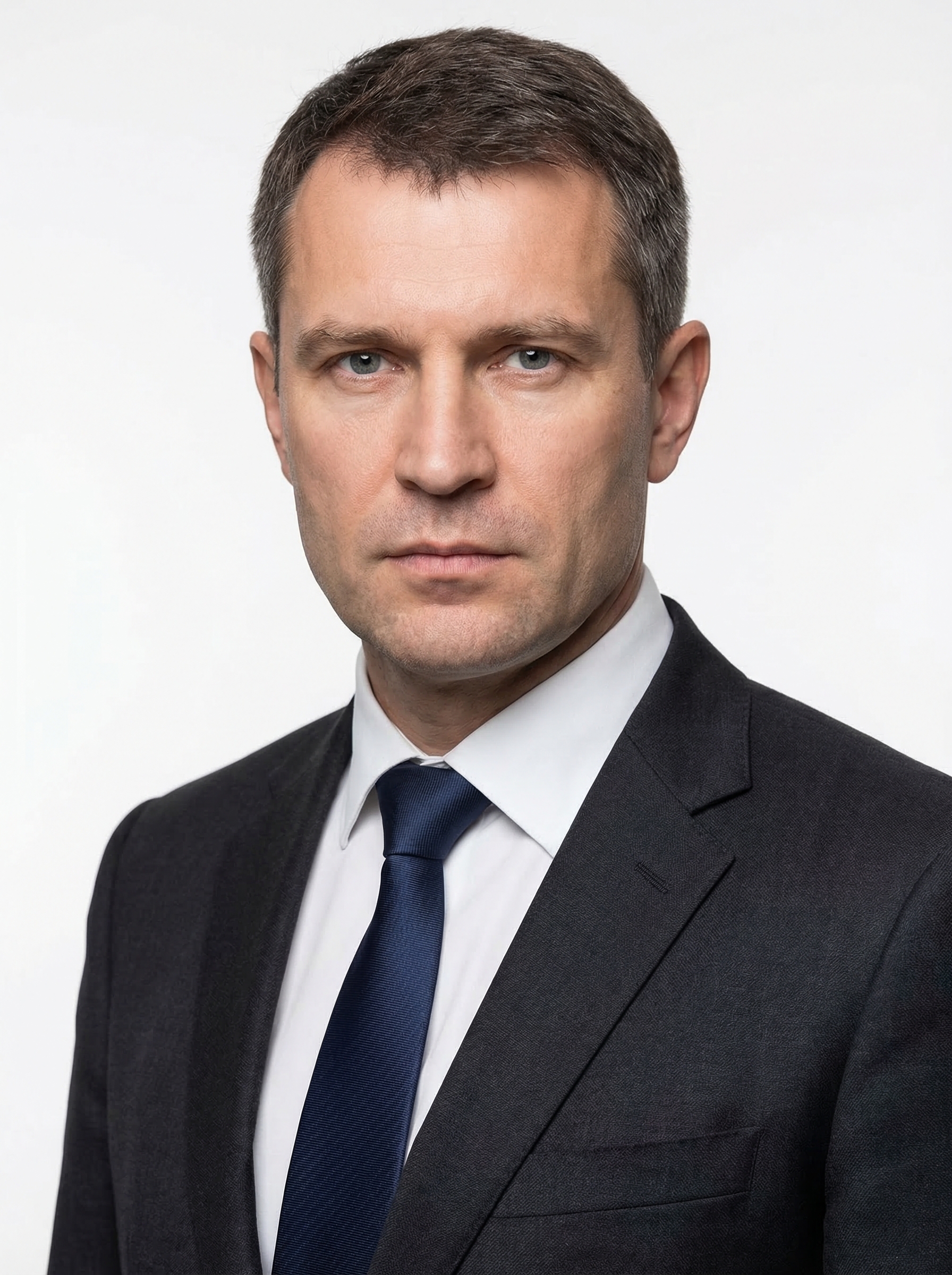
The digital landscape of Russia, often viewed through a lens of geopolitical complexity, is currently grappling with a phenomenon that blurs the lines between reality and artifice: the rapid ascent of AI-generated influencers. These virtual personalities, crafted by algorithms and imbued with synthetic charm, are accumulating millions of followers on platforms like VKontakte and Telegram, captivating audiences with their flawless aesthetics and curated lives. This is not merely a global trend observed from afar, but a development unfolding directly within the Russian digital sphere, prompting urgent questions about its origins, implications, and the underlying technological prowess it purports to represent.
Just last week, the virtual persona 'Svetlana_AI', an alleged fashion model with over 3 million followers on a popular Russian social network, announced a major endorsement deal with a prominent domestic luxury brand. This event, widely reported by local tech outlets, has ignited a fresh debate. Is this a testament to Russia's burgeoning creative AI capabilities, or a clever marketing ploy leveraging imported technologies behind the sanctions curtain? As a journalist who has long observed the intricacies of Russian technology, I find that the official story doesn't add up, and a closer examination is warranted.
The genesis of these digital celebrities is often attributed to smaller, agile Russian studios, many operating under the radar. One such entity, 'PixelPersona Labs', based in St. Petersburg, recently claimed to have developed proprietary generative adversarial networks, or GANs, capable of producing hyperrealistic human avatars with unprecedented emotional range. "Our algorithms go beyond simple image generation," stated Dr. Elena Petrova, lead AI researcher at PixelPersona Labs, in a recent online interview. "We are synthesizing personality, crafting narratives, and building genuine engagement. This is a new form of digital artistry, uniquely Russian in its aesthetic and storytelling approach." While such claims are impressive, the specifics of their underlying technology remain opaque, a common characteristic in an environment where intellectual property and technological origins can be sensitive subjects.
However, not everyone shares this optimistic view. Professor Andrei Volkov, a respected expert in computational linguistics at Moscow State University, expressed skepticism. "While the visual fidelity of these AI influencers is indeed remarkable, we must ask about the foundational models," Professor Volkov remarked during a recent panel discussion at the Skolkovo Innovation Center. "Are these truly homegrown innovations, or are they fine-tuned versions of open source models like Meta's Llama 3 or Google's Gemini, adapted for the Russian market? Without transparency, it is difficult to ascertain the true depth of our domestic AI talent. Russian AI talent deserves better than to have its achievements conflated with rebadged foreign technology." His concerns echo a broader sentiment among academic circles, where the distinction between application and fundamental research is keenly felt.
Indeed, the economic implications are already tangible. Analysts at 'Digital Insights Russia' estimate that the virtual influencer market in Russia could exceed 5 billion rubles by the end of 2026, driven by lower production costs and the ability to sidestep the complexities of human celebrity endorsements. "For brands, the appeal is clear: control, predictability, and cost efficiency," explained Maria Ivanova, a senior marketing strategist at 'Digital Insights Russia'. "A virtual influencer does not demand a private jet, nor does it have public scandals. It is a marketer's dream, particularly in a market where traditional advertising channels face increasing scrutiny and fragmentation." This economic allure, however, masks potential vulnerabilities. What happens when the underlying foreign models are updated, or access becomes restricted? The dependence on external technological foundations could prove to be a brittle basis for a burgeoning industry.
The rise of these digital doppelgängers also touches upon deeper societal questions. The concept of authenticity, already strained in the age of filtered social media, is further eroded when the 'person' delivering a message does not exist. Olga Smirnova, a cultural critic writing for 'Novaya Gazeta', articulated this concern succinctly: "We are cultivating a generation that interacts with phantoms. What does this mean for human connection, for empathy, for the very fabric of our social interactions? When the ideal is synthetic, what becomes of the real?" This philosophical quandary is not unique to Russia, but it gains particular resonance in a society that has historically valued deep, personal connections.
Looking ahead, the trajectory of AI influencers in Russia will likely be shaped by two primary forces: technological self-sufficiency and regulatory oversight. There is a clear imperative for Russian developers to move beyond mere application and invest in foundational AI research, creating genuinely independent models. This would not only bolster national technological sovereignty but also provide a more robust platform for creative applications. Simultaneously, regulators are beginning to consider frameworks for disclosure and ethical guidelines. The Ministry of Digital Development, Communications and Mass Media has indicated that it is studying international precedents, such as those discussed by MIT Technology Review regarding synthetic media, to formulate appropriate responses. However, the pace of technological change often outstrips the speed of legislative action, leaving a significant gap.
In conclusion, while the spectacle of AI influencers with millions of followers offers a compelling narrative of digital innovation, it is crucial to look beyond the surface. Is this a genuine leap forward for Russian AI, or a sophisticated illusion built on borrowed foundations? The answer will determine whether this phenomenon represents a sustainable growth area for domestic technology or merely another fleeting trend. For now, the question remains: are we witnessing the dawn of a new creative era, or simply a more elaborate form of digital puppetry? The true measure of success will not be in follower counts, but in the verifiable, independent technological advancements that underpin these digital spectacles. As always, the truth lies in the details, and details, in this sphere, are often deliberately obscured. Readers interested in the broader impact of AI on creative industries might find relevant discussions on Wired or TechCrunch for global perspectives.