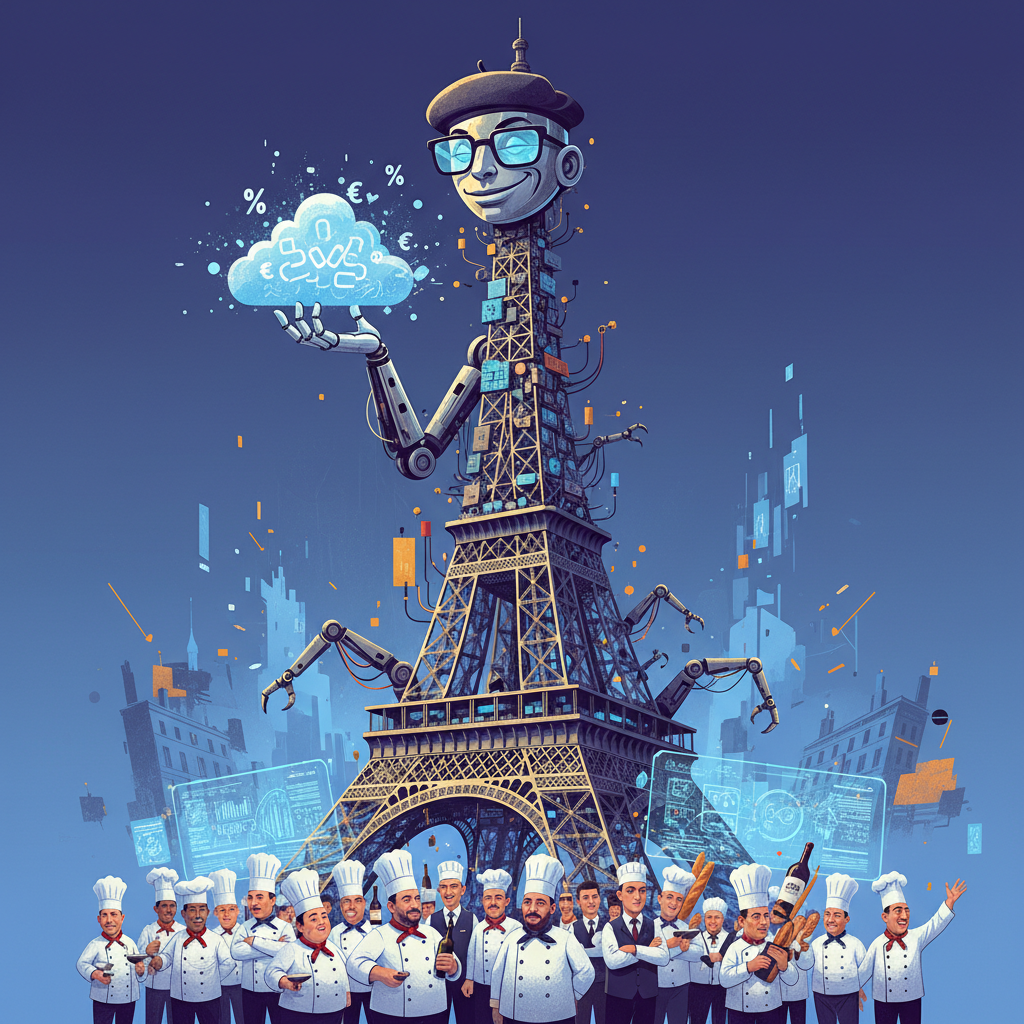

One might think, listening to the breathless pronouncements from Silicon Valley, that the future of hospitality is a cold, calculating machine. We are told, with an almost religious fervor, that AI will revolutionize our hotels and restaurants, bringing forth an era of unparalleled dynamic pricing, hyper-personalized guest experiences, and operational efficiency so streamlined it would make a Swiss clockmaker weep. Mon Dieu, the arrogance of Big Tech. They speak of these advancements as if they are universal truths, applicable to every corner of the globe, every culture, every human interaction. But let me be clear: France says non to Silicon Valley's vision, at least when it comes to the heart of our hospitality.
They envision algorithms dictating room rates in real time, shifting prices like sand in the Sahara based on demand, weather, and even a guest's perceived willingness to pay. They dream of AI porters, AI concierges, AI chefs, all designed to maximize profit and minimize human interaction. And for what, exactly? To turn a stay in a charming Parisian boutique hotel or a meal in a Michelin-starred restaurant into a transaction as sterile as ordering a package from Amazon? I think not. The European way is not the American way and that's the point. Our hospitality is an art, a tradition, a deeply human endeavor, not merely a logistical challenge to be optimized by code.
Consider dynamic pricing, for example. Proponents like those at TechCrunch often highlight its potential to maximize revenue, citing studies where hotels using AI-driven pricing models saw a 5-10 percent increase in bookings or average daily rates. They point to companies like IDeaS Revenue Solutions or Duetto, whose algorithms can analyze millions of data points to predict demand and adjust prices instantly. But what does this do to the guest? It fosters a sense of distrust, a feeling of being manipulated. Imagine booking a room for a certain price, only to see it fluctuate wildly moments later. Where is the transparency? Where is the relationship? Madame Dubois, who has run her quaint hotel near the Pont Neuf for thirty years, understands that loyalty is built on trust and consistent value, not on an algorithm trying to extract every last euro from a traveler's wallet. She told me last week, "My guests are not data points, Monsieur. They are people. They come here for a certain feeling, a certain welcome. An algorithm cannot provide that."
Then there is guest personalization. The idea sounds appealing on the surface, does it not? An AI remembering your preferred pillow type, your favorite coffee, your usual breakfast order. Companies like Revinate and Cendyn promise to create hyper-targeted marketing campaigns and in-stay experiences using AI to analyze guest data. They say it enhances satisfaction. But there is a fine line between thoughtful anticipation and intrusive surveillance. When an AI knows too much, when every interaction feels pre-programmed and devoid of spontaneity, it ceases to be personal and becomes, frankly, a little creepy. It strips away the joy of discovery, the pleasant surprise, the genuine human connection that a skilled hotelier or waiter instinctively provides. "We pride ourselves on anticipating needs, yes," says Jean-Luc Picard, the esteemed director of the Hotel Le Bristol Paris, "but it is done with discretion, with observation, with a human touch. Not by a machine that has scraped your entire digital footprint. That is not service, that is data mining."
And operational efficiency, the holy grail of Silicon Valley. They speak of AI optimizing staff schedules, managing inventory, even predicting equipment failures. This is where companies like Siemens and IBM are making inroads, offering predictive maintenance and smart building management systems. While some aspects of this are undeniably useful, particularly in large, complex operations, the danger lies in extending this logic too far. The drive for efficiency can easily dehumanize the workplace, turning employees into cogs in a machine, constantly monitored and measured by an unfeeling algorithm. It risks eroding the very craft of hospitality, where human judgment, empathy, and adaptability are paramount. A truly efficient operation in France is one where staff are empowered, not enslaved by metrics, where a chef's intuition is valued as much as a supply chain algorithm.
Of course, the counterarguments are swift and predictable. The proponents of AI will tell me I am a luddite, clinging to outdated notions in a world that is rapidly advancing. They will argue that AI can free up human staff from mundane tasks, allowing them to focus on higher-value, more personal interactions. They will claim that dynamic pricing simply reflects market realities and that personalization, when done right, enhances guest loyalty and satisfaction. They will point to the economic imperative, the need for hotels and restaurants to remain competitive in a globalized market, where American chains and their AI-driven strategies are already making significant inroads.
But I say to them: competitive at what cost? What good is a 10 percent increase in revenue if it alienates your most loyal customers, if it turns your staff into automatons, and if it strips your establishment of its unique character? The argument that AI frees up staff for 'higher-value' interactions often translates into fewer staff overall, leading to overworked employees and a reduction in the very human touch they claim to preserve. And as for market realities, are we to simply accept a race to the bottom, where every hotel becomes indistinguishable from the next, all optimized by the same algorithms, all offering the same sterile experience? This is not progress; it is homogenization.
We in Europe, and particularly in France, have a different philosophy. We understand that true luxury, true service, true hospitality, is about connection, about culture, about an experience that cannot be quantified by an algorithm or optimized by a neural network. It is about the warmth of a human smile, the discernment of a sommelier, the quiet elegance of a perfectly set table. It is about the art of living, l'art de vivre, which cannot be reduced to a series of data points. We are not against technology, not entirely. We can embrace AI for tasks that genuinely improve the human experience without replacing it. Perhaps for behind-the-scenes inventory management or energy efficiency, yes. But not for the soul of our service.
We must choose our path carefully. Do we allow the relentless march of Silicon Valley's AI to dictate the future of our most cherished industries, turning every interaction into a transactional data exchange? Or do we insist on a human-centric approach, leveraging technology to augment, not replace, the irreplaceable human element? The EU AI Act, with its focus on ethical considerations and human oversight, is a step in the right direction, a recognition that technology must serve humanity, not the other way around. We have an opportunity here, a chance to demonstrate that there is a different way to innovate, a way that respects culture, privacy, and the profound value of human connection. Let us not squander it for the sake of a few percentage points on a balance sheet. Our heritage, our identity, and the very essence of French hospitality depend on it. For more on how AI is shaping global industries, one might look at The Verge's AI section. The conversation is far from over. Perhaps we can even learn from how other regions are grappling with the ethical implications of AI, as discussed in this article about AI ethics documentary. The future of hospitality is not written in code; it is written in the hearts of those who serve and those who are served.