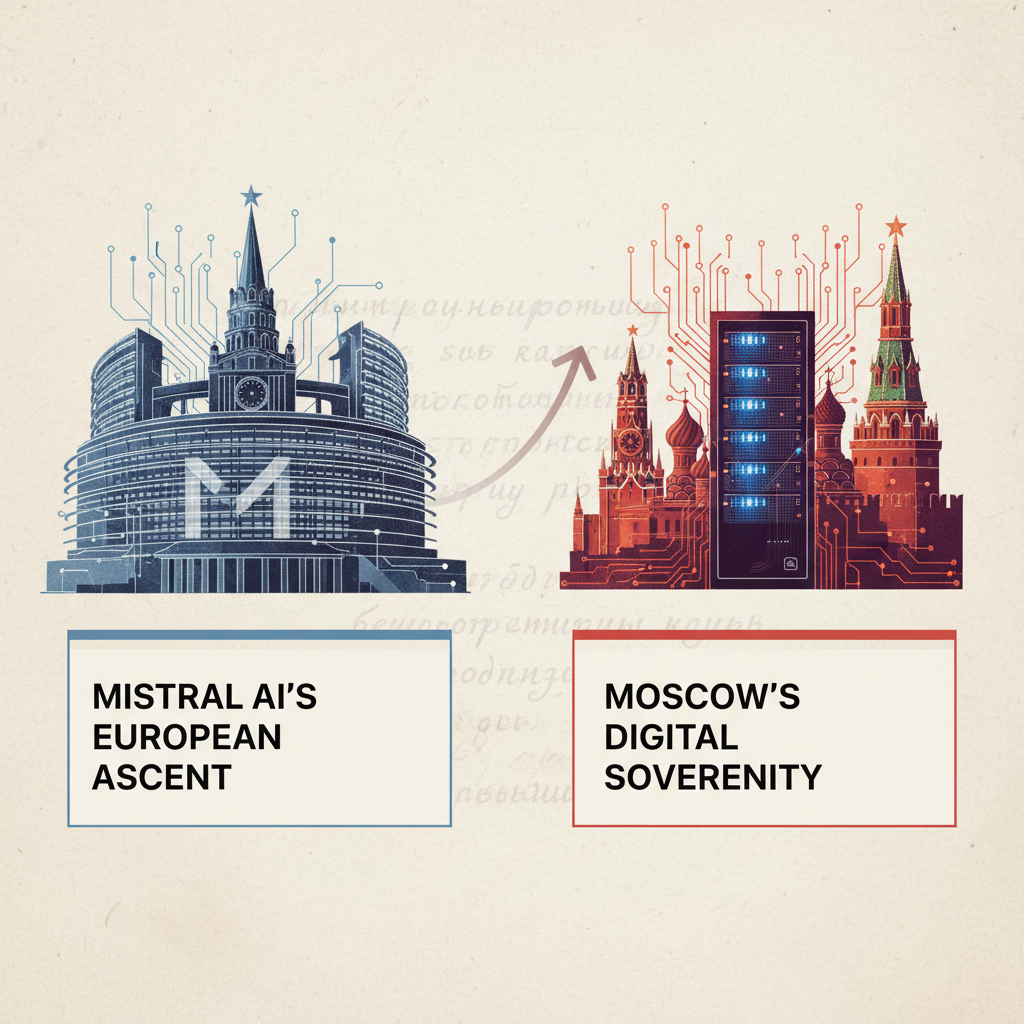

The emergence of Mistral AI, a French startup founded by three former Meta researchers, has sent ripples through the global artificial intelligence landscape. In a mere 18 months, this company has transformed from an ambitious concept into Europe's most valuable AI enterprise, reportedly securing over 600 million euros in funding and achieving a valuation exceeding 6 billion euros. Its trajectory, marked by a commitment to open source models and a strategic partnership with Microsoft, offers a compelling narrative, one that Moscow's AI strategists are undoubtedly dissecting with keen interest. The question for Russia is not merely how Mistral achieved such rapid growth, but what lessons, if any, can be gleaned for our own pursuit of digital sovereignty in a world increasingly dominated by Western and Asian tech behemoths.
The Policy Move: Europe's AI Act and Mistral's Advantage
The European Union, with its landmark AI Act, has sought to establish a comprehensive regulatory framework for artificial intelligence, aiming to balance innovation with ethical considerations and fundamental rights. This legislation, which is set to become fully applicable later this year, categorizes AI systems by risk level, imposing stringent requirements on high risk applications. While some in the industry initially expressed concerns about stifling innovation, Mistral AI has, in many ways, navigated this environment with remarkable agility. Their focus on open source models, particularly those released under permissive licenses, allows for broad accessibility and community-driven development, which aligns with certain aspects of the EU's desire for transparency and explainability in AI.
This approach has not been without its critics. Concerns have been raised about the potential for misuse of powerful open source models, a debate that resonates deeply within Russia, where the state maintains a tight grip on information and technology. However, for Mistral, the open source strategy has been a key differentiator, fostering a vibrant developer ecosystem and accelerating iteration. As Dr. Eva Kaili, a prominent European Parliament member and digital policy expert, stated in a recent interview, "The AI Act aims to create a trustworthy environment for AI development. Companies like Mistral, by embracing transparency through open source, can actually thrive within this framework, demonstrating that regulation and innovation are not mutually exclusive." Her words underscore a nuanced perspective often lost in the broader discourse.
Who is Behind It and Why: A European Response to Silicon Valley
Mistral AI was founded by Arthur Mensch, Guillaume Lample, and Timothée Lacroix, all alumni of Meta's AI research division. Their vision was clear: to build a European champion in generative AI, capable of competing with the likes of OpenAI, Google DeepMind, and Anthropic. The motivation was not purely commercial; it was also geopolitical. Europe, having largely missed the first wave of internet giants, saw an opportunity to assert its technological independence in the burgeoning field of AI. The significant investments from venture capital firms, including Andreessen Horowitz, Lightspeed Venture Partners, and France's own Bpifrance, reflect a concerted effort to cultivate indigenous AI talent and infrastructure.
My sources in the tech sector confirm that the French government, in particular, has been a strong proponent of Mistral, viewing it as a strategic asset. The partnership with Microsoft, which involved a substantial investment and a collaboration on model development and deployment, further solidified Mistral's position. This alliance, while providing critical resources and cloud infrastructure, also raises questions about the true independence of a European champion when deeply intertwined with an American tech giant. For Moscow, this presents a complex dilemma: how to foster domestic innovation while navigating a global tech landscape where strategic partnerships often come with implicit dependencies. The Kremlin's digital strategy reveals a clear preference for self-sufficiency, yet the practicalities of achieving it in advanced AI are daunting.
What It Means in Practice: A Regulatory Tightrope
For companies operating within the EU, Mistral's success story illustrates the potential for growth even under stringent regulation. The AI Act's emphasis on data governance, algorithmic transparency, and human oversight means that AI systems must be designed with these principles in mind from inception. Mistral's commitment to releasing its models, such as Mistral 7B and Mixtral 8x7B, with detailed documentation and under open licenses, allows for external scrutiny and validation, which can help satisfy regulatory requirements. This contrasts sharply with the more opaque, proprietary models often developed by their American counterparts.
However, the definition of "open source" itself is a point of contention. Some critics argue that models requiring significant computational resources to train or fine-tune are not truly open in practice, as access remains limited to well-funded entities. This is a crucial distinction for Russia, where access to cutting edge hardware, particularly NVIDIA GPUs, has been severely impacted by sanctions. The ability to leverage and adapt truly open models, rather than just access their weights, is paramount for Russian developers and researchers.
Industry Reaction: A Mix of Admiration and Apprehension
Across Europe, the tech industry has largely welcomed Mistral's ascent as a validation of European innovation. "Mistral has shown that Europe can produce world-class AI," commented Dr. Stefan Heumann, Director of Policy at Stiftung Neue Verantwortung, a German think tank focusing on technology and society. "Their ability to attract top talent and significant investment, while navigating a complex regulatory environment, is a testament to their vision and execution." However, some smaller European AI startups express concerns that the focus on a few large players like Mistral might inadvertently consolidate power, making it harder for nascent companies to compete for talent and funding. This dynamic is familiar to Russian entrepreneurs, who often face similar challenges when competing with state-backed giants like Yandex or Sberbank.
For Russian tech companies, Mistral's trajectory offers both inspiration and a stark reminder of the challenges they face. While Russia possesses a strong foundation in mathematics and computer science, the ability to commercialize and scale AI solutions on a global level is hampered by sanctions, limited access to international markets, and a comparatively smaller venture capital ecosystem. The brain drain, a persistent issue, further exacerbates this, as talented individuals seek opportunities in less restrictive and more lucrative environments.
Civil Society Perspective: Openness Versus Control
Civil society organizations in Europe have generally lauded the open source aspect of Mistral's strategy, viewing it as a safeguard against unchecked corporate power and a means to promote democratic values in AI development. Transparency, they argue, is essential for accountability. "When models are open, researchers and civil society can scrutinize them for biases, security vulnerabilities, and potential for misuse," explained Sarah Chander, a Senior Policy Advisor at European Digital Rights EDRi. "This is critical for building public trust in AI systems." This sentiment aligns with a growing global movement advocating for more transparent and ethical AI.
However, the debate around open source also touches on national security. The potential for powerful AI models to be adapted for malicious purposes, such as generating disinformation or developing autonomous weapons, is a serious concern. This is particularly relevant for Russia, where the state's interest in controlling information and leveraging technology for defense purposes is paramount. The balance between promoting open innovation and ensuring national security is a tightrope walk for any nation, and Moscow's AI ambitions tell a bigger story about this ongoing tension.
Will It Work? The Russian Conundrum
Mistral AI's success demonstrates that a European AI champion can emerge, even under strict regulatory conditions, by strategically leveraging open source principles and attracting significant investment. For Russia, the lessons are complex. The Kremlin's digital strategy, focused on import substitution and fostering domestic tech, aligns with the idea of creating national champions. However, the methods differ significantly.
Russia's AI development, often driven by state corporations and academic institutions, tends to be more closed and centrally controlled. While this approach can ensure alignment with state objectives, it risks stifling the rapid, iterative innovation that characterizes the open source ecosystem Mistral thrives on. The sanctions regime further complicates matters, limiting access to the advanced hardware and global talent pools that are critical for cutting edge AI research and deployment. The question remains: can Russia foster its own Mistral, or will its approach to digital sovereignty inadvertently isolate its tech sector from the very advancements it seeks to harness? The answer will likely shape the future of Russian technology for decades to come. For further insights into the broader AI landscape, one might consult TechCrunch's AI section or Wired's coverage of AI. The path forward for Russia's AI sector is not simply about technological prowess, but also about navigating a geopolitical minefield, where every decision has far-reaching consequences.