
For years, the AI world has been captivated by the sheer scale of large language models, those digital behemoths like OpenAI's GPT-4 or Google's Gemini that can generate text, code, and images with astonishing fluency. They are, without a doubt, incredible feats of engineering. But let's be honest, for all their dazzling capabilities, they often feel like incredibly sophisticated parrots, masters of pattern matching without a true grasp of underlying logic or causality. It's like having a brilliant chef who can recreate any dish perfectly from memory, but can't tell you why certain ingredients combine to create a specific flavor profile. That, my friends, has been the unspoken limitation, a kind of intellectual glass ceiling for AI.
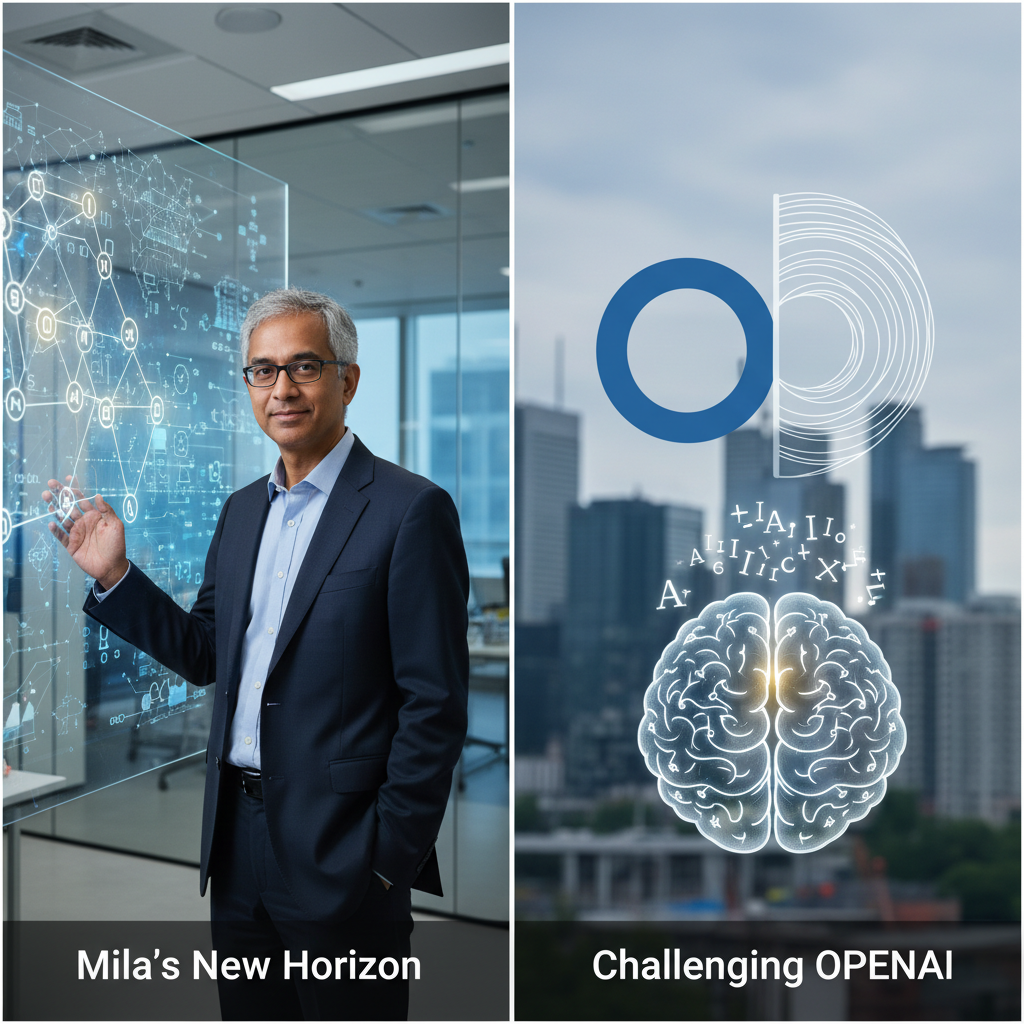
But here in Montreal, a city that has long been a quiet powerhouse in artificial intelligence, something truly groundbreaking is stirring. Let me break down what Mila just published, a development that could fundamentally shift our understanding of AI reasoning. Researchers at Mila, the Quebec AI Institute co-founded by Turing Award laureate Yoshua Bengio, have unveiled new architectural approaches that aim to imbue AI with symbolic reasoning capabilities, moving beyond the statistical correlations that define current models.
Think about it this way: current AI models are like a master mosaic artist. They can take millions of tiny, fragmented pieces of data and assemble them into a beautiful, coherent picture. They see the patterns, the colours, the shapes, and learn how they fit together. But they don't necessarily understand the meaning behind the picture, the narrative it tells, or the rules that govern its composition. They are phenomenal at interpolation and extrapolation within their learned data space, but struggle when asked to reason about novel situations or abstract concepts that require a deeper, more symbolic understanding.
This is where Mila's work comes in. Their new architectures, still in the research phase but showing immense promise, are designed to integrate a more explicit form of symbolic manipulation alongside the neural network's pattern recognition. It's not about replacing deep learning, but augmenting it. Imagine our mosaic artist, now also equipped with a philosophy degree and a rulebook for storytelling. They can still assemble the mosaic, but now they can also interpret its symbolism, understand its context, and even create entirely new narratives based on abstract principles, not just learned examples.
“We’ve been pushing the boundaries of what neural networks can achieve, but we always knew there was a missing piece, a cognitive gap,” explains Dr. Genevieve Dubois, a lead researcher at Mila and a principal investigator on the project. “Our latest work, which we’re calling ‘Neuro-Symbolic Fusion Networks,’ attempts to bridge that gap by allowing the system to not only recognize patterns in data but also to manipulate abstract symbols and rules. This is crucial for tasks requiring true understanding, like complex scientific discovery or robust ethical decision-making.”
The implications are profound. Consider the current challenges with AI 'hallucinations,' where models confidently generate factually incorrect information. This often stems from their inability to truly reason about the truthfulness of statements, instead relying on statistical likelihoods of word sequences. By introducing symbolic reasoning, an AI could potentially verify facts against a knowledge base of rules and relationships, much like a human would. This could drastically improve reliability, a critical factor for adoption in fields like medicine, law, and engineering.
Montreal's AI scene is world-class, here's the proof. This isn't just about incremental improvements; it's about a paradigm shift. For years, Yoshua Bengio has been a vocal proponent of moving beyond purely data-driven, black-box models. His vision has consistently pointed towards systems that can learn more efficiently, generalize better, and offer greater transparency. This latest research from his institute is a direct manifestation of that long-term vision.
Data points support the urgency of this shift. A recent study by the University of Toronto found that while large language models could achieve 90% accuracy on pattern-recognition tasks, their performance dropped to below 40% on tasks requiring multi-step logical deduction or counterfactual reasoning. This stark contrast highlights the current limitations. “The industry has been chasing bigger models and more data, which yields diminishing returns for true intelligence,” states Dr. Alex Chen, a senior AI architect at a major Canadian bank, who closely follows academic research. “What Mila is doing is tackling the foundational problem, not just scaling up the existing solution. It’s a more sustainable path to advanced AI.”
This Canadian leadership in foundational AI research is not new. From the early days of deep learning to current work on responsible AI, our researchers have consistently contributed pivotal insights. This latest breakthrough is a testament to the collaborative spirit and intellectual freedom fostered within institutions like Mila, a stark contrast to the often-secretive, product-focused development cycles of some Silicon Valley giants.
What does this mean for the global AI race, particularly with titans like Microsoft, Google, and Meta pouring billions into their own AI initiatives? It means that the path to truly advanced general intelligence might not be solely paved with more GPUs and larger datasets. It might require a fundamental rethinking of AI architecture itself. If these neuro-symbolic approaches prove scalable and effective, they could offer a competitive edge, allowing for more robust, interpretable, and ultimately, more trustworthy AI systems.
“We’re seeing a convergence, a recognition that pure deep learning, while powerful, isn’t the whole story,” says Dr. Anya Sharma, a professor of computer science at the University of British Columbia, specializing in AI ethics. “The research is fascinating, and it points towards a future where AI can not only perform complex tasks but also explain its reasoning, which is vital for accountability and public trust. This is particularly important for Canada, given our strong emphasis on responsible innovation.”
The road ahead is still long, of course. Integrating symbolic reasoning effectively into neural networks is a complex challenge, requiring novel training methodologies and significant computational resources. But the initial results are promising, offering a glimpse into an AI future where machines don't just mimic intelligence, but genuinely exhibit it. We might be moving from AI that can tell us what happened, to AI that can tell us why it happened, and even what should happen next, based on a deeper, more human-like understanding of the world.
This shift could also impact how we develop AI applications. Instead of simply feeding models vast amounts of data and hoping they learn the right patterns, developers might be able to inject explicit knowledge and logical constraints, guiding the AI towards more reliable and predictable behavior. This could accelerate development in areas where precision and safety are paramount, such as autonomous vehicles or drug discovery.
For those of us watching the AI landscape evolve from our vantage point here in Canada, these developments from Mila are a source of immense pride and excitement. They remind us that true innovation often comes from challenging established norms and daring to explore new intellectual frontiers. It’s not just about building bigger, faster machines, but about building smarter, more thoughtful ones. This is the kind of progress that truly moves the needle, pushing us closer to AI that can genuinely augment human intelligence, rather than just automate tasks. For more insights into cutting-edge AI research, you can always check out MIT Technology Review or arXiv for the latest papers. The future of AI, it seems, is not just about scaling up, but about thinking differently, and Montreal is leading the charge.