
¡Hola, mis amigos! Marisèl Rodriguèz here, and today we are talking about something that touches the very soul of our digital lives, something that can either empower us or silence us: the immense power of platforms like Meta and their AI-driven content moderation strategies. In Mexico, where the lines between information, disinformation, and even threats are often blurred, this is not just a technical debate, it is a fight for our right to speak, to organize, and to be heard.
The Strategic Move: Meta's Localized AI Moderation Push
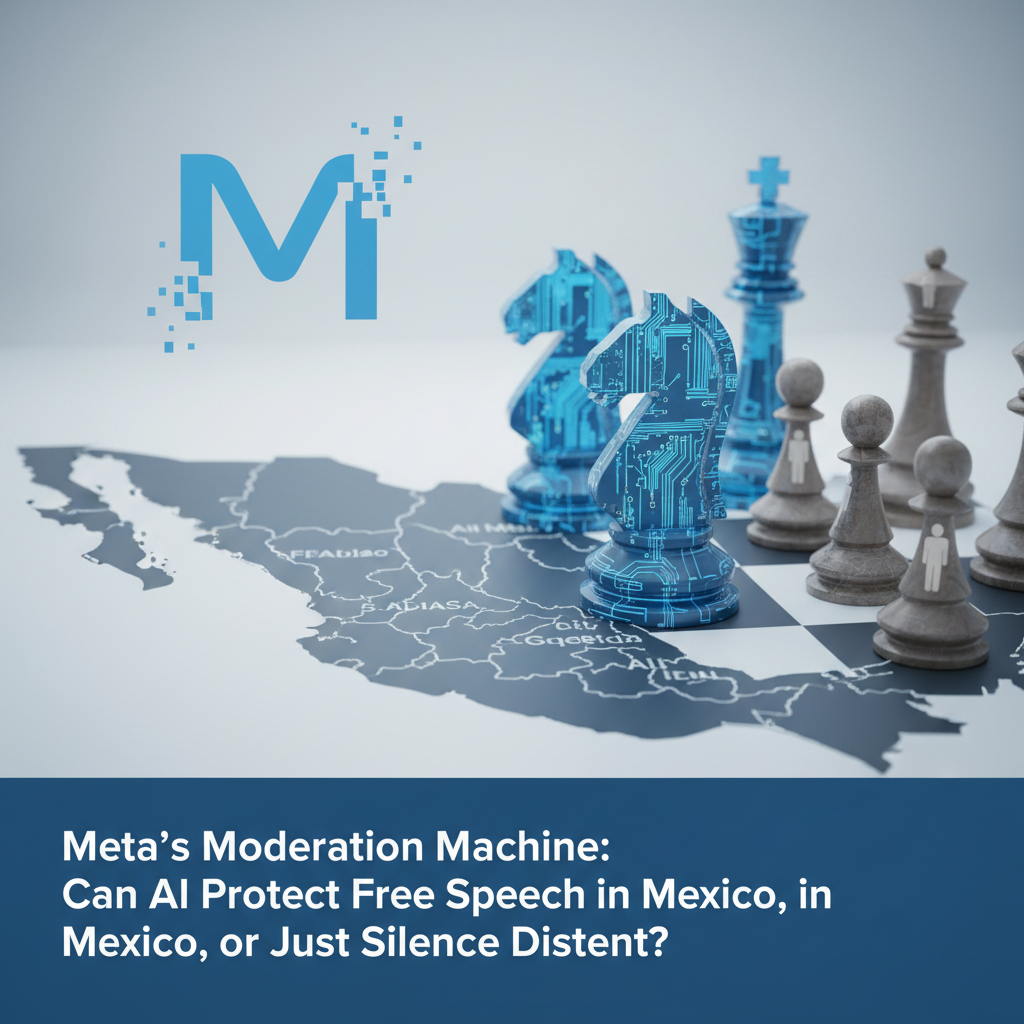
Just a few weeks ago, Meta announced a significant expansion of its AI capabilities for content moderation, specifically targeting non-English languages and regions, with a particular emphasis on Latin America. The company, under Mark Zuckerberg's leadership, claims this move is designed to improve the accuracy and cultural sensitivity of its moderation systems, moving beyond a one-size-fits-all approach that has historically failed communities outside of the Anglosphere. They are investing heavily in training their large language models, like Llama 3, on more diverse datasets, including vast amounts of Spanish-language content from various dialects and cultural contexts. The goal, they say, is to detect hate speech, incitement to violence, and misinformation with greater precision, reducing both under-moderation and over-moderation.
Context and Motivation: A Digital Battleground
Why now, and why such a focus on regions like ours? The answer is complex, rooted in years of criticism and the undeniable reality that platforms have become central to political discourse, social movements, and even criminal activity in countries like Mexico. For too long, content moderation for Spanish-speaking users was an afterthought, often handled by algorithms trained primarily on English data, or by human moderators who lacked the cultural context to understand local nuances, slang, and double meanings. This led to absurd situations, like indigenous activists being flagged for using traditional terms, or legitimate news reports being removed because AI misinterpreted local idioms. Meanwhile, real threats, organized crime recruitment, and political disinformation often slipped through the cracks.
In Mexico, social media is not just for sharing photos of your tacos, it is where journalists report on corruption, where activists organize protests, and where families search for missing loved ones. It is also, unfortunately, where cartels spread propaganda, where political campaigns disseminate fake news, and where vulnerable communities are targeted. The pressure on Meta to get this right has been immense, coming from governments, civil society organizations, and even their own employees. The motivation is clear: protect their brand, comply with increasing regulatory scrutiny, and, perhaps, genuinely improve user experience and safety in critical markets. As Reuters has reported extensively, the global push for platform accountability is intensifying.
Competitive Analysis: Who is Doing it Better?
Meta is certainly not alone in this struggle. Google, with its vast resources and AI expertise, has also been working on improving content moderation across its platforms, particularly YouTube, which is a major source of news and entertainment here. OpenAI, while primarily focused on foundational models, has also faced scrutiny over how its models can be misused for generating harmful content, prompting them to implement stricter safety guardrails. Even smaller, more localized platforms or news aggregators are grappling with these issues, albeit on a different scale.
However, Meta's sheer scale, with Facebook, Instagram, and WhatsApp dominating communication in Mexico, makes its strategy uniquely impactful. WhatsApp, for example, is the primary communication tool for millions of Mexicans, and its encrypted nature presents a different set of challenges for content moderation, often relying on user reports and metadata analysis rather than direct content scanning. The competitive edge here is not just about technological prowess, it is about cultural intelligence and the ability to deploy AI that truly understands the local context, not just the literal translation. Many argue that the current competitive landscape still favors the global giants, but local startups are emerging, trying to build solutions that are inherently more culturally attuned.
Strengths and Weaknesses: A Double-Edged Sword
On the surface, Meta's expanded AI moderation strategy has clear strengths. By training models on more diverse, localized datasets, there is a real possibility of reducing the egregious errors that have plagued moderation in the past. Imagine an AI that can differentiate between a genuine expression of cultural identity and a veiled threat, or one that understands the nuances of political satire versus outright incitement. This could lead to a more equitable application of platform rules, protecting marginalized voices that were previously silenced by blunt algorithms. The promise of faster, more consistent moderation across billions of posts is also alluring, especially in urgent situations like natural disasters or public health crises.
However, the weaknesses are equally glaring, and for me, they raise serious alarms. The very idea of an algorithm, no matter how sophisticated, fully grasping the complexities of human communication, particularly in a country as rich and diverse as Mexico, feels like a fantasy. How will AI distinguish between legitimate criticism of government and politically motivated attacks? How will it understand the historical context of certain phrases or images? Will it be able to discern sarcasm, irony, or the specific codes used by communities to communicate safely? The potential for algorithmic bias, even with more diverse training data, remains a significant concern. If the data itself reflects societal biases, the AI will only amplify them. As Wired has pointed out repeatedly, AI systems are only as unbiased as the data they are trained on.
Furthermore, the opacity of these systems is a major problem. When content is removed, users often receive generic notifications, with little to no explanation or recourse. This lack of transparency erodes trust and makes it impossible for users to understand why their speech was deemed unacceptable. In a country where freedom of the press and expression are constantly under threat, this kind of opaque power is dangerous. It gives Meta immense control over the public discourse, effectively making them arbiters of truth and acceptable speech, a role no private company should hold, especially not one whose primary motive is profit. This affects every family in Latin America, whether they realize it or not, because their access to information and their ability to express themselves is now mediated by these powerful, often invisible, systems.
Verdict and Predictions: A Cautious Hope, But Deep Skepticism
My verdict is one of cautious hope, tempered by deep skepticism. While I applaud Meta's recognition of the problem and their investment in more culturally sensitive AI, I fear it is not enough. The fundamental challenge is not just about better algorithms, it is about power, accountability, and democracy. La tecnología es para todos, yes, but only if it serves the people, not just the platforms.
I predict that while we will see some improvements in the accuracy of moderation, particularly for overt violations, the nuanced cases, the ones that truly test the boundaries of free speech and cultural understanding, will continue to be problematic. There will be fewer instances of obviously innocent content being removed, which is a step forward. However, I also foresee a rise in new forms of algorithmic censorship, where certain topics or viewpoints are subtly suppressed, not explicitly removed, making it harder for users to even notice. This 'soft censorship' is perhaps even more insidious.
For Mexico, this means we must remain vigilant. We cannot simply trust that Big Tech will get it right. Our government, our civil society organizations, and our academic institutions must demand greater transparency, accountability, and avenues for redress. We need independent audits of these AI systems, clear explanations for moderation decisions, and robust appeal processes that are culturally informed and accessible. Mexico's AI story is not being told, until now, and it is a story that must include our voices, our struggles, and our unwavering commitment to freedom of expression.
We need to push for open-source alternatives, for federated models that distribute power, and for policies that prioritize human rights over corporate convenience. The conversation around AI and content moderation cannot be left solely to engineers in Silicon Valley. It must be a global dialogue, with voices from places like Mexico at the forefront, shaping a future where technology truly empowers, rather than controls, our ability to speak our minds. Our digital future, and our freedom, depend on it.