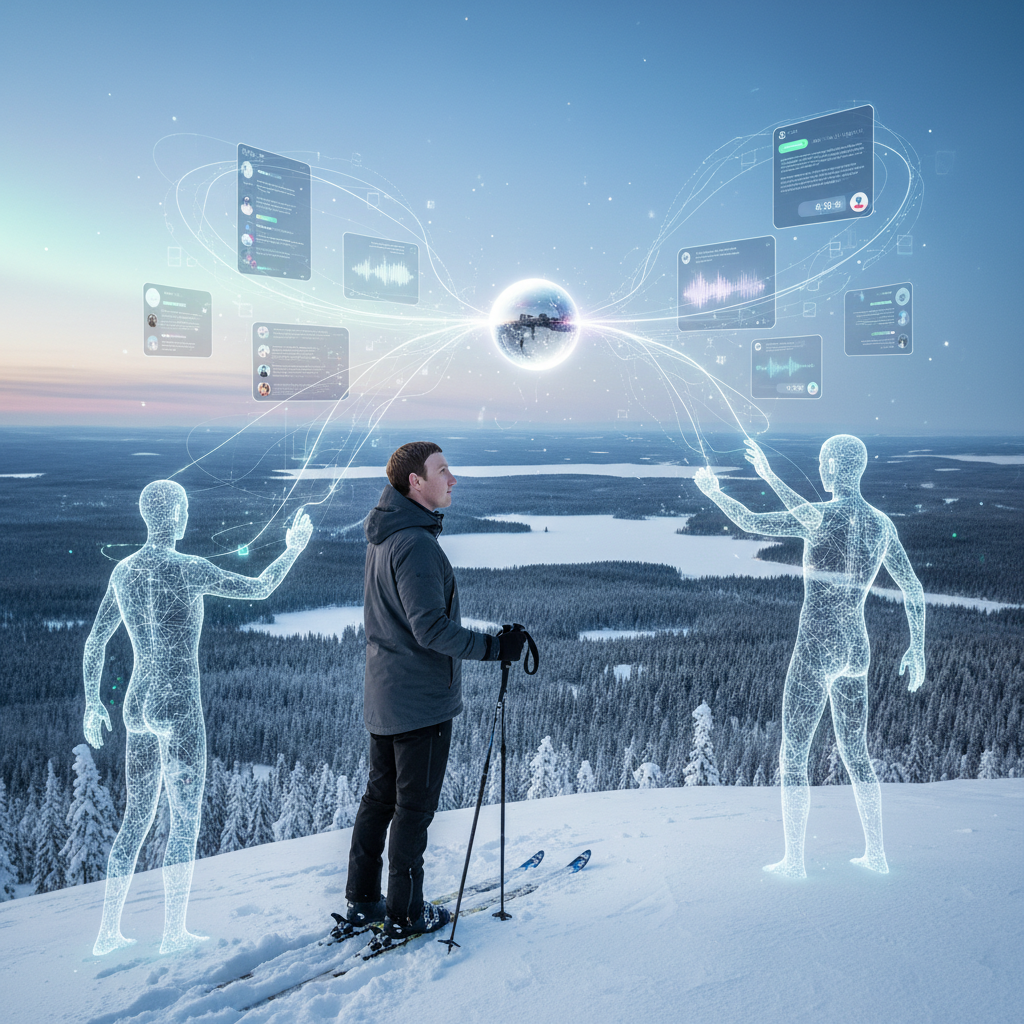
The digital landscape, much like the Finnish winter, often appears deceptively simple on the surface. Beneath, however, complex systems are constantly at work, processing vast amounts of data to shape our daily experiences. Nowhere is this more evident than in the ubiquitous platforms of WhatsApp and Instagram, where Meta, under the direction of Mark Zuckerberg, has been quietly deploying sophisticated artificial intelligence to redefine how billions of people communicate.
For those of us in Finland, a nation that has seen its share of technological reinvention, particularly with the legacy of Nokia, the steady evolution of these platforms is not a surprise. It is a testament to continuous development, often unseen, that underpins modern digital life. This is not about flashy new features alone; it is about the fundamental mechanics of interaction. Let us dissect how this intricate machinery operates.
The Big Picture: Intelligent Communication at Scale
At its core, Meta's objective is to enhance user engagement and facilitate more meaningful, or at least more efficient, interactions across its platforms. Instagram, with its visual dominance, and WhatsApp, the global messaging behemoth, present distinct challenges and opportunities for AI. The AI systems deployed aim to personalize content feeds, filter unwanted messages, summarize conversations, suggest replies, and even generate creative content. This is a far cry from the early days of social media; we are now interacting with systems that learn and adapt, acting as digital intermediaries in our conversations and content consumption.
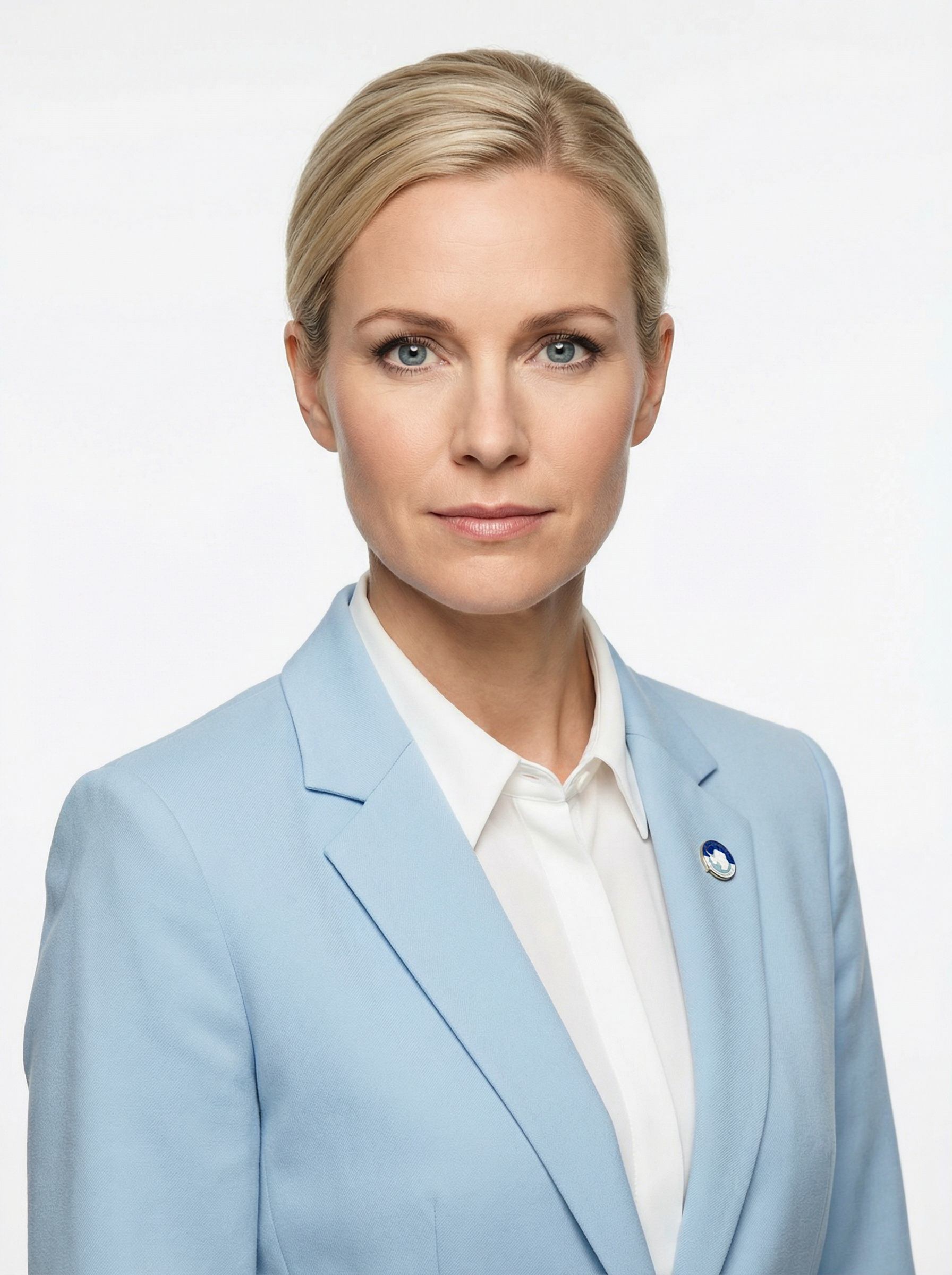
Consider the sheer scale: WhatsApp alone processes over 100 billion messages daily, and Instagram boasts billions of active users. Managing this volume while maintaining relevance and safety is an immense computational task. "The scale at which Meta operates demands AI solutions that are not only powerful but also incredibly efficient," explains Dr. Elina Virtanen, Head of AI Research at Aalto University in Espoo. "They are dealing with a dynamic, multilingual, and culturally diverse dataset that few other entities can rival. Finland's approach is quietly revolutionary in its focus on practical, scalable solutions, a mindset mirrored in Meta's engineering efforts."
The Building Blocks: Key AI Components
To achieve this intelligent communication, Meta leverages several foundational AI technologies:
- Natural Language Processing (NLP) and Understanding (NLU): These are the bedrock for WhatsApp's AI features. NLP allows the system to process human language, while NLU enables it to comprehend the meaning, sentiment, and intent behind messages. Meta's Llama models, for instance, are central to this, providing the linguistic intelligence needed to interpret text.
- Computer Vision (CV): Predominantly for Instagram, CV algorithms analyze images and videos. They identify objects, faces, scenes, and even emotions, which is crucial for content moderation, personalized feed ranking, and suggesting relevant filters or effects.
- Recommendation Systems: These algorithms are the silent architects of your Instagram feed. They predict what content you are most likely to engage with based on your past interactions, the interactions of similar users, and the characteristics of the content itself. This involves complex matrix factorization and deep learning models.
- Generative AI: The newest frontier, generative models are now creating content, from suggested text replies in WhatsApp to image editing suggestions on Instagram. These are often powered by large language models (LLMs) and diffusion models.
- Reinforcement Learning (RL): This technique allows AI models to learn through trial and error, optimizing their performance based on user feedback. For example, if a suggested reply leads to a longer conversation, the RL system learns that it was a 'good' suggestion.
Step by Step: How It Works From Input to Output
Let us trace the journey of a message or a piece of content through Meta's AI systems:
- Input Capture: A user sends a WhatsApp message or posts an Instagram story. This is the raw data input.
- Feature Extraction: AI models immediately begin processing. For text, NLP extracts keywords, sentiment, entities, and language. For images/videos, CV identifies objects, colors, text within images, and potential policy violations.
- Contextual Analysis: The system considers the broader context. Who is the sender/poster? Who is the recipient/audience? What is their relationship? What is the historical interaction pattern between them? What time of day is it? What are current trends?
- Prediction and Ranking (Instagram): For Instagram feeds, recommendation algorithms predict the likelihood of a user engaging with a piece of content. This involves hundreds of factors, resulting in a personalized ranking. The goal is to show you what you are most likely to 'like', comment on, or share.
- Intelligent Assistance (WhatsApp): For WhatsApp, NLU identifies potential needs for assistance. Is it a question? Is it a request? Can a quick reply be suggested? Is the message part of a longer thread that could benefit from summarization? Generative AI might then formulate a concise summary or a contextually appropriate reply option.
- Content Moderation and Safety: Simultaneously, specialized AI models scan for harmful content, misinformation, spam, or policy violations. This happens across both platforms, often leveraging a combination of NLP and CV to detect problematic patterns. "The sheer volume of content makes manual moderation impossible, so AI is the first line of defense," states Mikael Lindholm, a former cybersecurity analyst at Finland's National Cyber Security Centre. "It is a constant arms race against malicious actors."
- Output Delivery: The processed and enhanced content or interaction is then delivered to the user. This could be a ranked Instagram feed, a suggested reply in WhatsApp, or a flagged message for review.
A Worked Example: Planning a Weekend Trip on WhatsApp
Imagine you are discussing a weekend trip to Lapland with friends in a WhatsApp group chat. Instead of scrolling through dozens of messages to recall details, Meta's AI could offer:
- Smart Summaries: A small prompt appears,