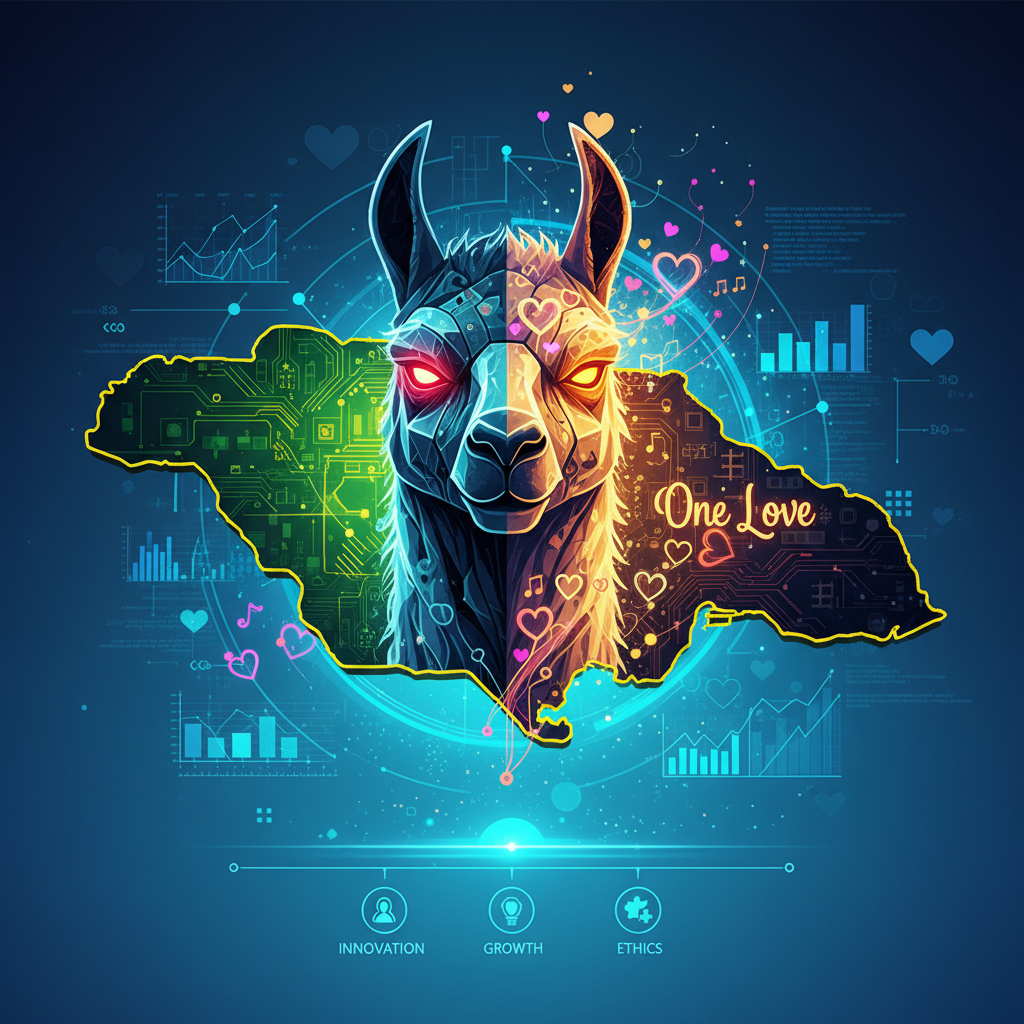

Alright, settle down, because we need to talk about something that’s got the tech world buzzing louder than a Kingston street on a Saturday night. We’re talking about AI, specifically the great divide between the open-source evangelists, led by Meta with their Llama models, and the gatekeepers like OpenAI and Google, who prefer to keep their algorithmic magic under lock and key. The question on everyone’s lips, including mine while sipping my morning Blue Mountain coffee, is this: is this open-source movement a genuine revolution, or just a clever marketing ploy dressed in the garb of collaboration? And more importantly, what does it mean for places like Jamaica, where innovation often has to climb mountains to be seen?
For years, the big tech players treated their AI models like precious family heirlooms, locked away in digital vaults. You could use them, sure, but only on their terms, through their APIs, and usually for a hefty price. Then came Meta, swinging its digital machete, and suddenly, Llama was out there, free for developers to download, tinker with, and build upon. It felt like a sudden shift, a seismic tremor in the carefully constructed world of AI. It was a bit like when reggae first hit the global stage, surprising everyone with its infectious rhythm and undeniable power. Jamaica's tech scene is like reggae, it'll surprise you, and this open-source wave has certainly got our attention.
Now, let's rewind a bit. The idea of open source isn't new. It's the bedrock of the internet itself, from Linux to Apache. But large language models, these behemoths of code that can write poetry, debug software, and chat like a human, were different. They required immense computational power to train, billions of dollars, and datasets so vast they’d make your head spin. So, when Meta decided to release Llama, first in a more restricted academic setting and then more broadly with Llama 2 and now Llama 3, it sent ripples through the industry. Suddenly, smaller companies, researchers, and even individual developers could access state-of-the-art models without having to build them from scratch or pay exorbitant fees to API providers.
This isn't just charity, mind you. Meta, under Mark Zuckerberg, has been quite vocal about its belief that open source accelerates innovation. Zuckerberg himself stated, "Open source is the best way to drive innovation and safety in AI." He argues that by allowing a wider community to inspect, stress-test, and improve these models, they become more robust, safer, and ultimately, more useful. It's a compelling argument, especially when you consider the potential for bias and misuse in AI. Many eyes on the code are better than a few, right? It’s like having a whole village raise a child, rather than just two parents trying to figure it all out.
On the other side of the fence, you have OpenAI and Google. They champion a more controlled approach, often citing safety and ethical concerns. OpenAI's CEO, Sam Altman, has frequently emphasized the need for careful deployment of powerful AI, suggesting that full open sourcing of frontier models could pose risks. Google, with its Gemini models, largely keeps its core architecture proprietary, offering access primarily through cloud services and controlled APIs. Their argument often boils down to this: these models are too powerful, too potentially dangerous, to just let loose into the wild without guardrails. It's a valid concern, like giving a brand new, powerful car to someone who's never driven before. You want to make sure they know how to handle it.
But here's where my Jamaican skepticism kicks in. Is it really just about safety, or is it also about maintaining a competitive edge and monetizing access? When you control the most powerful models, you control a significant chunk of the future AI economy. OpenAI, backed by Microsoft, and Google, with its massive cloud infrastructure, are perfectly positioned to profit from this controlled access. They offer enterprise solutions, fine-tuning services, and premium API access, all of which come with a price tag. Meanwhile, Meta, while seemingly giving away the farm, benefits from a massive developer ecosystem building on Llama, potentially feeding back improvements, attracting talent, and solidifying its position as a foundational AI player. It's a shrewd move, a long game, if you ask me.
The numbers tell an interesting story. According to a report by Reuters, the open-source AI market is projected to grow significantly, with some analysts estimating it could reach billions of dollars in value by the end of the decade. Companies like Hugging Face, which provides a platform for sharing open-source models and datasets, have seen explosive growth. Their platform hosts thousands of models, many of them derivatives or fine-tuned versions of Llama. This proliferation means more innovation, faster iteration, and a more diverse range of applications. It's a vibrant marketplace, a digital downtown where everyone can set up shop.
For us in Jamaica, this open-source movement is a game-changer. We don't have the deep pockets of Silicon Valley giants to train our own foundational models from scratch. But with Llama, we can take these powerful tools, fine-tune them with our unique datasets, and build solutions tailored to our specific needs. Imagine a Llama model trained on Jamaican patois, helping to preserve our language and culture, or one specialized in predicting agricultural yields for our farmers, or even one assisting our tourism sector with hyper-personalized experiences. The possibilities are endless. The Verge has highlighted how smaller nations and startups are leveraging open models to leapfrog traditional development cycles.
Dr. Carla Brooks, a leading AI researcher at the University of the West Indies, Mona campus, recently told a local tech conference, “Open-source models like Llama are democratizing AI. They allow our local talent to innovate without being beholden to the pricing structures or priorities of foreign tech behemoths. This is crucial for digital sovereignty in developing nations.” Her point is well taken. It's about empowerment, about having a seat at the table, not just being served what's on offer.
However, the open-source path isn't without its potholes. There are concerns about the quality of some community-contributed models, the potential for malicious actors to exploit open access, and the sheer effort required to manage and maintain these models. Security, bias, and responsible deployment remain critical challenges, regardless of whether a model is open or closed. As Professor David Patterson, a pioneer in computer architecture and a distinguished engineer at Google, once said, “The biggest challenge in AI is not building the models, it’s making them reliable and safe.” His words echo the sentiment that power comes with responsibility.
My verdict? The open-source AI movement is far from a fad. It's the new normal, a powerful current reshaping the entire landscape. While the closed models from OpenAI and Google will continue to dominate the high-end enterprise market, offering polished, well-supported, and often proprietary solutions, the open-source models, particularly Meta's Llama, are fueling a grassroots revolution. They are lowering the barrier to entry, fostering innovation in unexpected places, and allowing diverse voices to contribute to the future of AI. The Caribbean has entered the chat, and we are not just here to observe. We are here to build, to adapt, and to show the world that small island, big ideas is not just a slogan, it's a reality. This isn't just about code, it's about opportunity, equity, and ensuring that the future of AI reflects the rich tapestry of humanity, not just the perspectives of a few tech giants. It's about finding our own rhythm in this new digital dance.