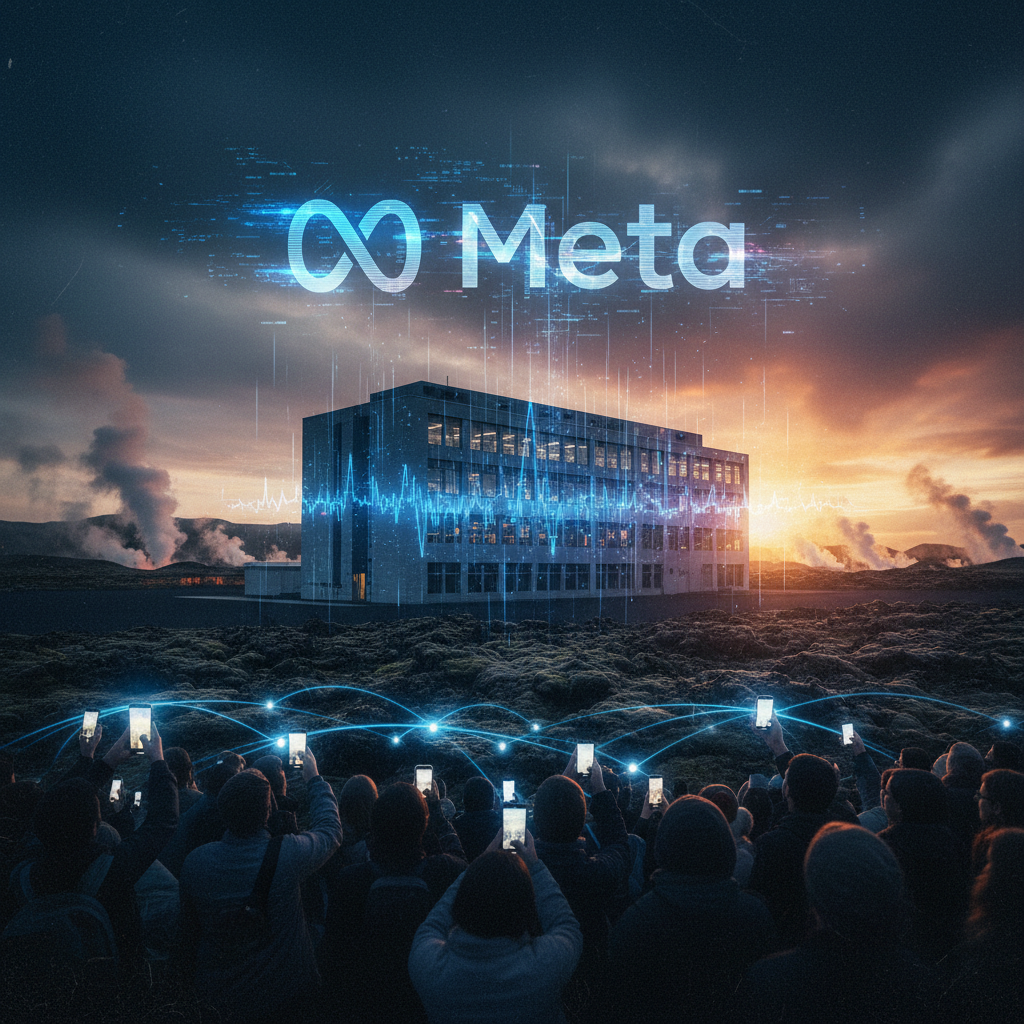

The digital world, as we know it, just got a fundamental shake-up. It happened quietly, not with a bang in Silicon Valley, but with the hum of servers cooled by Arctic air and powered by volcanic steam right here in Iceland. Meta, the company behind Instagram and WhatsApp, has pushed live a suite of advanced AI features that are already reshaping how billions of people communicate, and the genesis of this rollout is deeply tied to their operations near Reykjavík.
For months, whispers have circulated about Meta's increased investment in its Icelandic data infrastructure. Not just for raw processing power, mind you, but for something more strategic. We've seen the trucks, the engineers, the quiet expansion. Now, we know why. This isn't just about faster photo filters or clever chatbots. This is about Meta integrating its Llama 3 derived AI directly into the core messaging and content creation experience for its entire global user base, with a significant part of its development and initial scaling happening right here on our volcanic rock.
The breaking news, confirmed by Meta's head of AI, Yann LeCun, in a brief statement this morning, is that AI-powered conversational tools, real-time content generation for stories, and intelligent search functions are now live across Instagram and WhatsApp. “Our Icelandic team has been instrumental in optimizing these models for energy efficiency and linguistic diversity, a crucial step for global deployment,” LeCun stated, acknowledging the local contribution. This isn't just an update; it's a fundamental shift in how these platforms operate, driven by what I like to call the geothermal approach to computing.
What does this mean in practice? Imagine typing a message in WhatsApp and having an AI suggest a more eloquent phrase, or even translate it instantly with nuanced cultural understanding. Picture creating an Instagram story where a few keywords generate a stunning visual or a short video clip, all within the app. Meta claims these tools are designed to enhance creativity and connection, making communication more expressive and breaking down language barriers. The company’s internal data suggests a 15% increase in user engagement with new AI features during limited beta tests, a number that has surely caught the attention of investors.
However, the implications are vast, and not everyone is cheering. "This is a double-edged sword, plain and simple," stated Dr. Katrín Magnúsdóttir, a leading computational linguist at the University of Iceland. "While the potential for seamless, multilingual communication is exciting, the sheer volume of data these AI models will process, and the subtle ways they might influence human interaction, demand extreme caution. We're talking about billions of daily interactions being mediated by an algorithm." She pointed out that the Icelandic language, with its unique grammatical structure and limited dataset, has been a fascinating, albeit challenging, testbed for Meta's AI models, pushing the boundaries of what these systems can learn from smaller, more specific linguistic contexts. In Iceland, we think differently about this, especially when it comes to preserving our unique cultural heritage.
Officials here are also weighing in. Guðmundur Ólafsson, Director of the Icelandic Data Protection Authority, expressed a measured concern. "We have been in discussions with Meta regarding their data handling practices, particularly with the new AI features. The scale of personal data involved is unprecedented. Our focus remains on ensuring that Icelandic and European privacy standards are not just met, but rigorously upheld, especially when AI models are learning from user interactions. This is not a trivial matter, and we expect full transparency." The DPA has reportedly initiated a new review process specifically targeting the AI features' compliance with GDPR, a move that could set a precedent for other European nations.
Experts outside Iceland are watching closely. "Meta's move is a clear signal of their intent to dominate the 'AI-first' social experience," observed Alex Heath, a senior reporter at The Verge. "They're leveraging their massive user base to deploy these features at a scale no other company can match right now. The question isn't if AI will change social media, but how quickly and how profoundly Meta's version will redefine it." He highlighted that the energy efficiency gains from Meta's Icelandic data centers are not just good for PR, but a critical operational advantage in a world increasingly mindful of AI's carbon footprint.
The immediate impact is already visible. Users are experimenting with the AI's ability to summarize long conversations, draft witty replies, or even generate images based on text prompts. Small businesses on Instagram might find new tools for creating engaging marketing content without needing graphic designers. For those in remote parts of Iceland, or indeed, anywhere in the world, the promise of breaking down communication barriers through instant, context-aware translation is significant. Small nations have big advantages in AI, particularly when it comes to focused, ethical development.
However, the long-term implications are what truly merit our attention. Will these AI assistants make us more articulate, or will they subtly homogenize our communication styles? What happens when billions of people rely on an algorithm to craft their messages, potentially losing some of their unique voice? The ethical considerations around bias, misinformation, and the potential for manipulation are immense. Meta has stated that it has implemented safeguards and user controls, but the proof will be in the pudding, as they say.
Looking ahead, we can expect other tech giants to follow suit, if they haven't already begun. Google's Gemini, OpenAI's GPT models, and Anthropic's Claude are all vying for integration into our daily digital lives. The race is on to see who can make their AI the most indispensable, the most seamless, and critically, the most trusted. The lessons learned from Meta's Icelandic experiment, particularly regarding sustainable infrastructure and responsible AI deployment in diverse linguistic contexts, will be crucial for the entire industry.
This isn't just a tech story; it's a societal one. How we communicate, how we express ourselves, and how we connect with others are fundamental aspects of the human experience. When AI starts mediating these interactions at a global scale, we need to pay very close attention. The servers humming in the lava fields near Reykjavík are now, more than ever, at the heart of this global conversation. For further insights into the broader implications of AI in communication, you might find this article on Wired interesting. The future of communication just got a whole lot more intelligent, and a whole lot more complicated. It’s a development that demands our scrutiny, not just our admiration. After all, the best technology serves humanity, it doesn't dictate it. This is a lesson we in Iceland have learned from living with nature's raw power; it applies equally to artificial intelligence.```