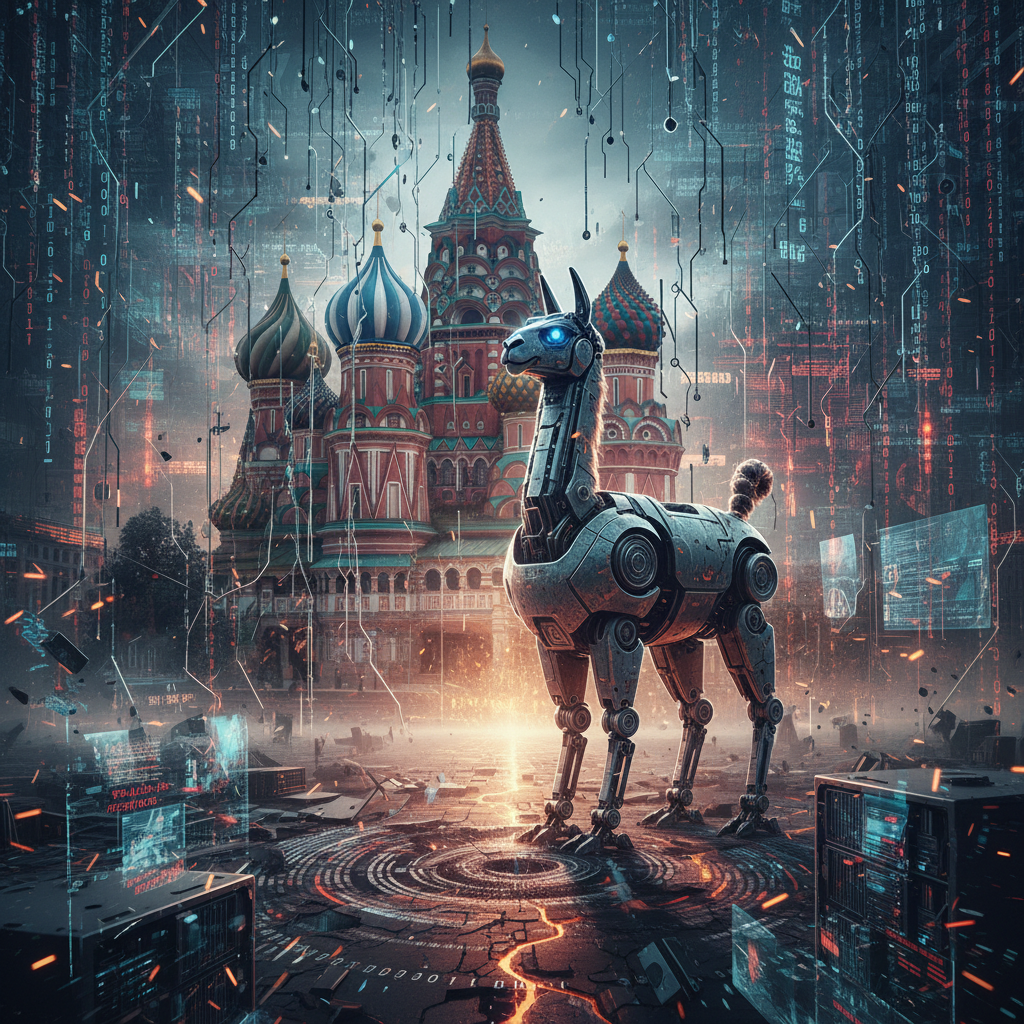
The digital world, for all its promises of openness, often erects its own invisible barriers. Today, those barriers feel more palpable than ever in Russia, following Meta's quiet but profound update to its AI-powered content recommendation algorithms, reportedly driven by the latest iteration of its Llama large language model. While the official announcement from Meta focused on 'enhanced user engagement' and 'more relevant feeds' globally, the practical implications within Russia, where Meta platforms like Facebook and Instagram are officially banned but widely accessed via VPNs, are far more complex and, frankly, unsettling.
For months, whispers circulated among Russian tech analysts and digital rights advocates about Meta's ongoing efforts to refine its recommendation engines. The company, through its AI research division, has been aggressively pushing the boundaries of what its Llama models can achieve, from code generation to sophisticated content curation. This latest deployment, however, appears to have fundamentally altered how information, particularly news and politically charged content, propagates across its platforms for Russian users. The official story doesn't add up, not when you observe the sudden shifts in content visibility and engagement metrics.
Sources within Russia's vibrant, albeit constrained, IT sector report a noticeable decline in the reach of independent news sources and critical commentary, while state-affiliated narratives and entertainment content appear to receive an algorithmic boost. "It is like a digital filter has been applied, not overtly, but subtly, shifting the current of information," observed Dr. Elena Petrova, a senior researcher at the Skolkovo Institute of Science and Technology, speaking from Moscow. "We are seeing a significant drop, sometimes 30 to 40 percent, in organic reach for pages that previously thrived on critical analysis of current events. This is not random, it is algorithmic design, whether intentional or an unforeseen consequence of global optimization."
Meta, through a spokesperson who declined to be named citing company policy regarding sanctioned regions, stated that its algorithms are designed for global consistency and do not target specific geopolitical contexts. "Our goal is to provide a positive and relevant experience for all users, adhering to our community standards and local laws where applicable," the spokesperson communicated via email. This boilerplate response, however, offers little comfort to those navigating the increasingly opaque digital landscape.
This development is not merely an inconvenience, it is a significant shift in the battle for information. For years, despite the official bans, Meta's platforms served as crucial conduits for alternative viewpoints, a digital square where Russian citizens could, with some effort, access perspectives beyond the state-controlled media. Now, even with VPNs, the algorithmic gatekeepers appear to be tightening their grip. "This is a new form of soft censorship, far more insidious because it is invisible, attributed to an 'algorithm' rather than a direct government directive," stated Ivan Sokolov, a digital rights activist based in St. Petersburg. "It makes it harder to even identify the source of the information suppression, let alone challenge it. Russian AI talent deserves better than to be caught in this digital crossfire, where their tools are used to inadvertently limit access to diverse perspectives."
The technical underpinnings of this shift likely lie in the sophisticated contextual understanding capabilities of Llama 3 or its subsequent iterations. These models excel at identifying patterns, sentiment, and thematic connections within vast datasets. When applied to content recommendation, they can, intentionally or not, prioritize certain types of content based on engagement signals, perceived user preferences, or even subtle semantic cues that align with broader, globally defined 'safety' or 'relevance' parameters. In a politically charged environment, these parameters can have unintended, yet profound, consequences.
Experts suggest several mechanisms could be at play. The algorithm might be penalizing content that triggers its internal 'harmful content' classifiers more aggressively in regions deemed sensitive, or it could be optimizing for engagement metrics that are more easily achieved by less controversial, more entertainment-focused material. "It is a black box, of course, but the observed outcome is a narrowing of the information diet," explained Professor Olga Volkov, head of the Department of Artificial Intelligence at Moscow State University. "Whether Meta intended this specific outcome for Russian users is secondary to the fact that it is happening. Large language models, when deployed at scale for content recommendation, possess an immense power to shape public discourse, often without human oversight or even full comprehension of their systemic effects."
The immediate impact is a further fragmentation of the Russian internet. While platforms like VKontakte and Odnoklassniki remain dominant for domestic social networking, Meta's platforms continued to hold sway among certain demographics, particularly younger, more globally connected individuals and those seeking non-mainstream news. This algorithmic shift could drive these users further into encrypted messaging apps or niche, less accessible online communities, making information sharing even more challenging.
Looking ahead, this situation underscores the urgent need for greater transparency in algorithmic design, particularly for systems that mediate access to information on a global scale. The idea that a single, globally optimized algorithm can serve diverse populations fairly, especially in politically sensitive regions, is increasingly untenable. Regulations, such as those proposed in the European Union's Digital Services Act, aim to address some of these issues, but their reach into regions like Russia remains limited. For more on how AI is shaping global tech, see TechCrunch's AI section.
What happens next is uncertain. Will Meta acknowledge these localized effects and adjust its algorithms, or will it maintain its stance of global neutrality, effectively allowing its AI to act as an unwitting arbiter of information flow? The situation highlights a fundamental tension: the universal ambition of global tech giants versus the specific, often challenging, realities of local contexts. For those living behind the sanctions curtain, the digital landscape is not merely a reflection of global trends, but a unique battleground where every algorithmic tweak can have significant real-world consequences. This is a developing story, and its implications for digital freedom and information access in Russia are only just beginning to unfold. For further analysis on AI's societal impact, Wired's AI coverage offers valuable perspectives. The struggle for a truly open and unbiased information ecosystem continues, even as the algorithms grow ever more sophisticated. The question remains: who truly controls the narrative when AI becomes the gatekeeper? You can also explore academic discussions on AI ethics at arXiv.