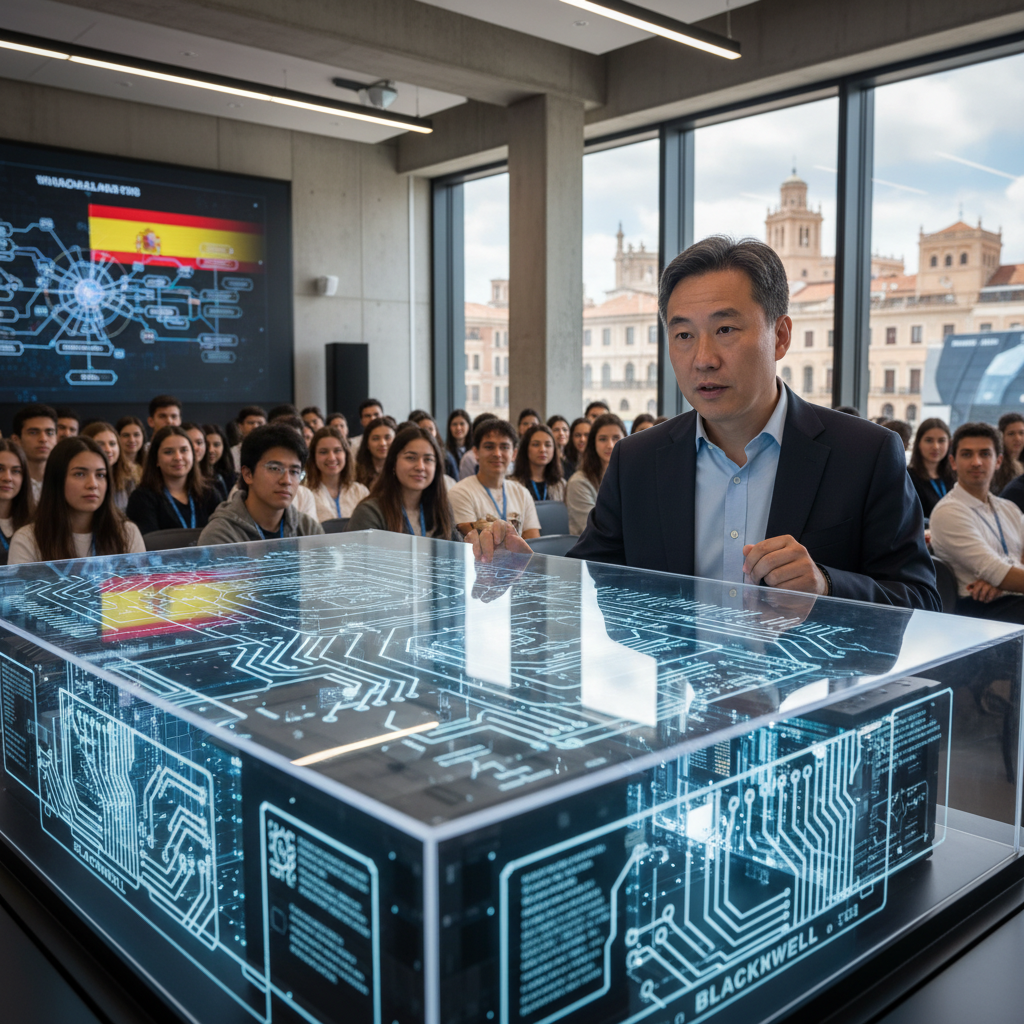

¡Hola, amigos! Marisolò Garcíà here, bursting with excitement because, let me tell you, the future of AI is not just coming, it is sprinting towards us, powered by something truly spectacular. We're talking about NVIDIA's Blackwell architecture, a name that’s on everyone’s lips from Silicon Valley to our very own tech hubs in Madrid and Barcelona. This isn't just another incremental upgrade, no. This is a seismic shift, a terremoto of innovation that promises to redefine the very limits of what AI can achieve.
For years, NVIDIA has held a commanding lead in the GPU market, especially when it comes to the demanding world of AI training. Their Cuda platform has become the de facto standard, a language almost universally spoken by AI developers. But with Blackwell, unveiled by the visionary Jensen Huang, they are not just maintaining their lead, they are extending it into a whole new dimension. Imagine the difference between a brisk walk and a supersonic flight. That's the leap we're talking about.
Blackwell, named after the pioneering mathematician David Blackwell, is designed to handle the colossal models that are becoming the norm in generative AI. We're talking about models with trillions of parameters, demanding unprecedented levels of computational power and memory bandwidth. The previous Hopper architecture was a marvel, but Blackwell is engineered for a future where AI models are not just large, but enormous, and constantly learning. It boasts capabilities that make training these gargantuan models faster, more efficient, and frankly, more accessible to those who can afford the infrastructure.
One of the most striking features is its sheer scale. Blackwell introduces the concept of a superchip, integrating two reticle-limit dies into a single, unified GPU. This allows for a staggering 208 billion transistors on a single chip. To put that into perspective, it's like having a miniature supercomputer in your hands, ready to chew through data at speeds that were unthinkable just a few years ago. This kind of power is what allows companies to train models like OpenAI’s GPT-4 or Google’s Gemini in fractions of the time it used to take, accelerating discovery and deployment across every sector.
And what does this mean for us, here in Europe, and particularly in Spain? It means that Spain's AI moment has arrived, and it's being turbocharged. Our researchers, our startups, our brilliant minds are no longer just observing; they are actively participating in this global technological race. The demand for these high-performance GPUs is absolutely insatiable. Data centers across Europe are scrambling to get their hands on Blackwell, understanding that it's the foundational bedrock for the next wave of AI innovation. From climate modeling to drug discovery, from personalized education platforms to advanced robotics, the applications are endless.
Take, for instance, the burgeoning AI scene in Barcelona. Barcelona is buzzing with energy, attracting talent and investment at an incredible pace. Startups focused on natural language processing for Spanish and Catalan, AI-driven solutions for renewable energy optimization, and even intelligent tourism platforms are all looking at how to leverage this new generation of hardware. "The Blackwell architecture is a game-changer for anyone working with large language models," says Dr. Elena Rodríguez, a lead AI researcher at the Barcelona Supercomputing Center. "The ability to scale training efficiently will allow us to push the boundaries of what's possible, especially in areas like multilingual AI and scientific simulation, where computational demands are immense." Her enthusiasm is palpable, and it mirrors the sentiment across our tech community.
Indeed, the implications for sovereignty are also profound. As nations grapple with the idea of AI sovereignty, having access to cutting-edge hardware becomes paramount. Europe, through initiatives like the European High-Performance Computing Joint Undertaking, is investing heavily in supercomputing infrastructure. The goal is to ensure that European researchers and companies aren't solely reliant on external providers for their AI compute needs. Blackwell, while an American innovation, is becoming the indispensable tool that powers these European ambitions. It’s a fascinating dance between global technological leadership and regional self-reliance.
Of course, this dominance isn't without its challenges. The sheer cost of these advanced GPUs means that the barrier to entry for truly cutting-edge AI research remains high. Only a few companies and well-funded institutions can afford to build the massive clusters required to fully exploit Blackwell's power. This creates a potential divide, where smaller players might struggle to compete with the giants. However, the rise of cloud computing services offering access to these powerful GPUs, like NVIDIA DGX Cloud, helps democratize access to some extent, allowing startups to rent the power they need without the upfront capital expenditure.
Another point of discussion is the energy consumption. Training these massive AI models on Blackwell systems, while more efficient per computation, still requires significant amounts of electricity. This is a critical consideration, especially in Europe where sustainability is a core value. Researchers are constantly working on more energy-efficient algorithms and hardware designs, but the demand for compute power continues to outpace these gains. It's a delicate balance we must strike as we accelerate into this AI-powered future.
Yet, the optimism remains. "We are witnessing a golden age of AI, and NVIDIA's contributions are foundational," stated Jensen Huang, CEO of NVIDIA, during a recent keynote, his words resonating with the energy of a true pioneer. His vision for accelerated computing is not just about faster chips, it's about enabling a future where AI can tackle humanity's grand challenges, from climate change to disease. And with Blackwell, that vision feels closer than ever. For more insights into these technological shifts, you can always check out resources like MIT Technology Review.
Here in Spain, we are not just spectators. Our universities are training the next generation of AI engineers, our startups are innovating with incredible speed, and our government is actively supporting the growth of our digital economy. The arrival of architectures like Blackwell means that our local talent has the tools to compete on a global stage. We are seeing a surge in interest from global tech giants looking to establish AI research centers in places like Málaga and Valencia, drawn by the talent and the vibrant ecosystem. The ripple effect of this technological advancement is truly exciting.
This isn't just about faster computers; it's about unlocking human potential. It's about giving our scientists the ability to model complex systems, our artists the power to create new forms of expression, and our entrepreneurs the tools to build solutions for a better tomorrow. The Blackwell architecture is more than silicon and code; it's a testament to human ingenuity, a beacon lighting the path forward into an AI-driven future that feels both thrilling and full of promise. And I, for one, cannot wait to see what we build with it. For ongoing developments in AI and technology, The Verge is always a great source of information.