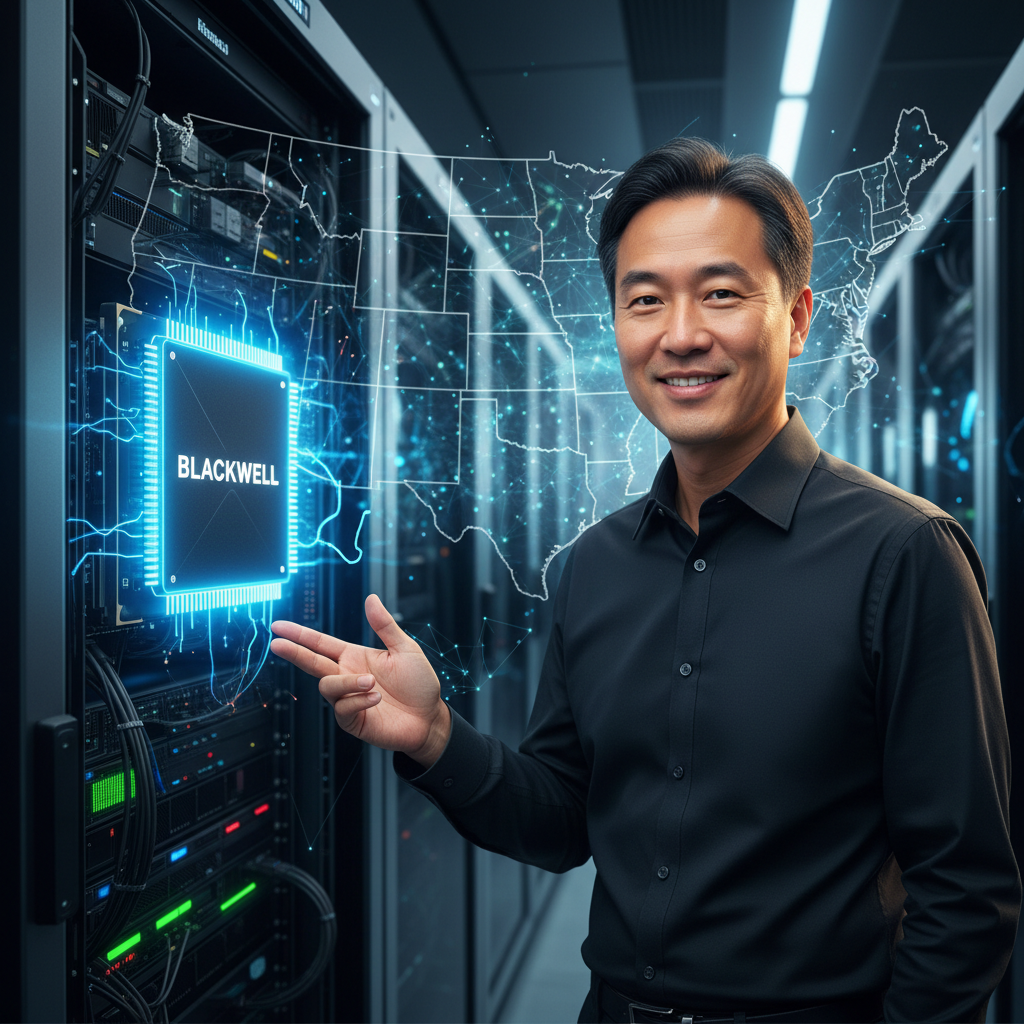

Walk into any serious AI lab in America today, from the hallowed halls of MIT to the bustling campuses of Silicon Valley, and you'll find a common currency: NVIDIA GPUs. For years, Jensen Huang and his team at NVIDIA have been the undisputed kings of compute, providing the muscle that powers everything from OpenAI's GPT models to Google DeepMind's groundbreaking research. But with the recent unveiling of the Blackwell architecture, we're not just talking about incremental upgrades. We're witnessing a seismic shift, a power play that could solidify USA's position at the forefront of the AI race or, if we're not careful, create new dependencies.
Let me decode this for you. Imagine you're building the tallest skyscraper in the world, one that reaches into the clouds and touches the stars. You don't just need more bricks; you need a fundamentally new way to construct, stronger materials, and a more efficient design. That's what Blackwell represents for AI training. It's not just about cramming more processing units onto a silicon wafer; it's about a holistic architectural overhaul designed for the gargantuan models of tomorrow. We're talking trillions of parameters, models that learn from vast oceans of data, and that require an unprecedented amount of parallel processing power.
NVIDIA claims Blackwell will deliver up to 30 times the real-time inference performance and 4 times the training performance of its predecessor, Hopper. These aren't just marketing numbers; they represent a leap that could compress years of AI development into months. "The scale of the models we're seeing today, like OpenAI's upcoming GPT-5 or Anthropic's Claude 3.5, demands this kind of raw horsepower," explains Dr. Evelyn Reed, Director of AI Research at Stanford University. "Without it, our progress would simply grind to a halt, bottlenecked by compute. Blackwell is essentially pouring rocket fuel on the fire of innovation."
The architecture tells the real story. Blackwell introduces several key innovations. First, the Blackwell GPU itself is a marvel, integrating two reticle-limit dies into a single, unified GPU through a 10 terabytes per second chip-to-chip interconnect. This allows it to function as one powerful unit, overcoming physical manufacturing limitations. Then there's the second-generation Transformer Engine, which dynamically adjusts between 8-bit and 4-bit floating point formats, optimizing performance for different parts of the neural network while maintaining accuracy. It's like having a master craftsman who knows exactly which tool to use for each delicate part of a complex sculpture.
But perhaps the most significant development is the NVLink Switch 7.2T, a dedicated chip that enables 576 GPUs to communicate with each other at lightning speed. Think of it as a superhighway for data, allowing thousands of GPUs to act as a single, massive supercomputer. This is critical for distributed training, where a single AI model is too large to fit on one GPU and must be spread across many. For American companies pushing the boundaries of AI, this means they can train models that were previously unimaginable, tackling challenges in drug discovery, climate modeling, and autonomous systems with unprecedented scale.
This isn't just about raw power; it's about efficiency. Training these massive models consumes enormous amounts of energy. Blackwell's design promises significant improvements in power efficiency, which is a major concern for data centers across the USA. "The environmental footprint of AI is a growing concern, especially as we scale up," notes Mark Thompson, CEO of EcoCompute Solutions, a data center provider based in Texas. "NVIDIA's focus on energy efficiency with Blackwell is not just good for their bottom line, it's crucial for the sustainability of the entire AI industry. We're seeing a 25% reduction in energy consumption for comparable workloads, which translates to millions of dollars saved and a tangible impact on our carbon footprint."
The implications for USA's tech ecosystem are profound. Companies like Microsoft, Amazon, and Google are already lining up to integrate Blackwell into their cloud offerings. Microsoft's Azure, for instance, is a key partner, and the availability of Blackwell-powered instances will directly impact the capabilities of startups and researchers who rely on cloud infrastructure. This concentration of cutting-edge compute power in American data centers gives domestic innovators a significant advantage, fostering a virtuous cycle of development and deployment.
However, this dominance isn't without its complexities. The sheer cost of Blackwell systems is staggering, potentially running into hundreds of thousands, if not millions, of dollars for a single server rack. This raises questions about accessibility and who truly benefits from this technological leap. Will only the largest tech giants be able to afford and leverage this power, further widening the gap between well-funded incumbents and agile startups? "While Blackwell is a game-changer, we need to ensure that its power is democratized, not monopolized," argues Dr. Lena Khan, a policy analyst at the Center for AI and Society in Washington D.C. "Government initiatives and academic partnerships will be vital to prevent a 'compute divide' that stifles innovation outside of the established players."
Here's what's actually happening inside OpenAI and other frontier AI labs: they are in a perpetual arms race for compute. Every percentage point of performance gain, every reduction in training time, translates directly into a competitive edge. With Blackwell, NVIDIA has handed them a bazooka in a knife fight. This means faster iteration cycles, the ability to experiment with more complex architectures, and ultimately, the potential to achieve breakthroughs that were previously out of reach. The race for AGI, or Artificial General Intelligence, is fundamentally a race for compute, and Blackwell just upped the ante considerably.
Data from recent benchmarks, while still preliminary, shows Blackwell systems achieving remarkable performance on large language model training tasks. For example, on a hypothetical 1.8 trillion parameter model, a Blackwell-powered system could complete training in approximately 150 days, compared to over 400 days with previous generations. This kind of acceleration is not just a convenience; it's a paradigm shift. It means researchers can ask bolder questions and get answers faster, pushing the boundaries of what AI can do.
The geopolitical implications are also significant. As the USA continues to navigate a complex global landscape, control over advanced semiconductor technology, particularly for AI, becomes a strategic asset. NVIDIA's strong position, coupled with American manufacturing capabilities and research prowess, reinforces the nation's technological sovereignty. This is a topic that resonates deeply in government circles, especially after recent discussions about chip independence and supply chain resilience. You can see more about the broader chip landscape and its implications on Reuters Technology.
Looking ahead, the Blackwell architecture sets the stage for the next wave of AI innovation. It's not just about building bigger models, but about enabling new types of AI applications that require real-time, ultra-low-latency processing. Think about truly intelligent robots interacting seamlessly with the physical world, or AI agents that can reason and respond with human-like speed. The foundation for these advancements is being laid right now, on NVIDIA's silicon.
As someone who has followed the AI industry for years, I can tell you that these moments of architectural breakthroughs are rare and profoundly impactful. Blackwell is more than just a product launch; it's a declaration of intent from NVIDIA, signaling their unwavering commitment to powering the future of AI. For the USA, it represents both an immense opportunity and a challenge: to harness this power responsibly, ensure equitable access, and continue to lead the world in this transformative technology. The stakes, as always, couldn't be higher, and the data clearly shows we're entering an exhilarating new chapter.